TL;DR
- What is a small language model (SLM)?
A small language model, or SLM, is a compact AI model that understands and generates language using fewer parameters and less compute. In AI, SLMs commonly target local, edge, private or specialized workloads, although no universal parameter cutoff exists.
- What are the best small language models right now?
The best small language models depend on the task. Phi-4-mini is strong for compact reasoning and function calling; Qwen3.5 offers long context and multilingual multimodal support; Gemma 4 targets on-device multimodal AI; Ministral 3 emphasizes edge deployment; Granite 4.2 targets enterprise reasoning; and SmolLM3 provides an unusually open research recipe.
- How do you build and train a small language model?
Teams usually start from an existing pretrained SLM and prepare task-specific data, fine-tune or use LoRA, evaluate on held-out examples, apply quantization if needed, and test the deployed model on target hardware. Modern projects such as SmolLM3 publish full training recipes that show how staged data mixtures and post-training improve compact models.
- What are the different types of language models (SLM vs. LLM)?
SLMs and LLMs use many of the same underlying transformer techniques, but they target different operating points. SLMs trade some breadth and capacity for lower compute, local deployment, and easier specialization. LLMs retain more capacity for general knowledge and complex reasoning. Hybrid systems can use both, routing each request to the smallest adequate model.
- What are micro models in NLP?
Micro models in NLP are compact models designed for narrow and low compute tasks. A 2026 EMNLP paper defines micro language models as 8M-30M parameter systems that generate the beginning of a response locally before a cloud model completes it, allowing responsive AI on devices too constrained for conventional SLMs.
- Can small language models run locally?
Yes. Many small language models can run locally on CPUs, laptops, phones, and edge accelerators. Quantization can reduce memory usage: Google reports Gemma 4 E2B at under 1.5GB on some devices; IBM lists quantized Granite 4.2 3B configurations at around 3GB of estimated VRAM; and Meta designed Llama 3.2 1B and 3B specifically for mobile and edge use.
Table of Contents
Small language models (SLMs) are moving from experimental AI into practical edge and enterprise applications. For example, Google’s Gemma 4 E2B runs in under 1.5 GB using LiteRT, while Apple deploys ~3-billion-parameter models on consumer devices. SLMs are also replacing cloud infrastructure and reach a 99.67% task completion rate in autonomous agent benchmarks with significantly lower latency.
In this guide, we’ll walk you through the best small language models you need to know to build, train, and run locally.
Here’s what we cover:
- What are small language models (SLMs)?
- Small language model vs LLM (SLM vs LLM): What’s the difference?
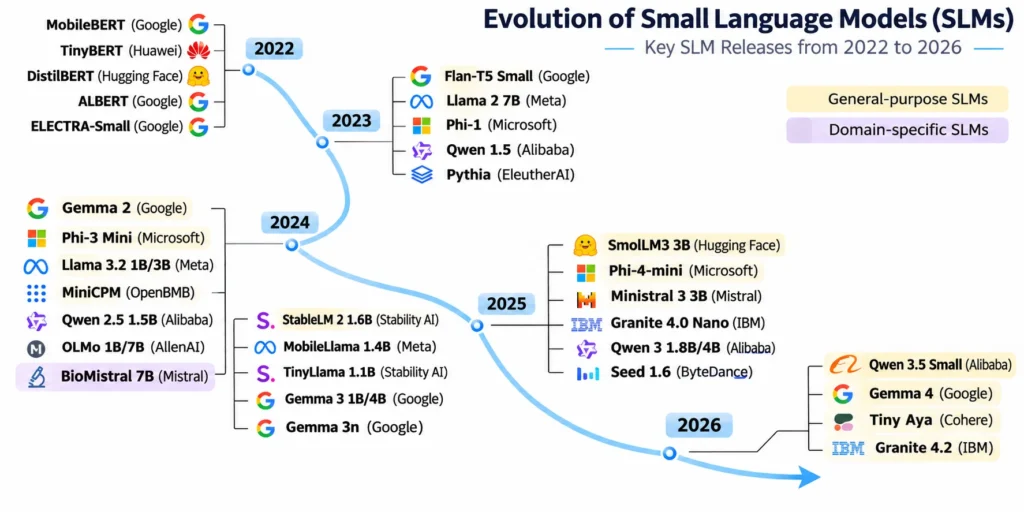
- Best small language models available in 2026
- Why small language models are the future of agentic AI
- Real-world use cases of small language models
- How much memory do small language models need?
What Are Small Language Models (SLMs)?
Small language models are compact neural language models that use less computing power and memory than large language models to process and generate language. They often have fewer than 10 billion parameters, and some now have as few as 1B and 4B parameters. For example, Meta’s Llama 3.2 1B and 3B, Microsoft’s Phi-4-mini at 3.8B, Hugging Face’s SmolLM3 at 3B, and Google’s Gemma 4 E2B and E4B.
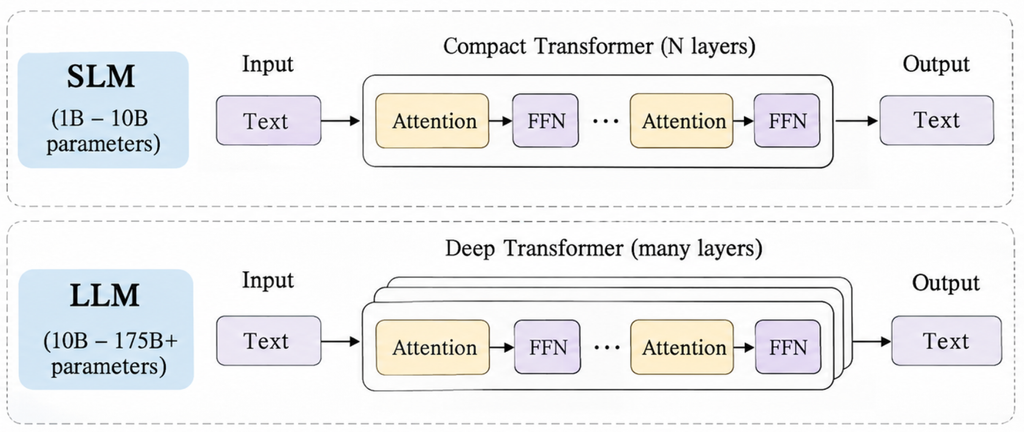
A model’s size is only one factor. Its training data quality (trillions of curated, synthetic, and deduplicated tokens), design, fine-tuning, context, and quantization matter too. For example, datasets such as FineWeb-Edu remove low-quality web content and help the SLMs learn reasoning and language patterns.
There is also a smallest-variations category known as micro models in natural language processing. An EMNLP paper introduced micro language models (or μLMs) as models with 8 million to 30 million parameters. These models generate the opening few words of a response locally, then pass the task to a cloud model. This reduces perceived latency (making replies feel faster) on constrained devices such as smartwatches and smart glasses.
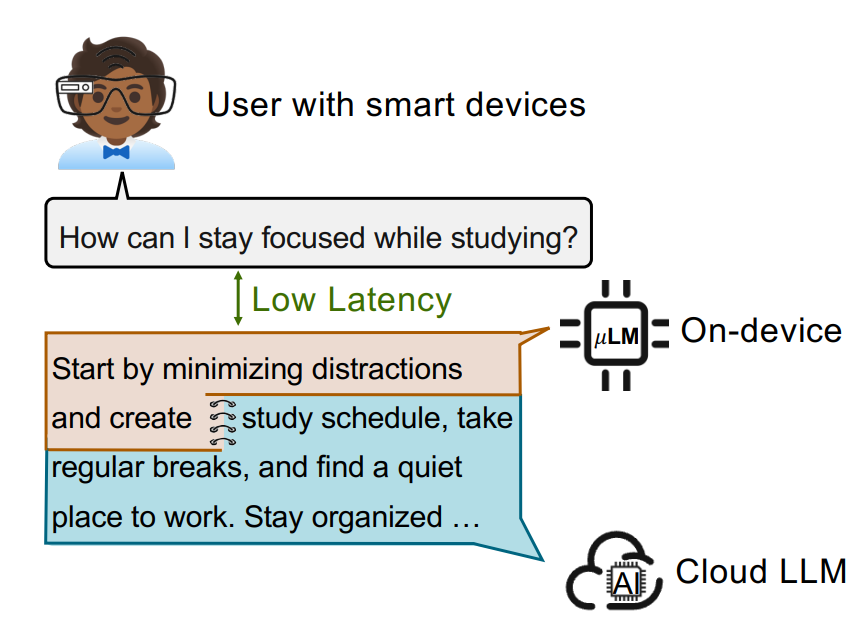
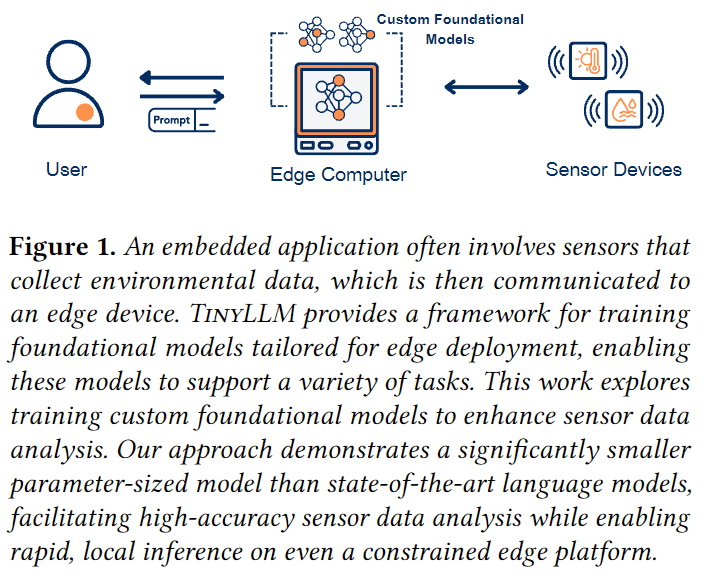
Other research uses tiny or ultra-small models such as Tiny Aya for classification, sensing, or narrow language tasks. For example, TinyLLM studied models around 30 million to 120 million parameters, highlighting that micro models in NLP are best understood as specialized models for narrow edge applications.
Small Language Model vs LLM (SLM vs LLM): What’s the Difference?
The small language model vs LLM distinction comes down to capacity, infrastructure, specialization, and economics.
LLMs devote enormous capacity to broad knowledge and flexible reasoning. SLMs reduce that capacity to gain lower memory requirements, faster local inference, easier fine-tuning, and greater deployment control.
From a deployment perspective, the SLM vs LLM debate becomes more clearer since a local SLM can process data without sending it to a third-party inference service, which can simplify privacy and data-residency requirements. It can also avoid network round trips.
LLMs remain stronger when a task demands broad world knowledge, open-ended reasoning, unfamiliar problem solving, or high performance across many unrelated domains.
Here is the summary table that highlights the technical specifications of SLM vs LLM:
| Factor | SLM | LLM |
| Parameter range | < 10 billion parameters | 70 billion to 1+ trillion parameters |
| Weight memory | 3 GB to 10 GB (4-bit Quantized) | 40 GB to 160+ GB (4-bit Quantized) |
| Deployment costs | Near-zero marginal cost on local hardware | High per-token API fees or massive GPU clusters |
| Inference location | Phone, laptop, edge, local server or cloud | Primarily server/cloud for very large models |
| Inference latency | Often lower for bounded tasks (sub-200ms Time-To-First-Token (TTFT)) | Can be higher (500ms to 2000+ms Time-To-First-Token) |
| Data privacy | 100% private, supports strict air-gapped compliance | Cloud inference may require transmitting data |
| General knowledge | More limited | Usually much broader |
| Specialized task performance | Can be highly competitive after adaptation | Strong zero-shot breadth |
| Training data | Synthetic reasoning chains, strict knowledge distillation | Broad web scrapes and multimodal/text corpora |
| Fine-tuning cost | Lower in many cases | Typically higher |
| Agent roles | Routing, extraction, tool calling, summarization | Complex planning and open-ended reasoning |
Available Small Language Models at a Glance
The best small LLM models span text, multimodal, reasoning, coding, and agentic workloads. The table below covers the small LLM model cards available as of November 2026.
| Model and version | Parameters | Main capabilities | License | Intended deployment | Suitable workloads | Important limitations |
| Microsoft Phi-4-mini | 3.8B | Text, reasoning, function calling, multilingual | MIT | Edge, local, cloud | Math, logic, assistants, structured tools | Smaller factual capacity |
| Qwen3.5-0.8B/2B/4B/9B | 0.8B–9B | Multimodal, reasoning, agentic tasks, 201 languages/dialects | Apache 2.0 | Local to server | Agents, coding, vision-language, multilingual apps | Smallest variants trade depth for efficiency |
| Google Gemma 4 E2B/E4B | 2.3B/4.5B effective | Text, image, audio, reasoning, function calling | Apache 2.0 | Mobile, IoT, laptop | On-device agents, multimodal assistants | Lower capability than larger Gemma variants |
| Ministral 3 | 3B/8B/14B | Text, vision, tool calling, structured outputs | Apache 2.0 | Edge and local | Agents, documents, local multimodal apps | 14B may exceed strict SLM definitions |
| Meta Llama 3.2 | 1B/3B | Text, summarization, retrieval, rewriting | Llama 3.2 Community License | Mobile and edge | Local assistants and RAG | Older generation; text-only at 1B/3B |
| IBM Granite 4.2 | 3B/8B | Reasoning, coding, tool calling, JSON | Apache 2.0 | Local and enterprise | RAG, coding, enterprise agents | Hardware needs rise sharply at full precision |
| Hugging Face SmolLM3 | 3B | Reasoning, multilingual text, long context | Apache 2.0 | Local, research, server | Open research, reasoning, experimentation | Six primary supported languages |
What Are the Best Small LLM Models in 2026?
Small LLMs perform far better than their parameter counts might suggest. That’s because developers use curated datasets, synthetic training data, distillation, pruning, long-context optimization, and stronger post-training. So consider workload, context length, licensing, tool use, hardware requirements, and supported modalities when comparing the best small LLMs.
Microsoft Phi Series (Phi-4-mini and Phi-3)
Microsoft’s Phi family showed that quality filtered and synthetic training data could make compact models unusually capable. The Phi-3 small language model line began with Phi-3-mini, a 3.8B model trained on 3.3T tokens. Microsoft reported 69% MMLU and 8.38 MT-Bench, while emphasizing that the model was small enough for phone-class deployment.
- Approach and architecture: Phi-4-mini is a 3.8B dense decoder-only transformer with grouped-query attention and a 200K-word vocabulary. It was trained on 5T tokens and supports a 128K-token context. Microsoft designed it for memory-constrained and latency-sensitive environments.
- License and availability: Phi-4-mini and Phi-4 are available through Hugging Face, Azure AI Foundry and Ollama. Phi-4 uses the MIT license.
- Multilingual and agentic capabilities: Phi-4-mini supports more than 20 listed languages and built-in function calling. Phi-4-multimodal adds text, image and audio input through a 5.6B architecture (processes up to 131K tokens of multimodal context) that uses modality-specific LoRA components.
Microsoft released Phi-4-Reasoning-Vision-15B, a compact vision-language model, on March 4, 2026. It combines the SigLIP-2 vision encoder with a mid-fusion architecture, allowing it to analyze complex math diagrams and user interface screenshots. The model decides whether to use a full chain-of-thought reasoning process or answer directly. It scored 84.8% on the AI2D benchmark. Developers can access the MIT-licensed model through Hugging Face and Ollama, but stable quantization requires at least 12 GB of VRAM.
Alibaba Qwen3.5 and Qwen2.5
Qwen3.5 SLM families are designed for multimodal and agentic workloads. Official 2026 releases include 0.8B, 2B, 4B and 9B models. The 4B and 9B models use a hybrid layout that combines Gated DeltaNet linear-attention blocks with periodic gated attention.
- Context window: Qwen3.5’s 0.8B, 2B, 4B and 9B model cards specify a native 262,144-token context, with some variants supporting extension to approximately one million tokens.
- License: The small Qwen3.5 releases use Apache 2.0.
- Multilingual and agentic support: Qwen says the broader Qwen3.5 family expands support to 201 languages and dialects and trains agent behavior across large-scale tool environments. The smaller 0.8B and 2B cards emphasize prototyping and task-specific fine-tuning, while the 4B and 9B models offer more capacity for local coding, reasoning and multimodal work.
Google Gemma 4 Series
Google’s Gemma 4 small language model family spans E2B, E4B, 12B, 26B-A4B and 31B variants. Google released the first Gemma 4 models on March 31, 2026, followed by the unified 12B model on June 3. The family supports more than 140 languages and mixes dense and mixture-of-experts architectures.
- E2B and E4B: Google reports 2.3B and 4.5B effective parameters respectively. Their total parameter counts are higher because of per-layer embeddings. Both support text, image and audio, 128K context, reasoning modes, and local execution.
- 12B: Gemma 4 12B uses Google’s unified encoder-free multimodal architecture, accepting raw image and audio representations alongside text.
- 26B A4B and 31B: These target workstation-class deployments. The 26B variant is a sparse MoE model with roughly 4B active parameters, while the 31B model is dense. Both support up to 256K context.
- License and availability: Gemma 4 uses Apache 2.0 and is distributed through Google’s ecosystem, Hugging Face and Kaggle. Google specifically positions E2B and E4B for phones, Raspberry Pi-class hardware and other edge devices.
Mistral Ministral 3
Mistral released its small language model Ministral 3 in December 2025 in 3B, 8B and 14B sizes. Each size has base, instruct and reasoning variants, with image understanding, multilingual capabilities and an Apache 2.0 license. Mistral positions the family for local and edge inference.
All three models support native function calling and structured outputs through Mistral’s platform. The 3B and 8B documentation lists a 256K context window. Mistral also distributes downloadable weights for local deployment.
The 3B version is particularly relevant to small language model deployments as the 3B checkpoint contains about 3.4B language-model parameters plus a 0.4B vision encoder. The quantized version can fit in less than 8GB of RAM or VRAM, while an FP8 variant fits within roughly 8GB of VRAM.
Meta Llama 3.2
Meta continues to dominate the mobile deployment ecosystem with the popular Llama 3.2 series. These models focus on text generation, summarization, and local retrieval. The Llama 3.2 1B and 3B models remain compact text-only networks, featuring 1.23 billion and 3.24 billion parameters respectively. They include a robust 128,000-token context window and compile seamlessly into mobile applications using the ExecuTorch framework.
Developers adopt these networks to process on-device messages and execute rapid text completion on iOS and Android processors. Complementing the edge networks, the Llama 3.1 8B model serves as a lightweight multilingual baseline, offering stable instructional compliance for general-purpose enterprise automation.
IBM Granite 4.2
IBM Granite 4.2 offers dense 3B, 8B and 30B reasoning small language models. The 3B and 8B variants support a 128K context window, tool calling, coding, multilingual generation and agentic workflows under Apache 2.0.
The 3B model uses a decoder-only transformer with grouped-query attention, RoPE and SwiGLU. IBM estimates about 8GB of VRAM for BF16 inference and as little as roughly 3GB for its Q2_K quantized variant under the assumptions in its model selector.
Granite is especially relevant for enterprise teams that want transparent licensing, local deployment, RAG, structured JSON, coding assistance and multi-step tool invocation without depending entirely on an external frontier-model API.
Hugging Face SmolLM3
SmolLM3-3B is notable because Hugging Face published much more than the weights. The project releases training mixtures, intermediate checkpoints, training configurations and evaluation tooling, making it one of the most transparent modern SLM projects.
- Architecture: SmolLM3 uses a decoder-only transformer with grouped-query attention. Every fourth layer removes rotary positional embeddings through a NoPE (No Positional Embeddings) design, which Hugging Face found improved long-context behavior while reducing KV-cache requirements through Grouped Query Attention (GQA).
- Training and context: The model was pretrained on about 11.2T tokens, then received reasoning-focused mid-training and post-training. It supports a 64K trained context and up to 128K through YaRN (Yet Another RoPE Extension) extrapolation.
- Multilingual and agentic use: It supports six primary languages and dual reasoning modes. The model works with Transformers and vLLM and is available under Apache 2.0 through Hugging Face.
Why Small Language Models Are the Future of Agentic AI
Small language models are the future of agentic AI because they can reduce latency, token generation, infrastructure cost and energy use across workflows that may call a model many times. SLMs work well for bounded tasks such as routing, parsing, extraction, tool selection and structured output generation.
NVIDIA’s paper Small Language Models are the Future of Agentic AI, first published in 2025 and revised in September 2026, says many agent tasks are specialized and repetitive. It recommends starting with small language models, with larger models available for tasks that need deeper reasoning.
So, the cost savings are easy to understand. An autonomous agent may call a model several times to understand an instruction, decide which tool to invoke, format arguments, inspect output, update state, and determine the next action. A large reasoning model can be unnecessarily expensive for every step that follows a tight schema. NVIDIA reports that SLM inference can be 10x to 30x cheaper than frontier LLM use in relevant deployment comparisons, although exact savings depend on model, provider and workload.
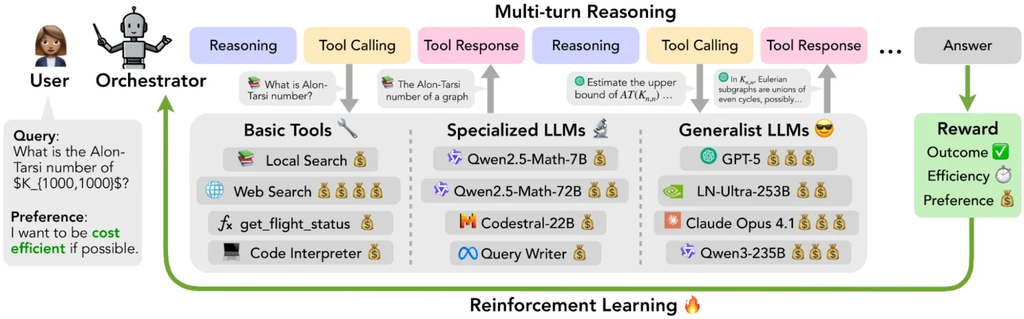
New research also shows that small models can act as orchestrators. NVIDIA’s ToolOrchestra study trained an 8-billion-parameter model using Qwen3-8B. In tests on Humanity’s Last Exam, FRAMES, and τ²-Bench, it outperformed several larger models while using less measured cost and time in the study’s tool environment.
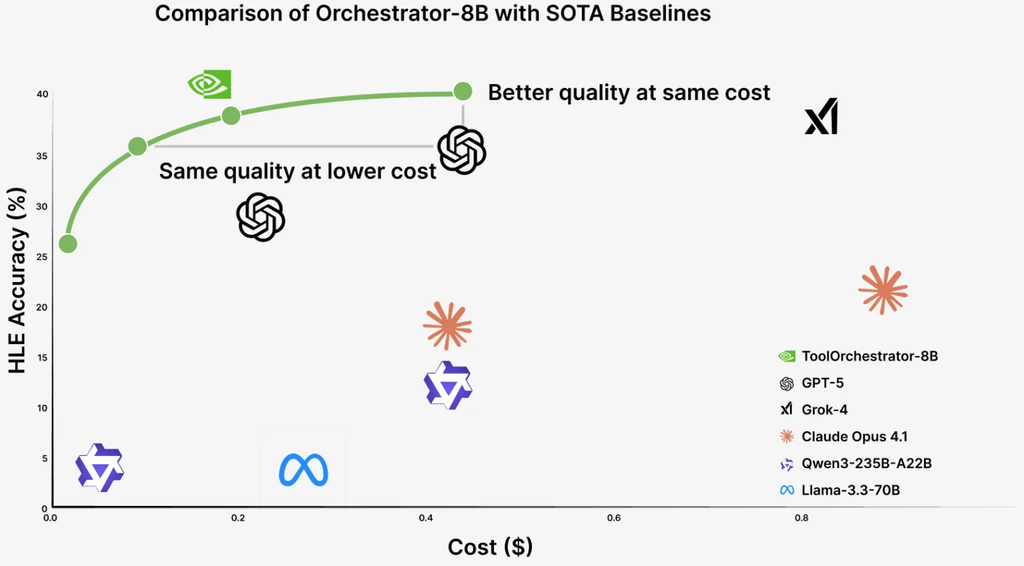
The best approach is not to use small models for everything. Use them for routine, high-volume tasks, check their structured outputs, and send unclear or complex requests to a larger model. This keeps advanced reasoning available without paying for it at every step.
What Are the Real-World Use Cases of Small Language Models?
Companies are deploying SLMs to solve tangible enterprise challenges under strict privacy and hardware constraints. Below are some real-life small language model use cases.
- Enterprise knowledge search: Capacity replaced parts of its previous answer-engine pipeline with Microsoft’s Phi models. Microsoft reports 4.2× cost savings, 97% first-shot tagging success, and a 56% improvement in tagging accuracy compared with the prior generation pipeline. Capacity uses smaller models for tasks such as title enrichment while reserving more capable models for higher-touch research and document-chat tasks.
- Mobile intent understanding: Google researchers studied small multimodal models that infer a user’s intent from mobile and web interaction trajectories. Their decomposed pipeline first summarizes individual screens and then extracts the overall intent. The approach outperformed conventional chain-of-thought and end-to-end fine-tuning baselines; Gemini 1.5 Flash 8B approached the performance of the much larger Gemini 1.5 Pro in tested mobile settings.
- Supply-chain application interaction: A Microsoft Research case study fine-tuned SLMs for an internal cloud supply-chain application. Researchers reported that small models could outperform much larger ones in both accuracy and runtime even with relatively small fine-tuning datasets. This demonstrates the value of specialization when the vocabulary, actions and workflow are constrained.
- Private distributed RAG: The DRAGON research framework splits retrieval between edge and cloud resources while keeping user-specific private documents local. Its hardware evaluations reported up to 1.9× greater gains over a standalone SLM than centralized RAG, together with lower per-token latency and negligible time-to-first-token overhead in the studied setup.
How Much Memory Do Small Language Models Need?
A small language model’s memory needs depend on weight precision, KV cache, context length, runtime buffers, batch size, activations and multimodal encoders too. A model can successfully load into memory yet still run too slowly or leave too little room for a context window.
In standard 16-bit floating-point (FP16) format, each parameter uses two bytes, so a dense 8-billion-parameter model needs about 16 GB. To address this, researchers use advanced quantization algorithms such as GGUF, AWQ, and NF4 (4-bit NormalFloat) to cut each parameter’s precision from 16 bits to 8 or 4 bits.
Compressing a model to 4-bit precision reduces its memory footprint by roughly 75%. An 8B model quantized to Q4_K_M formats requires only 4.9 gigabytes of storage, allowing it to run smoothly on a consumer laptop or a high-end smartphone.
Can Small Language Models Run on a CPU, Laptop, or Smartphone?
In short, yes. Many small language models can run on CPUs, laptops or smartphones after quantization.
Memory capacity determines whether the device can load the model. The full quantized weight file must fit within the physical memory. For laptops, Unified Memory (as seen in Apple Silicon) or dedicated VRAM on an NVIDIA graphics card provides the necessary space. If a model is larger than the available VRAM and spills over into standard system DDR4 RAM, the communication bottleneck causes inference speeds to drop by up to 91%, crippling performance.
Loading the model is only the first step. Running it with acceptable response times needs enough memory bandwidth. Memory bandwidth determines the speed at which the hardware sends parameters to compute cores to generate the next word.
Engineers calculate generation speed using a strict formula: Decode Throughput (Tokens per Second) equals Memory Bandwidth (GB/s) divided by the bytes read per token. A laptop with 200 GB/s of bandwidth will generate text, while a standard CPU limited by 50 GB/s DDR5 RAM will produce output much more slowly.
Furthermore, context length also affects memory use. As a model reads a document and generates an answer, it stores attention states in the Key-Value (KV) Cache. This cache grows linearly with every token processed. Older models using Multi-Head Attention (MHA) need a large amount of memory for the KV cache.
Modern SLMs reduce this need with Grouped-Query Attention (GQA). GQA makes multiple query heads share one KV head to reduce the cache memory footprint. This change lets a local smartphone handle a 128,000-token context window without crashing the operating system.
Conclusion
Small language models such as Phi-4-mini and Phi-3 small language model, Qwen3.5, Gemma 4, Ministral 3, Granite 4.2, Llama 3.2, and SmolLM3 are becoming serious deployment options. They offer long context, reasoning, multilingual support, multimodal inputs, and tool calling with substantially smaller resource footprints. Small language models’ best use cases are bounded tasks where latency, privacy, deployment control and cost matter. The evidence also points toward hybrid architectures: use specialized SLMs for repeated work and escalate only difficult requests to larger models. That approach preserves broad capability while improving the economics of production AI.