For many AI teams, closed-source models like the GPT-5.6 family (Sol, Terra, and Luna) and Claude Fable 5 are convenient. You can prototype an AI product in minutes with a simple API call. But this ease comes with trade-offs of vendor lock-in, limited customization, unpredictable costs and performance issues, and data privacy concerns.
That’s why open source LLMs have become so important. And each comes with its own strengths in reasoning, multimodal understanding, and efficiency.
This post will share a curated list of the best open source LLM models for coding, multimodal tasks, AI agents, local deployment, and self-hosted production. We regularly publish open source LLM updates, adding newly verified releases to the top while retaining older models that continue to deliver practical value.
TL;DR
- An open source LLM gives users the freedom to use, study, modify, and redistribute the model.
- The best open source LLM model depends on task quality, license terms, context requirements, hardware availability, inference cost, framework support, and whether the model will run locally or on distributed infrastructure.
- Smaller dense models are usually better suited to a local LLM deployment, edge devices, and constrained hardware. Frontier-scale Mixture-of-Experts models may activate fewer parameters per token but can still require substantial storage and distributed GPU infrastructure.
- Downloadable weights do not make a model free to operate. A free LLM still requires compute, storage, networking, monitoring, security, evaluation, and engineering support.
- Many open source language models support commercial use through permissive licenses such as Apache 2.0 or MIT, but always review the specific model license, attribution requirements, and acceptable-use terms before deploying in production.
- To choose the right open source LLM, evaluate benchmark performance (MMLU-Pro, HLE, GPQA, SWE-bench, LiveCodeBench, LiveBench), licensing, hardware requirements, deployment ecosystem, and your specific production use case.
Table of Contents
What are open source LLMs?
Generally, when people ask what is an open-source LLM, they often mean any language model with downloadable weights. But an actual open source LLM is one that shares enough development artifacts so developers can understand, reproduce, modify, and improve the model.
These artifacts typically include:
- Model architecture and tokenizer
- Pre-trained model weights
- Training and inference code
- Training recipe and hyperparameters
- Dataset or dataset documentation
- Data preprocessing and filtering pipeline
- Post-training data and alignment methods
- Evaluation harnesses and benchmark results
- Chat templates and inference configuration
- License terms governing use, modification, and redistribution
Models that release most of these artifacts provide greater transparency, reproducibility, and flexibility in the long run. By comparison, open-weight models give developers less visibility into how the model was trained or how its capabilities were achieved.
Simply put, open source LLMs are language models whose architecture, code, and weights are openly available for anyone to download, run locally, fine-tune, and deploy on their own infrastructure.
The table below summarizes the common release models you will encounter: open source vs. open weights vs. source available
| Category | What is available | Best suited for | Typical examples |
| Fully open AI | Weights, training and inference code, reproducible training details, and sufficient training data information under open terms | Research, auditing, rebuilding, fine-tuning, and redistribution | OLMo 3, K2-V2 (360-Open) |
| Open-weight model | Downloadable weights and usually inference code, but limited disclosure of the training datasets or training pipeline | Local deployment, quantization, fine-tuning, private inference | GLM-5.2, DeepSeek-V4-Pro, Qwen3.5, MiMo-V2.5-Pro, LongCat-2.0 |
| Source-available | Some code or weights are released, but the license includes additional restrictions beyond standard open-source terms | Commercial use subject to model-specific conditions | Kimi K2.6, Kimi K2 Thinking |
| Proprietary model | Model weights and training artifacts remain private and are accessed through managed APIs | Fully managed AI services with vendor support | GPT-5.6 (Sol, Terra, Luna), Claude Fable 5, Gemini 3 |
How to evaluate open source LLMs
Selecting the best open source LLM models involves evaluating them using a set of technical and practical criteria based on official documentation, technical reports, model cards, and independent benchmark evaluations.
We evaluated each open-source LLM based on:
- Open-source status and licensing: Availability of model weights, license type, commercial-use permissions, redistribution rights, attribution requirements, and alignment with the Open Source Initiative (OSI) definition where applicable.
- Real-world capabilities: Performance across reasoning, coding, tool calling, multilingual tasks, retrieval, multimodal understanding, long-context reasoning, and AI agent workflows.
- Benchmark performance: Results on benchmarks such as MMLU-Pro, Humanity’s Last Exam (HLE), GPQA Diamond, AIME 2025, LiveCodeBench, SWE-bench Verified, LiveBench, Arena-Hard, BFCL, MMMU, and LongBench. We also highlight where official evaluations show a model outperforming proprietary alternatives like GPT-5, Claude 4, or Gemini 3 on specific tasks.
- Architecture efficiency: Dense vs. Mixture-of-Experts architecture, active parameters, attention mechanisms, inference throughput, and quantization support.
- Context and deployment: Native context window, long-context quality, support for Hugging Face Transformers, vLLM, SGLang, llama.cpp, Ollama, and production readiness.
- Hardware requirements: Memory footprint, GPU recommendations, FP16 and BF16 support, quantization options, tensor/expert parallelism, and local deployment feasibility.
- Safety and transparency: Model cards, documented limitations, responsible AI guidance, provenance information, update frequency, and reproducibility.
Open Source LLMs and Open-Weight Models to Consider
The open source LLM models below are ordered by release or major update date, with the newest verified releases appearing first. Each entry examines benchmark performance, architecture, licensing, context length, hardware requirements, and deployment options. We revise this list as part of our ongoing open source LLM updates.
Qwen 3.8
Best for large-scale coding, enterprise knowledge work, multimodal reasoning, and long-horizon agentic tasks.
Qwen 3.8 Max is Alibaba’s largest and most capable Qwen model to date. It uses a Mixture-of-Experts architecture with 2.4 trillion total parameters while activating 95 billion parameters during inference. The production model was officially released on August 3, 2026, and is available as qwen3.8-max through QwenCloud and Alibaba Cloud Model Studio. It supports deep reasoning and native vision-language understanding, making it suitable for coding, research, document analysis, productivity workflows, and complex AI agents.
Qwen3.8-Max scores 93.0 on PaperBench, ahead of Opus 4.8 at 80.3, Fable 5 at 88.8, and GPT-5.6 Sol at 90.5; 86.1 on OSWorld-Verified, beating Opus 4.8 at 83.4, Fable 5 at 85.0, Gemini 3.1 Pro at 76.2, and GPT-5.6 Sol at 83.2; and 77.8 on ERQA, above all compared closed models, which score between 57.2 and 70.0.
It also reaches 63.5 on PerceptionBench and 81.8 on LVBench, outperforming the closed-source models shown in both evaluations. However, the results are not uniformly dominant: Qwen3.8-Max still trails Fable 5 on SWE-Pro and GPT-5.6 Sol on TerminalBench.
The production release has replaced the earlier preview version, but downloadable weights are still expected later, so it should currently be described as an API-accessible model with a planned open-weight release rather than an already downloadable open-source LLM.

| Core feature | Frontier-scale reasoning, coding, visual understanding, and long-horizon execution |
| Best for | Coding agents, enterprise knowledge work, research, productivity, and complex agentic workflows |
| Availability | QwenCloud and Alibaba Cloud Model Studio API |
| Open-weight status | Announced; downloadable weights were not yet available at the time of writing |
| Watch out for | Do not list a license or self-hosting requirements until the official model card and weights are published |
Inkling
Best for customizable multimodal agents, efficient reasoning, coding, and audio-enabled applications.
Inkling is Thinking Machines Lab’s general-purpose open-weight model for developers building customizable AI applications. It is a 975B-parameter Mixture-of-Experts model that activates 41B parameters per token and supports a context window of up to one million tokens. The model accepts text, images, and audio as input and generates text, making it suitable for coding assistants, research agents, multimodal chatbots, retrieval-augmented generation, and tool-using systems.
Its architecture uses a 66-layer decoder-only transformer with 256 routed experts and two shared experts. Each token is sent to six routed experts alongside the shared experts. Inkling was pretrained on 45 trillion tokens spanning text, images, audio, and video, and supports controllable thinking effort so developers can trade additional reasoning for lower latency and token usage. The model is released under Apache 2.0 with full weights available, and supports deployment through Hugging Face Transformers, vLLM, SGLang, TokenSpeed, and Unsloth.
Benchmark results: Inkling scores 77.6 on SWE-bench Verified and 54.3 on SWE-bench Pro, indicating competitive software-engineering performance among open-weight models. It reaches 97.1 on AIME 2026, 87.2 on GPQA Diamond, and 46.0 on Humanity’s Last Exam with tools. Its broader multimodal results include 73.5 on MMMU Pro, 78.1 on CharXiv reasoning, and 91.4 on VoiceBench. However, the official comparisons show that Inkling does not lead every reasoning, coding, or multimodal benchmark. Its main advantage is a balanced combination of multimodality, agentic capabilities, controllable reasoning effort, permissive licensing, and support for customization rather than universal benchmark leadership.

| License | Apache 2.0 |
| Context | Up to 1M tokens |
| Core feature | Controllable thinking effort and native multimodal reasoning |
| Best for | Customizable agents, coding, multimodal applications, audio understanding, and fine-tuning |
| Watch out for | The full 975B-parameter checkpoint requires frontier-scale storage and distributed inference infrastructure despite activating only 41B parameters per token |
Kimi K3
Best for multimodal knowledge work, long-horizon coding, and autonomous agent workflows.
Kimi K3 is Moonshot AI’s 2.8-trillion-parameter (104B active) mixture-of-experts model for long-horizon coding, knowledge work, multimodal reasoning, and agentic task execution. It provides a 1M-token context window and processes text and images. Its Stable LatentMoE architecture activates 16 of 896 experts for each token, while Kimi Delta Attention and Attention Residuals improve information flow across long sequences and deep model layers. It also provides approximately 2.5× better overall scaling efficiency than Kimi K2.
Kimi K3 scores 88.3 on Terminal-Bench 2.1, narrowly behind GPT-5.6 Sol at 88.8 but ahead of Claude Fable 5 and Claude Opus 4.8 at 84.6, GPT-5.5 at 83.4, and GLM-5.2 at 82.7. Its FrontierSWE score of 81.2 exceeds GPT-5.6 Sol at 71.3, Claude Opus 4.8 at 66.7, GPT-5.5 at 64.9, and GLM-5.2 at 67.3, although it remains below Claude Fable 5 at 86.6. Kimi K3 also reaches 77.8 on Program Bench, slightly ahead of GPT-5.6 Sol at 77.6 and Claude Fable 5 at 76.8.
For agentic tasks, Kimi K3 scores 91.2 on BrowseComp, ahead of GPT-5.6 Sol at 90.4 and Claude Fable 5 at 88.0. It also leads the compared models on Automation Bench with 30.8 and SpreadsheetBench 2 with 34.8. Its vision results include 91.1 on OmniDocBench and 97.8 on MathVision with Python, demonstrating strong document, mathematical, and multimodal reasoning capabilities.
| License | Kimi K3 License |
| Context | 1M |
| Core feature | Kimi Delta Attention, Attention Residuals, and Stable LatentMoE |
| Best for | Long-horizon coding, multimodal knowledge work, research, and autonomous agents |
| Watch out for | Full weights and self-hosting is designed for supernodes with 64 or more accelerators |
GLM-5.2
Best for long-horizon coding with flexible reasoning effort.
GLM-5.2 is Z.ai’s flagship open-weight model for long-horizon tasks with a stable one-million-token context and multiple thinking-effort levels for balancing coding quality against latency. The IndexShare architecture reuses an indexer across groups of sparse-attention layers for efficient long-context inference. It reduces the computational cost per generated token by up to 2.9× at a one-million-token context compared with the previous approach.
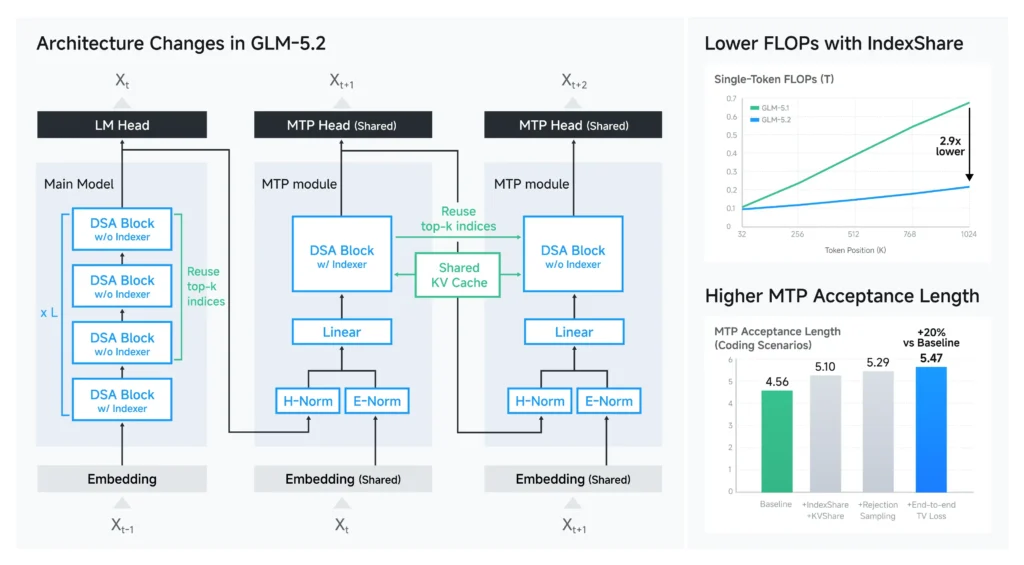
- Benchmark results: It scores 99.2 on AIME 2026, ahead of Claude Opus 4.8 at 95.7, GPT-5.5 at 98.3, and Gemini 3.1 Pro at 98.2, and reaches 91.0 on IMOAnswerBench versus Claude at 83.5 and Gemini at 81.0. For software engineering, GLM-5.2 62.1 SWE-bench Pro result beats GPT-5.5 at 58.6 and Gemini at 54.2 but remains below Claude at 69.2. Its best-reported Terminal-Bench 2.1 score of 82.7 exceeds Claude’s 78.9 and Gemini’s 70.7, while FrontierSWE at 74.4 beats GPT’s 72.6 and Gemini’s 39.6.
| License | MIT |
| Context | 1M |
| Core feature | IndexShare sparse attention and flexible effort |
| Best for | Long-horizon coding and agentic engineering |
| Watch out for | Frontier-scale serving and benchmark variability |
LongCat-2.0
Best for large-scale coding, search, and enterprise agent workflows.
LongCat-2.0 is a 1.6T-parameter MoE with about 48B active per token. The model introduces LongCat Sparse Attention and emphasizes code understanding, repository edits, automated task execution, search, and agentic workflows.
The weights are released under MIT terms, but practical self-hosting requires a distributed accelerator environment. LongCat-2.0 is a model to evaluate when an organization already operates large inference clusters or plans to use a managed endpoint. Smaller teams should compare the business value against Qwen3-Coder-Next or a hosted frontier API before taking on the operational burden.
- Benchmark results: LongCat-2.0 reaches 59.5 on SWE-bench Pro, beating Gemini 3.1 Pro at 54.2, GPT-5.5 at 58.6, and Claude Opus 4.6 at 57.3, though it trails newer Claude 4.7 and 4.8 results. Its 78.8 RWSearch score beats Gemini at 76.3 and Claude Opus 4.8 at 77.3, while IFEval reaches 90.0, above Claude 4.7 at 88.7 and Claude 4.8 at 86.0.
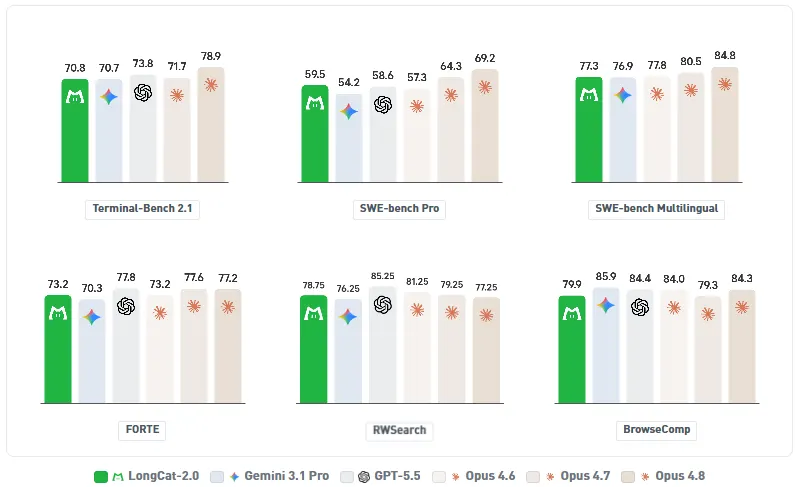
For a frontier open source LLM, the clearest proprietary wins are selected repository coding, search, and instruction-following tasks; the same table shows that it does not lead every agent or knowledge benchmark.
| License | MIT |
| Scale | 1.6T total / ~48B active |
| Long-context training | Hundreds of billions of 1M-context tokens |
| Best for | Coding, search, automated task execution |
| Watch out for | Very large cluster and immature independent evidence |
LongCat-2.0 official model card.
DeepSeek-V4 Pro and Flash
Best for choosing between maximum capability and a smaller million-token model.
DeepSeek-V4 is released as two MoE sizes. The Pro checkpoint has 1.6T total parameters and 49B active; Flash has 284B total and 13B active. Both support a one-million-token context. The architecture combines compressed sparse attention methods intended to reduce long-context inference compute and KV cache usage relative to DeepSeek-V3.2.
The two-size strategy is useful for capacity planning. Pro targets the hard reasoning and agentic coding tasks, while Flash is the more efficient candidate.

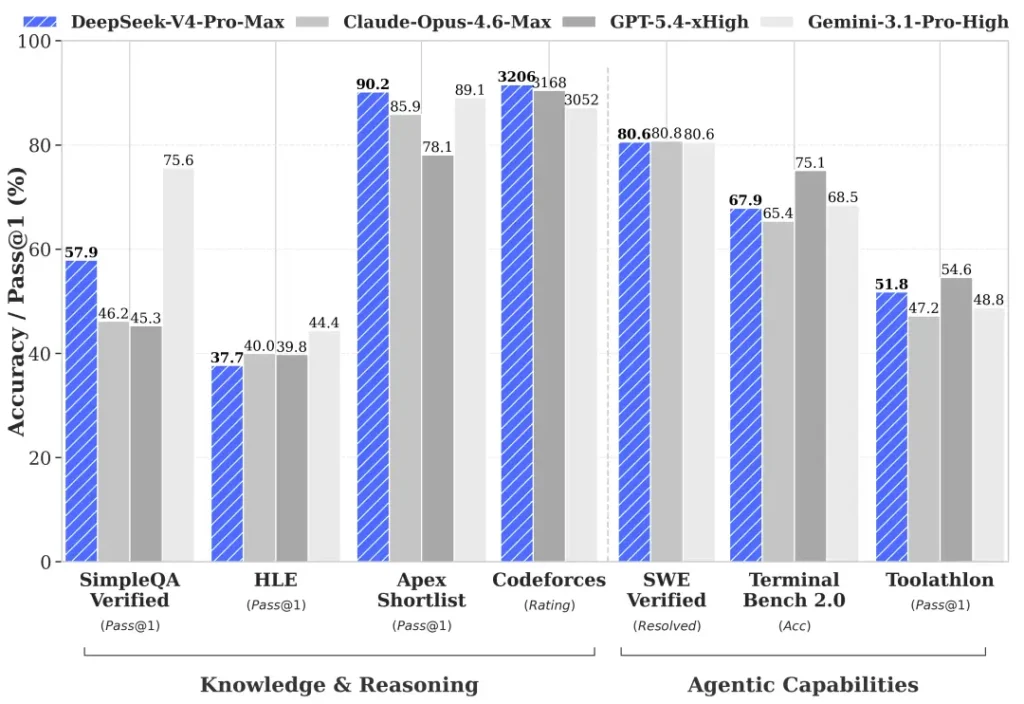
- Benchmark results: DeepSeek-V4-Pro-Max scores 93.5 on LiveCodeBench, above Claude Opus 4.6 at 88.8 and Gemini 3.1 Pro at 91.7, and its Codeforces rating of 3206 exceeds GPT-5.4 at 3168 and Gemini at 3052. It also leads Apex Shortlist with 90.2 vs Claude at 85.9, GPT at 78.1, and Gemini at 89.1. On Toolathlon, its 51.8 beats Claude and Gemini but trails GPT-5.4 at 54.6; on SWE-bench Verified, 80.6 matches Gemini and remains slightly below Claude’s 80.8.
| License | MIT |
| Scale | Pro: 1.6T/49B active; Flash: 284B/13B active |
| Context | 1M |
| Best for | Reasoning, agentic coding, long context |
| Watch out for | New architecture and significant deployment complexity |
DeepSeek-V4 Pro and Flash official model card
MiMo-V2.5-Pro
Best for long-horizon software engineering with one-million-token context.
MiMo-V2.5-Pro scales Xiaomi’s architecture to 1.02T total parameters and 42B active parameters. It supports one million tokens and targets complex software engineering, agentic work, and trajectories that span thousands of tool calls. Hybrid sliding-window and global attention reduces the cost of attending over long sequences, while multi-token prediction supports faster decoding.
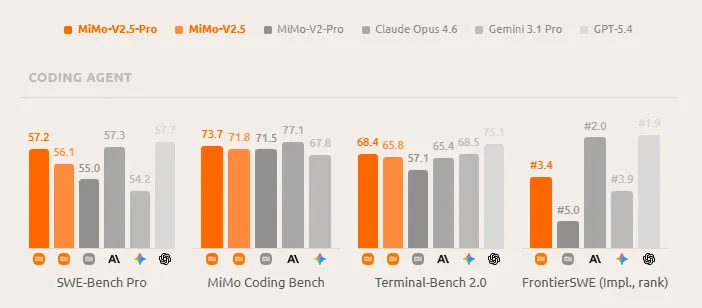
- Benchmark results: MiMo-V2.5-Pro scores 73.7% on MiMo Coding Bench, surpassing prominent proprietary models like Gemini 3.1 Pro (67.8%) and 57.2% on SWE-bench Pro. It sustains coherent execution across nearly 1,000 tool calls in a single task, allowing it to autonomously complete full-stack app development and chip EDA design.
| License | MIT |
| Scale | 1.02T total / 42B active |
| Context | 1M |
| Best for | Complex software engineering and long agents |
| Watch out for | Large distributed serving footprint |
MiMo-V2.5-Pro official model card.
MiMo-V2-Flash
Best for a lower-active-parameter agentic MoE serving target.
Xiaomi’s MiMo-V2-Flash uses a hybrid attention design that interleaves sliding-window and global attention to reduce KV-cache storage, while multi-token prediction is intended to improve decoding speed. Post-training emphasizes coding and agentic behavior.
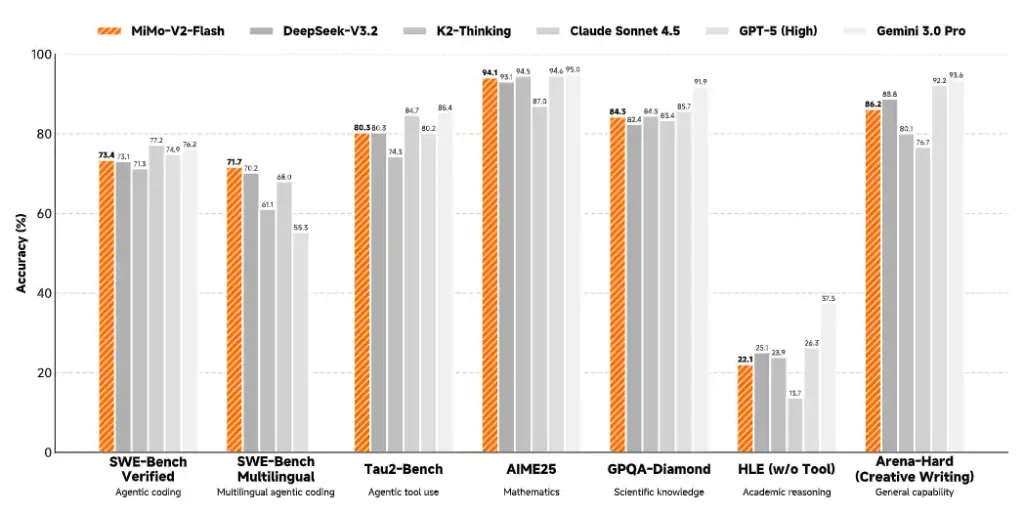
- Benchmark results: MiMo-V2-Flash scores 71.7 on SWE-bench Multilingual, beating GPT-5 High at 55.3 and Claude Sonnet 4.5 at 68.0, which supports its use for multilingual repository repair. It also records 80.3 on tau2-Bench, narrowly above GPT-5’s 80.2 but below Claude’s 84.7. On AIME 2025, its 94.1 beats Claude’s 87.0 while remaining just behind GPT-5 at 94.6 and Gemini 3.0 Pro at 95.0. The 73.4 SWE-bench Verified score does not beat GPT-5 or Claude, so the clearest advantage is efficient agentic and multilingual coding rather than universal coding leadership.
| License | MIT |
| Scale | 309B total / 15B active |
| Context | 256K |
| Best for | Agentic coding with efficient MoE activation |
| Watch out for | Full checkpoint still requires large infrastructure |
Source: Official model card
Gemma 4
Best multimodal open source LLM for local AI and efficient enterprise deployment.
Gemma 4 is Google’s latest family of open-weight LLMs built from the same research that powers Gemini models. Gemma 4 focuses on delivering strong reasoning, coding, and multimodal performance in smaller, more deployable checkpoints ranging from 2B to 31B, including a 26B MoE model.
Larger variants support up to a 256K-token context window, native image understanding, multilingual generation across more than 140 languages, and broad compatibility with frameworks such as Hugging Face Transformers, vLLM, Ollama, llama.cpp, and Vertex AI.
Despite its smaller size, Gemma 4 achieves competitive performance on reasoning, coding, and multimodal benchmarks. The Gemma 4 31B model outperforms Llama 4 Maverick, DeepSeek-V3, and OpenAI o3-mini on LMArena, while the lightweight Gemma 4 27B surpasses Gemini 2.0 Flash-Lite, Mistral Small 3.1, and Llama 3.3 70B on the multimodal MMMU benchmark.
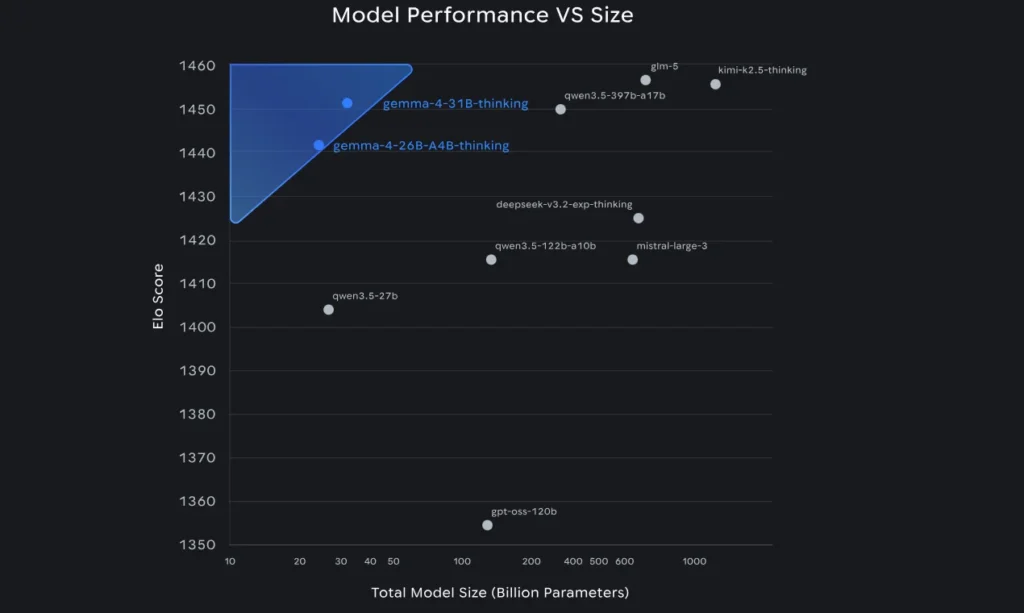
Gemma 4 offers one of the highest intelligence-per-parameter ratios among publicly released open-source LLMs. This makes it an excellent choice for organizations seeking strong performance without the need to operate large distributed GPU clusters.
| License | MIT |
| Scale | Four distinct sizes: E2B, E4B, 26B A4B, and 31B. |
| Context | Up to 256K |
| Best for | Local AI assistants, coding, multilingual applications, document understanding |
| Watch out for | Not designed to match trillion-parameter frontier models on the most demanding long-horizon reasoning tasks |
Qwen3-Coder-Next
Best open source LLM for coding and efficient agent deployments.
Qwen3-Coder-Next is one of the best open source coding LLMs for efficient coding agents and local development workflows. It uses 80B total parameters but activates only 3B per token, supports a native 262,144-token context, and is trained for long-horizon reasoning, complex tool use, and recovery from execution failures.
- Benchmark results: Qwen’s official coding-agent chart reports 70.6 on SWE-bench Verified, 62.8 on SWE-bench Multilingual, 44.3 on SWE-bench Pro, 36.2 on Terminal-Bench 2.0, and 66.2 on Aider. On SWE-bench Pro, the model sits only 0.1 point behind Claude Sonnet 4.5 at 44.4 and 2.3 points behind Claude Opus 4.5 at 46.6 while activating just 3B parameters.
| License | Apache 2.0 |
| Scale | 80B total / 3B active |
| Context | 256K native |
| Best for | Coding agents, IDE and CLI integrations |
| Watch out for | Weight storage exceeds the active compute footprint |
Qwen3-Coder-Next official model card.
Qwen3.5-397B-A17B
Best among open source multilingual LLMs for multimodal agents and broad language support.
Qwen3.5-397B-A17B is one of the more capable open source multilingual LLMs for vision-language tasks, agents, and coding. It combines a vision encoder with a 397B-parameter MoE language model that activates 17B parameters per token, supports 262,144 tokens, and covers 201 languages and dialects.
- Benchmark results: Qwen3.5 records 76.5 on IFBench, ahead of GPT-5.2 at 75.4, Claude 4.5 Opus at 58.0, and Gemini 3 Pro at 70.4, and its 67.6 MultiChallenge score also leads all three. With the card’s discard-all context strategy, BrowseComp rises to 78.6, above GPT-5.2 at 65.8, Claude at 67.8, and Gemini at 59.2. For multimodal use, it scores 88.6 on MathVision, 90.8 on OmniDocBench 1.5, and 93.1 on OCRBench, beating the three proprietary baselines in those tables.
As a multimodal open source LLM, its clearest wins are instruction following, agentic search, visual math, and document understanding rather than SWE-bench leadership.
| License | Apache 2.0 |
| Scale | 397B total / 17B active |
| Context | 262K native; extensible to ~1.01M |
| Modality | Text and images |
| Best for | Multilingual multimodal agents |
Qwen3.5-397B-A17B official model card.
Kimi K2.6
Best for multimodal coding, interface generation, and orchestrated agents.
Kimi K2.6 keeps the 1T-total, 32B-active MoE structure and 256K context of the K2 family, then adds a 400M-parameter MoonViT vision encoder. Moonshot targets coding design, visual-to-interface generation, and agent orchestration. It features an agent-swarm mode that coordinates up to 300 sub-agents over 4,000 steps.
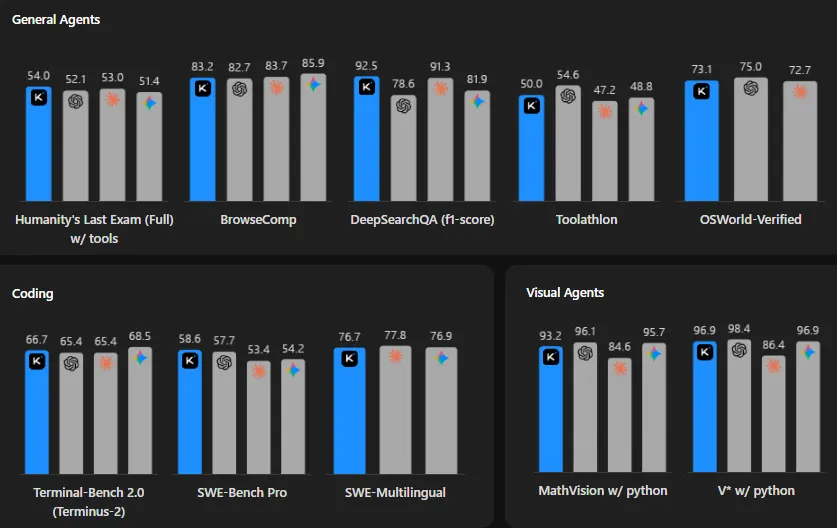
- Benchmark results: Kimi K2.6 scores 54.0 on HLE-Full with tools, ahead of GPT-5.4 xHigh at 52.1, Claude Opus 4.6 at 53.0, and Gemini 3.1 Pro at 51.4. Its DeepSearchQA results reach 92.5 F1 and 83.0 accuracy, beating all three proprietary baselines, while SWE-bench Pro reaches 58.6 versus GPT-5.4 at 57.7, Claude at 53.4, and Gemini at 54.2. Terminal-Bench 2.0 is 66.7, above GPT and Claude at 65.4 but below Gemini at 68.5.
| License | Modified MIT |
| Scale | 1T total / 32B active |
| Context | 256K |
| Modality | Text and images |
| Best for | Coding-driven design and complex orchestration |
Kimi K2.6 official model card.
K2-V2
Best for full-stack pretraining research and long-context experimentation.
K2-V2 is a 360-open, reasoning-enhanced LLM with a 70B-parameter dense model. The release links the pretraining, mid-training, and supervised fine-tuning data mixtures together with training and evaluation code.
K2-V2 is a better choice for teams studying data mixtures, scaling, long-context training, or downstream alignment than for teams that simply need a ready-to-use customer chatbot. A 70B dense model also carries a substantial inference cost compared with smaller quantized checkpoints.
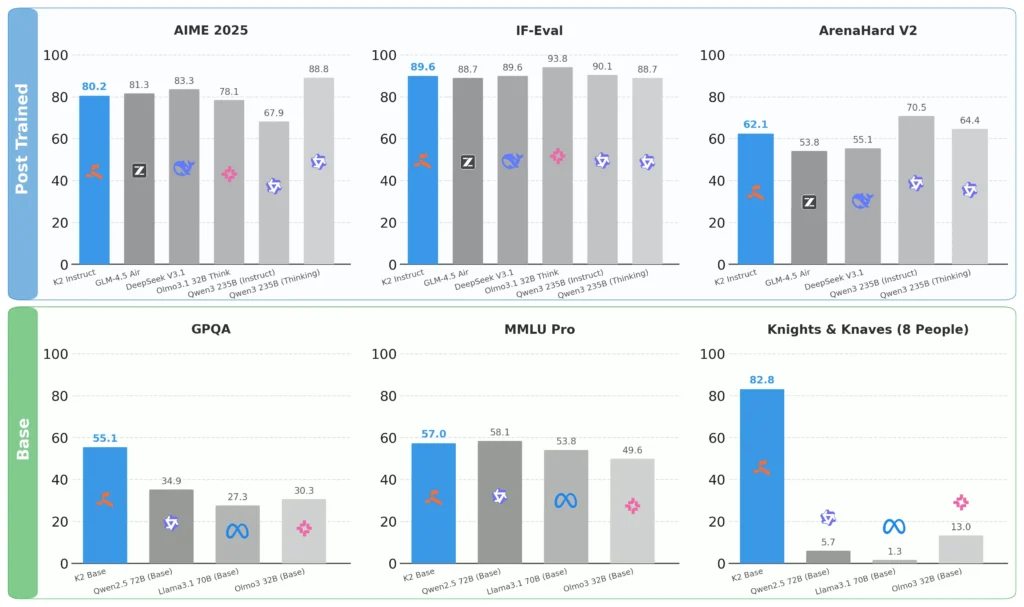
- Benchmark results: K2-V2’s mid-4 checkpoint scores 55.1 on GPQA-Diamond, 91.4 on MATH, 46.9 on AIME 2025, and 61.8 on MBPP. Its supervised-fine-tuned High variant reaches 80.2 on AIME25, 69.3 on GPQA-D, and 91.5 on HumanEval.
| License | Apache 2.0 |
| Scale | 70B dense |
| Context evidence | Up to 524K during mid-training |
| Open status | 360-open data, code, checkpoints, and evaluation artifacts |
| Best for | Pretraining research and downstream fine-tuning |
Kimi K2 Thinking
Best for long reasoning chains with repeated tool use.
Kimi K2 Thinking is an MoE model and trained to interleave reasoning and function calls across long agent trajectories. It shows stable behavior across 200–300 sequential tool invocations and offers a native INT4 checkpoint from quantization-aware training.
The native low-bit format can reduce inference cost relative to a high-precision checkpoint, but the full 1T-scale weight set still belongs in distributed infrastructure.
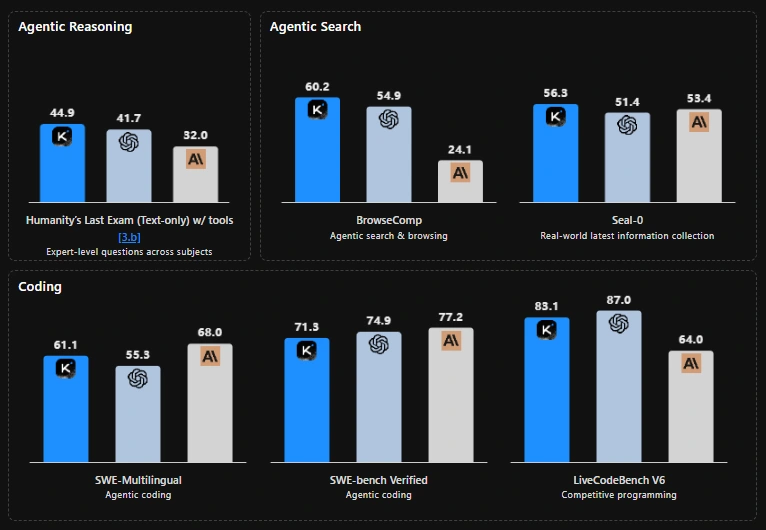
- Benchmark results: Moonshot reports 44.9 on HLE with tools, ahead of GPT-5 High at 41.7 and Claude Sonnet 4.5 Thinking at 32.0, and 60.2 on BrowseComp, ahead of GPT-5 at 54.9 and Claude at 24.1. For coding, K2 Thinking reaches 61.1 on SWE-bench Multilingual and 41.9 on Multi-SWE-bench, beating GPT-5’s reported 55.3 and 39.3, while its 47.1 Terminal-Bench score also exceeds GPT-5’s 43.8 but remains below Claude’s 51.0.
| License | Modified MIT |
| Scale | 1T total / 32B active |
| Context | 256K |
| Best for | Research agents, tool orchestration, long reasoning |
| Watch out for | Distributed deployment and modified terms |
Kimi K2 Thinking official model card.
LongCat-Flash-Thinking-2601
Best for tool-augmented reasoning in noisy, changing environments.
Meituan’s January 2026 LongCat update is a 560B-class MoE reasoning model. Its training focuses on environment scaling, multi-environment reinforcement learning, tool use, search, and robustness to imperfect results from tools or environments. A Heavy Thinking mode explores multiple trajectories before aggregating a final answer.
This model is relevant for teams building research or operations agents that must recover from ambiguous tool responses. The weights are licensed under the MIT license and include vLLM and SGLang adaptations.
- Benchmark results: With context management, LongCat-Flash-Thinking-2601 reaches 73.1 on BrowseComp versus GPT-5.2 Thinking at 65.8. It scores 99.3 on the tau2-Telecom tool-use task, above GPT-5.2 at 98.7 and Claude Opus 4.5 at 98.2, and 35.8 on Random Complex Tasks, above Claude at 32.6, Gemini 3 Pro at 32.5, and GPT-5.2 at 17.2. Heavy Thinking reaches 86.8 on IMO-AnswerBench, narrowly above Gemini’s 86.7 and Claude’s 82.8. Its 70.0 SWE-bench Verified result trails the proprietary leaders, so its best closed-model wins are search, noisy tool use, and agent generalization.

| License | MIT |
| Scale | 560B total reported in model introduction |
| Best for | Tool use, search, agentic reasoning |
| Serving | vLLM and SGLang adaptations |
| Watch out for | Harness-dependent performance and cluster size |
LongCat-Flash-Thinking-2601 official model card.
Why teams use open source AI models and why a free LLM still has costs
Open models are attractive because they move important design choices from the API provider to the deploying organization. The value is not simply free AI. The value is control over the model revision, infrastructure, data path, evaluation process, and adaptation strategy.
- Data control and privacy: A self-hosted model can keep prompts, retrieved documents, tool outputs, and logs inside a private network. This helps when legal, contractual, or operational requirements make third-party processing difficult.
- Customization: Teams can use supervised fine-tuning, LoRA adapters, preference optimization, distillation, quantization, constrained decoding, custom chat templates, and domain-specific retrieval without waiting for a provider feature.
- Version stability: A pinned checkpoint does not change unless the team changes it. This makes regression testing and regulated validation easier than relying on a continuously updated hosted alias.
- Deployment flexibility: The same model can be served on premises, in a private cloud, through a managed endpoint, or behind an OpenAI-compatible internal API.
- Research transparency: Fully open releases such as K2-V2 expose more of the training process. It enables researchers to examine data mixtures, checkpoints, optimization choices, and post-training methods.
- Economics at sustained volume: Self-hosting can reduce marginal inference cost when utilization is high and infrastructure is efficiently shared. At low or unpredictable traffic, a managed API may still be cheaper and easier.
Limitations you should plan for
- Infrastructure burden: Large checkpoints require fast storage, high-bandwidth networking, accelerator memory, tensor or expert parallelism, observability, autoscaling, and failure recovery.
- Security and safety ownership: The deploying team must handle authentication, prompt-injection defenses, tool permissions, abuse controls, content policies, red teaming, and incident response.
- License ambiguity: “Open” marketing language may hide modified terms, acceptable-use policies, branding requirements, or differences between the downloadable model and hosted service.
- Evaluation noise: Vendor-reported benchmark scores often use different reasoning budgets, tool access, prompts, context management, and agent harnesses.
- Model maintenance: Serving frameworks move quickly. A new architecture may require nightly builds, custom kernels, remote code, special parsers, or a specific quantization format.
- Total cost: GPU idle time, engineering, monitoring, data pipelines, security, and support can outweigh token-price savings.
How to choose the best open source LLM
A model shortlist should begin with constraints. Use the following sequence to avoid selecting a model that performs well in a vendor demo but cannot be licensed, served, or evaluated in your environment.
- Define the workload. Separate chat, retrieval-augmented generation, code completion, repository agents, research agents, multimodal document analysis, and long-form reasoning. Each workload stresses different capabilities.
- Set the license boundary. Decide whether the organization accepts Apache 2.0, MIT, modified licenses, or source-available terms. Record commercial use, redistribution, derivative works, attribution, patents, trademarks, and acceptable-use conditions.
- Choose the deployment tier. Decide whether the target is a laptop, single GPU, multi-GPU server, distributed cluster, or managed endpoint. Eliminate checkpoints that cannot fit the budget.
- Test realistic context. Do not select a one-million-token model because the maximum number looks impressive. Measure quality, first-token latency, prefill throughput, KV-cache memory, and cost at your common 8K, 32K, 128K, or larger prompts.
- Validate modality and tools. Check whether the exact downloadable checkpoint supports vision, reasoning output, function calling, structured JSON, parallel tools, and the chat template expected by your agent framework.
- Run task-specific evaluations. Build a private test set containing real documents, repositories, edge cases, security prompts, and failure scenarios. Measure correctness, tool success, latency, cost, and recovery—not only style preference.
- Plan operations. Confirm support for serving engine, quantization availability, loading time, autoscaling, observability, fallback behavior, and version pinning.
Best open source AI models for coding and other model picks by use case
The best open source LLM depends on the workload. The table below provides current shortlists for coding, multimodal applications, local deployment, multilingual systems, long-context processing, transparent research, and tool-using agents.
| Use case | Shortlist | Selection logic |
|---|---|---|
| Efficient coding agent | Qwen3-Coder-Next, Gemma 4 | Only 3B parameters are active per token, while the model targets coding agents, tool use, recovery from failures, and 256K context. |
| Local AI and edge deployment | Smaller Gemma 4 or other quantized dense models | RAM, VRAM, quantization support and tokens per second |
| Frontier agentic engineering | GLM-5.2, DeepSeek-V4-Pro, MiMo-V2.5-Pro, LongCat-2.0 | Evaluate repo-level edits, shell/tool reliability, long-task coherence, throughput, and infrastructure cost. |
| Multimodal coding and interface generation | Kimi K2.6, Qwen3.5-397B-A17B, Gemma 4 | Both combine language and vision; K2.6 emphasizes coding-driven design and orchestration, while Qwen3.5 emphasizes broad multilingual multimodal coverage. |
| Transparent research | K2-V2 | These releases expose substantially more of the training stack than weight-only checkpoints. |
| First local model | another small quantized checkpoint | Start with a model that fits comfortably in available memory before testing frontier MoE models. |
| Long documents and large codebases | GLM-5.2, DeepSeek-V4, MiMo-V2.5-Pro, LongCat-2.0 | All target very long contexts, but retained quality, prefill latency, KV cache, and cost must be tested at your real prompt length. |
| Long tool chains and search agents | Kimi K2 Thinking, Kimi K2.6, LongCat-Flash-Thinking-2601 | Their model cards emphasize interleaved reasoning, repeated tool use, search, or robust agentic workflows. |
| Commercial use with a standard permissive license | Apache 2.0 or MIT releases | Still review notices, patents, trademarks, acceptable-use guidance, and the exact model version. |
For multi-model systems, route tasks by workload instead of forcing one model to handle everything. A smaller coding model can handle routine repository operations, while a larger reasoning model receives only complex planning or recovery tasks. See our guide to AI agent routing for a practical routing framework.
How can you host open source LLM models?
Hosting can be as simple as opening a quantized model in a desktop application or as complex as sharding a trillion-parameter MoE across a cluster. The workflow below separates experimentation from production.
Option 1: Run a small quantized model with Ollama or LM Studio
Ollama and LM Studio provide local model catalogs, downloads, chat interfaces, and local API endpoints. Use them when a supported GGUF or other compatible quantization exists. Confirm that the quantization came from a trusted publisher and that the model’s license applies to the converted weights. Desktop tools are ideal for prototyping, not automatically for multi-user production.
Option 2: Use Hugging Face Transformers for development
Hugging Face Transformers provides the easiest way to load an open-source LLM, experiment with prompts, benchmark model performance, fine-tune on custom datasets, and integrate the model into Python applications. The example below demonstrates how to load the LongCat-Flash-Thinking-2601 checkpoint directly from Hugging Face for local inference and development.
from transformers import AutoModelForCausalLM, AutoTokenizer

model_name = "meituan-longcat/LongCat-Flash-Thinking-2601"

# Load the tokenizer and the model
tokenizer = AutoTokenizer.from_pretrained(model_name)

messages = [
    {"role": "system", "content": "You are a helpful assistant."},
    {"role": "user", "content": "Please tell me what is $$1 + 1$$ and $$2 \times 2$$?"},
    {"role": "assistant", "reasoning_content": "This question is straightforward: $$1 + 1 = 2$$ and $$2 \times 2 = 4$$.", "content": "The answers are 2 and 4."},
    {"role": "user", "content": "Check again?"}
]

text = tokenizer.apply_chat_template(
    messages,
    tokenize=False,
    enable_thinking=True,
    add_generation_prompt=True,
    save_history_reasoning_content=False # Discard reasoning history to save tokens
)

# Template Output Structure:
# <longcat_system>You are a helpful assistant.<longcat_user>Please tell me what is $$1 + 1$$ and $$2 \times 2$$?<longcat_assistant>The answers are 2 and 4</longcat_s><longcat_user>Check again? /think_on <longcat_assistant><longcat_think>\n

model_inputs = tokenizer([text], return_tensors="pt").to(model.device)

# Generate response
generated_ids = model.generate(
    **model_inputs,
    max_new_tokens=32768
)
output_ids = generated_ids[0][len(model_inputs.input_ids[0]):].tolist()

print(tokenizer.decode(output_ids, skip_special_tokens=True).strip("\n"))

# Example Output:
# The user wants a double-check. Since $$1 + 1 = 2$$ and $$2 \times 2 = 4$$ are basic arithmetic truths, the previous answer is correct.\n</longcat_think>\nI have verified the calculations: $$1 + 1 = 2$$ and $$2 \times 2 = 4$$. The initial answer remains correct.</longcat_s>Option 3: Serve an OpenAI-compatible API with vLLM
vLLM is designed for high-throughput, memory-efficient serving. Many model cards now provide commands for launching an OpenAI-compatible endpoint. Qwen’s official example for Qwen3-Coder-Next uses tensor parallelism and can enable automatic tool choice.
pip install 'vllm>=0.15.0'

vllm serve Qwen/Qwen3-Coder-Next --port 8000 --tensor-parallel-size 2 --enable-auto-tool-choice --tool-call-parser qwen3_coder --max-model-len 32768The model supports a larger native context, but starting with 32K reduces memory risk. Increase the limit only after measuring available VRAM, prefill latency, throughput, and KV-cache use.
Option 4: Serve with SGLang
SGLang is another production serving framework commonly referenced by the latest model cards. It supports OpenAI-compatible APIs, tool parsers, reasoning parsers, tensor parallelism, and architecture-specific optimizations. New frontier releases may require a minimum version, a nightly build, or a model-specific cookbook.
pip install 'sglang[all]>=0.5.8'

python3 -m sglang.launch_server --model-path qwen/qwen2.5-0.5b-instruct --host 0.0.0.0 --port 30000Call the self-hosted endpoint from an application
import openai

client = openai.Client(base_url="http://127.0.0.1:30000/v1", api_key="None")

response = client.chat.completions.create(
    model="qwen/qwen2.5-0.5b-instruct",
    messages=[
        {"role": "user", "content": "List 3 countries and their capitals."},
    ],
    temperature=0,
    max_tokens=64,
)

print(response.choices[0].message.content)Do you need an LLM API key for an open source LLM?
The API key belongs to the service layer. When you run inference locally, your application can call a loopback endpoint with no authentication during development. When the endpoint is shared, create your own tokens or use an identity-aware gateway. When a cloud vendor hosts the model, it issues its own key and controls pricing, rate limits, logs, retention, regional availability, and model revisions.
| Deployment | API key | What it means |
|---|---|---|
| Local desktop app | Usually no vendor key | Single-user experimentation |
| Self-hosted internal API | Your organization creates authentication | Private applications and team services |
| Managed inference provider | Provider-issued key | Fast deployment and elastic capacity |
| Developer’s hosted API | Model-developer key | Access to official hosted variants and tools |
Conclusion
Choosing the best open source LLM starts with the workload. Compare open source LLM models based on capability, license, context quality, hardware requirements, inference efficiency, framework support, safety, and total operating cost.
A smaller local model may be the right choice for private or resource-constrained deployment, while a frontier open-weight model may be better suited to complex coding, reasoning, multimodal or agentic workloads. Downloadable weights also do not eliminate the costs of compute, storage, monitoring, security and maintenance.
Because the open-model ecosystem changes rapidly, this guide is maintained as a rolling comparison. Newly verified releases are added to the top, while older models remain when they continue to provide practical advantages. Teams should use the list to create a shortlist and then test each candidate against representative production tasks.
Frequently asked questions
What is an open source LLM?
An open-source LLM is a language model released with freedoms to use, study, modify, and share it. Under the Open Source AI Definition, meaningful access also includes model parameters, training and inference code, and sufficiently detailed information about the training data and process. A downloadable checkpoint alone is usually open weight, not fully open source.
What is the best open source LLM?
The best model depends on the workload. Choose OLMo 3 or K2-V2 for transparent research, Qwen3-Coder-Next for efficient coding agents, Kimi K2.6 or Qwen3.5 for multimodal agents, and GLM-5.2, DeepSeek-V4-Pro, MiMo-V2.5-Pro, or LongCat-2.0 for frontier-scale long-horizon tasks. Run a task-specific evaluation before production.
What Is the best open source LLM for coding?
The best open source LLM for coding depends on whether you need fast code completion, repository-scale reasoning, autonomous tool use, multilingual development, or long-running software agents. Compare current candidates using SWE-bench, LiveCodeBench, terminal-task evaluations, tool-calling reliability, context quality, latency, and infrastructure requirements.
Which local LLM can run on consumer hardware?
Smaller dense models such as OLMo 3 7B can run locally after quantization, subject to RAM, VRAM, context length, and speed requirements. Frontier MoE checkpoints in this guide may activate only a fraction of their parameters per token, but the complete weight set still has to be stored and distributed. “Low active parameters” does not mean “laptop-sized.”
Is a free LLM actually free to deploy?
The weights may be downloadable without a purchase price, but deployment is not free. You still pay for storage, GPUs or cloud accelerators, power, networking, monitoring, engineering, security, and support. Modified or source-available licenses may also impose attribution, branding, use, or distribution conditions.
Are there any open-source LLM API keys available?
There is no universal API key for open-source LLMs. A self-hosted model can run without a vendor key, although you should protect the endpoint with your own authentication. A cloud provider or model developer issues a provider-specific API key when it hosts the model for you.
How do I deploy a self-hosted LLM?
Choose a checkpoint that fits the license and hardware, test it locally with a desktop app or Transformers, serve it through vLLM or SGLang, expose an authenticated API, and add monitoring, rate limits, evaluation, and rollback.
Is ChatGPT open source?
ChatGPT is a proprietary hosted product. It is not an open-source LLM with downloadable model weights and a reproducible training stack.
Can I use an open-source LLM commercially?
Often yes, especially under permissive licenses such as Apache 2.0 or MIT. But commercial use depends on the exact checkpoint license, associated acceptable-use terms, third-party notices, patent clauses, and any conditions in a modified license. Review the actual license text rather than relying on a model list.
How much GPU memory does an open-source LLM need?
It depends on total parameters, precision, quantization, context length, batch size, KV cache, and runtime overhead. A 7B 4-bit checkpoint may fit on consumer hardware, while the frontier MoE models in this guide need multi-GPU or distributed systems.
Are open-source LLMs safer than proprietary models?
Neither category is automatically safer. Open deployment provides more control and auditability, but the operator must build access controls, content safeguards, tool permissions, monitoring, red-team tests, and incident response.
How should I track open source LLM updates?
Follow official model organizations, repositories, technical reports, serving-framework release notes, and independent evaluation projects. Update a model matrix with the release date, license, exact checkpoint, context, framework support, and evaluation status.