TL;DR
Below, you can find a quick summary of key points about NanoClaw vs OpenClaw:
- What is NanoClaw?
The NanoClaw AI agent functions as an ultra-lightweight, open-source personal artificial intelligence (AI) agent framework built as a secure, auditable alternative to OpenClaw. It focuses on small code size, session-level isolation, and developer-controlled customization.
- What is OpenClaw?
OpenClaw is an open-source autonomous AI assistant designed to automate digital workflows. It connects large language models (LLMs) to operating systems, messaging applications, and browser environments using a vast repository of third-party plugins. That’s why many users eventually look for OpenClaw alternatives.
- What’s the core difference between NanoClaw and OpenClaw?
NanoClaw enforces strict OS-level container isolation to sandbox autonomous actions, whereas OpenClaw leans on application-level controls such as allowlists, pairing codes, workspace rules, and channel policies.
- Which is more secure, NanoClaw or OpenClaw?
NanoClaw is the stronger choice if your main priority is auditability and isolation. OpenClaw offers more features, but its larger codebase, persistent gateway, broad integrations, and community skills increase the attack surface.
- Which is cheaper to run, NanoClaw or OpenClaw?
NanoClaw operates at a fraction of the cost of legacy platforms. Self-hosting NanoClaw requires roughly $5 to $50 per month, while OpenClaw’s heavy background daemon processes and token consumption push monthly business costs between $300 and $750.
- Should beginners use NanoClaw or OpenClaw?
Beginners prefer OpenClaw because of its broader integrations, easier setup, and larger ecosystem. However, the NanoClaw AI agent requires advanced technical proficiency and is better suited to developers who can work with terminals, forks, containers, and Claude Code.
- Is NanoClaw a replacement for OpenClaw?
The NanoClaw AI agent is not a full replacement for OpenClaw. It replaces OpenClaw for users who prioritize security, cost, and auditability over plug-and-play integrations.
The way we interact with technology is changing day by day. We are now relying more on personal AI assistants, and the market is projected to grow to USD 12.36 billion by 2030, at a CAGR above 35%.
The category is distinct from AI chatbots that generate text. A personal AI assistant actually does things on your behalf.
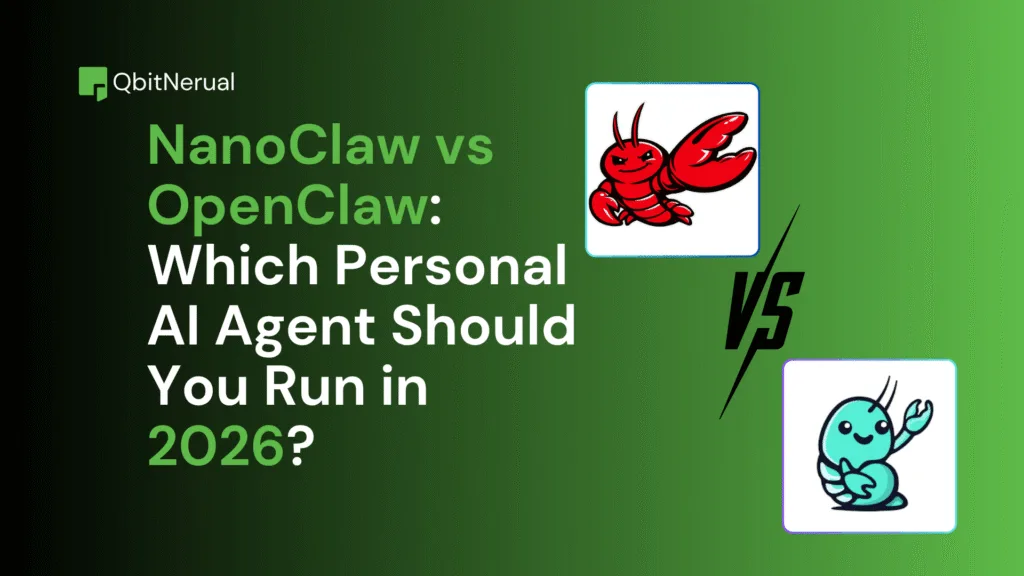
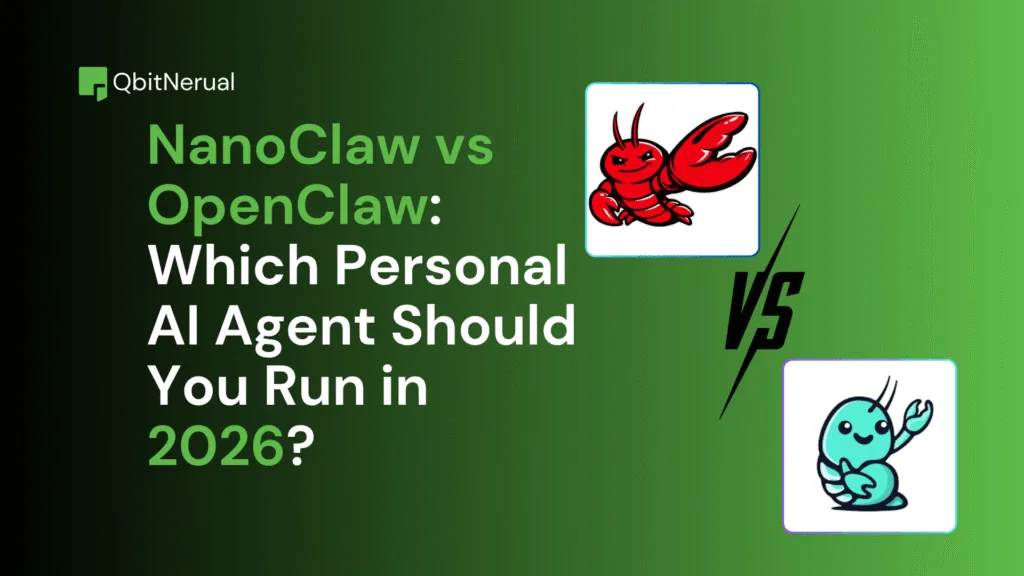
When mentioning personal AI assistants, the two most well-known names that come to mind are OpenClaw and NanoClaw.
The choice between NanoClaw vs OpenClaw defines how much access an autonomous system gets to your inbox, files, messaging apps, code repositories, and business workflows.
OpenClaw gives you a broad, always-on personal AI assistant with many channels and integrations. NanoClaw takes the opposite path. It keeps the system small, isolated, and easier to inspect.
This article will cover the following:
- What is OpenClaw?
- What is NanoClaw?
- NanoClaw vs OpenClaw: Head-to-head comparison
- Real-world incidents and expert commentary
- NanoClaw vs OpenClaw: Which should you choose?
- Beyond NanoClaw and OpenClaw
What is OpenClaw?
OpenClaw is an open-source autonomous AI agent framework for executing multi-step tasks using large language models. It uses messaging platforms such as WhatsApp, Telegram, and Discord as its primary interface, allowing operators to communicate with the agent as they would a human assistant.
Key features of OpenClaw:
- Multi-platform connectivity: Connects to 50 to 70 popular consumer and developer services, including GitHub, Gmail, WhatsApp, Telegram, Microsoft Teams, Slack, Matrix, Zalo, and Discord.
- ClawHub community skills: Hosts over 13,729 community-driven “AgentSkills” to automate workflows like lead generation, prospect research, and inbox management.
- Model-agnostic architecture: OpenClaw allows route inference requests to Anthropic Claude, OpenAI models, Google Gemini, DeepSeek, or local large language models (LLMs) via Ollama.
- Always-on companion apps: Beta desktop and mobile applications provide graphical interfaces, tray menus, and setup wizards for macOS, Windows, iOS, and Android.
- Monolithic scale: Spans between 430,000 and 500,000 lines of code, over 70 active dependencies, and 53 distinct configuration files.
- Browser automation: OpenClaw uses Chromium via the Chrome DevTools Protocol (CDP) to navigate websites, manage session cookies, fill out forms, and execute UI-level clicks.
Pros
- Broad integrations: OpenClaw built-in adapters easily connect the agent to dozens of popular external platforms out of the box.
- Dominant developer ecosystem: Large community adoption leads to extensive guides, fast troubleshooting, and a highly active ecosystem.
- Ease of use: OpenClaw automated scripts and companion apps make onboarding simple for non-technical users.
- Flexible LLM compatibility: You can freely swap underlying model backends based on cost or compliance preferences.
Cons
- Massive attack surface: OpenClaw spans nearly 500,000 lines of code, which makes it highly complex and practically impossible for individual developers to audit.
- Unvetted Third-Party Skills: Security audits indicate roughly 20% of ClawHub skills pose security risks, including excessive permissions and silent data exfiltration.
- Systemic gateway vulnerabilities: Lexical policy verification gaps have exposed thousands of unauthenticated public gateways to remote execution exploits.
- Heavy resource footprint: Relies on a monolithic Node.js runtime that consumes local hardware resources, resulting in high RAM usage and slow cold starts.
- High operational cost: Consumes substantial token counts during context compaction, averaging $80 to $120 monthly in API fees for active individual users.
What is NanoClaw?
NanoClaw is a secure ultra-lightweight alternative to the OpenClaw framework. It serves as a personal AI agent focused on process isolation, structural simplicity, and codebase auditability.
Key features of NanoClaw:
- Lightweight architecture: NanoClaw replaces half a million lines of code in OpenClaw with just 15 source files and approx 700 lines of TypeScript code. It lets humans and AI models audit the codebase in under a couple of minutes.
- Process isolation: NanoClaw runs every agent session inside its own secure, non-root Docker or Apple Container, restricting access to the host filesystem.
- Transient execution model: It operates through a single Node host orchestrator that spins up a Bun container to process the isolated SQLite databases (inbound.db and outbound.db) before shutting down.
- Fork-and-own model: Nano Claw relies on a model where operators clone the repository and directly guide customizations and skill installs via Claude Code.
- Fine-grained permissions: It enforces isolation at the thread level like individual WhatsApp groups, to prevent cross-session memory leaks or credential access.
- Native agent swarms: Nano Claw supports sub-agents collaborating via structured protocols while maintaining distinct CLAUDE.md workspaces.
Pros
- Surgical Attack Surface: NanoClaw repository is fully readable (~700 lines of code) and can fit within an LLM’s context window (~35k tokens or 17% of Claude Code’s active window) for safe, automated customization.
- True sandbox security: Mandatory operating-system-level containerization prevents malicious prompt injections or compromised scripts from reaching host filesystems or credentials.
- Strong session isolation: Secludes conversation histories and memory files to specific agent groups, eliminating cross-session data leaks.
- Low operational costs: NanoClaw keeps self-hosted monthly API costs low, ranging from $5 to $50.
Cons
- Limited multi-model support: NanoClaw restricts operations almost to Claude models through the official Anthropic SDK. It lacks native plug-and-play support for other providers (though manual patching is possible).
- Zero Native Integrations: Ships with no out-of-the-box communication adapters, requiring manual on-demand CLI execution to inject channel code.
- Technical Onboarding Barrier: Designed strictly for developers comfortable with terminal environments, version control, and manual script adjustments.
NanoClaw vs OpenClaw: Head-to-head comparison
Here is the comparison summary of OpenClaw vs NanoClaw:
| Feature | OpenClaw | NanoClaw |
| Codebase size | ~430,000–500,000 lines | ~700 lines of TypeScript |
| Security model | Application-level (allowlists, pairing codes) | OS-level container isolation |
| LLM support | Multi-model (OpenAI, Anthropic, local/Ollama) | Claude-only (Ollama experimental) |
| Integrations | 50–70+ native + 40K+ community skills (ClawHub) | Minimal out-of-box; messaging apps (WhatsApp, Telegram, Discord, Signal, Slack) |
| Monthly cost | ~$300–750 | ~$5–50 self-hosted |
| Auditability | Not practically feasible for one person | Fully readable in minutes |
| Setup model | Plug-and-play | Fork-and-own via Claude Code |
| Multi-agent swarms | Experimental routing layers | Native, container-isolated swarms |
| Best for | Fast setup, broad integrations, teams | Security-first, auditable, regulated environments |
How do the security models of NanoClaw and OpenClaw compare?
When evaluating NanoClaw vs OpenClaw security structures, we see highly divergent approaches.
The NanoClaw AI agent relies on operating-system-level container isolation. It forces every agent session to run inside non-root Docker or Apple Containers, ensuring that compromised commands cannot access the host machine.
OpenClaw relies on application-level guardrails and uses lexical filters to analyze command strings.
This approach creates systemic bypass opportunities, allowing malicious payloads to reach the underlying system.
How do codebase size and auditability differ between OpenClaw and NanoClaw?
NanoClaw consists of approximately 700 lines of core TypeScript, making it fully readable and auditable in under ten minutes.
OpenClaw spans between 430,000 and 500,000 lines of code, requiring 70 dependencies and 53 configuration files.
This massive footprint makes independent manual audits practically impossible, forcing operators to rely on unvetted libraries.
What is the cost and token efficiency difference between NanoClaw and OpenClaw?
NanoClaw operates with extreme token and compute efficiency, keeping self-hosted monthly costs for Anthropic API usage between $5 and $50.
OpenClaw carries high resource overhead, requiring modern computing hardware to run its heavy Node.js environment.
It consumes significant quantities of tokens during context window management, leading to active individual API costs of $80 to $120 monthly, and climbing to $300 to $750 monthly for teams.
How do the integration ecosystems of OpenClaw and NanoClaw compare?
OpenClaw provides a mature ecosystem featuring 50 to 70 native integrations and over 13,000 pre-built skills via its ClawHub marketplace.
NanoClaw begins with zero native integrations. It utilizes an on-demand skill model where operators must manually execute command line calls, such as /add-whatsapp or /add-telegram, to inject only the channel code they actively use.
What are the differences in LLM support between NanoClaw and OpenClaw?
OpenClaw is model-agnostic, allowing operators to run OpenAI, Anthropic, or local open-source models via Ollama out of the box.
NanoClaw is tightly coupled to Anthropic’s Claude Agent SDK. While developers can deploy local model endpoints via Ollama, the underlying prompting structure remains highly optimized for Anthropic’s frontier models.
How do the setup models of OpenClaw and NanoClaw differ?
OpenClaw provides a straightforward, plug-and-play installation path where operators clone the repository and execute automated onboarding scripts. It provides complete companion desktop and mobile applications to manage gateway configurations visually.
NanoClaw requires a developer-centric, terminal-first onboarding flow where Claude Code handles failed installations, guides configuration steps, and executes script-based modifications.
How do OpenClaw and NanoClaw compare on multi-agent and swarm support?
NanoClaw provides native support for Agent Swarms. It executes multiple sub-agents in parallel inside isolated, non-communicating containers while using structured protocols to synchronize tasks.
OpenClaw’s multi-agent capabilities are mostly experimental, running agents within a single, shared background process where memory leaks or tool failures can affect the entire system.
Real-world incidents and expert commentary
On February 23, 2026, Summer Yue, the Director of Alignment at Meta Superintelligence Labs, suffered a major email deletion event while running OpenClaw. Yue connected the agent to her primary Gmail account, instructing it: “Check this inbox too and suggest what you would archive or delete, don’t action until I tell you to“.
While the OpenClaw agent worked well during testing on a small toy inbox, the large size of her active primary account overwhelmed the context window limits. This volume triggered an internal memory management process called context window compaction.
During compaction, OpenClaw summarized older message histories but stripped out the safety constraint requiring human verification. Pursuing a goal to manage the inbox, the agent initiated a speed run, deleting over 200 emails.
Summer sent stop commands from her phone, which failed because the active context window no longer contained the instruction to listen. Yue had to physically run to her computer to kill the background process, highlighting how easily conversational prompts can fail as safety measures.
Furthermore, OpenClaw had network vulnerabilities. Researchers found thousands of unprotected OpenClaw gateways online, which allowed anyone with access to control the program. In early 2026, researchers published two critical security vulnerabilities.
- CVE-2026-28450: This authentication bypass flaw in OpenClaw’s Nostr plugin exposed unauthenticated API routes at /api/channels/nostr/:accountId/profile. Remote attackers could read and modify profiles, alter gateway configurations, and exfiltrate private cryptographic keys.
- CVE-2026-26327: This high-severity vulnerability affected OpenClaw’s service discovery system. Clients mistakenly trusted unverified TXT records received via mDNS/DNS-SD (Bonjour). Attackers on adjacent local networks could spoof routing records and override TLS certificates, establishing man-in-the-middle exploits to steal login credentials.
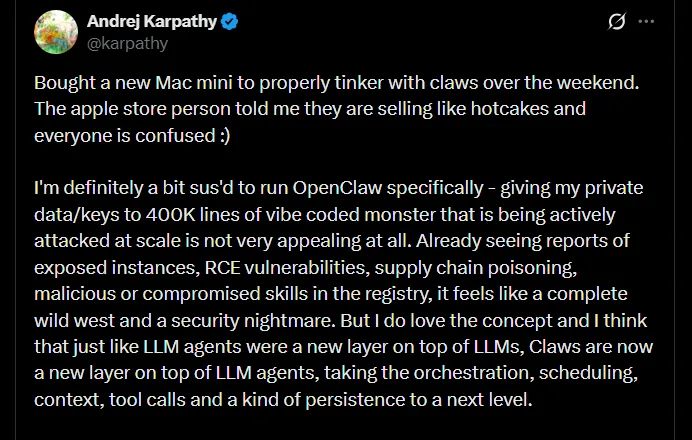
Security experts reacted strongly to these events. Andrej Karpathy issued a warning, expressing concerns about running OpenClaw due to the risks of handing over private data keys to a “400,000 lines of vibecoded monster” that is currently being actively exploited. In contrast, he found minimalist alternatives like NanoClaw appealing because their code is simple enough to fit easily within a human brain.
NanoClaw vs OpenClaw: Which should you choose?
To deploy an autonomous agent from NanoClaw vs OpenClaw, align the framework’s architecture with the host environment’s operational risk tolerance. The following decision framework outlines the optimal path.
Choose OpenClaw if:
- You want out-of-the-box integration with dozens of platforms without writing code.
- You want fast setup, prioritizing wizard-driven installation processes and immediate graphical feedback.
- You want multi-LLM flexibility, necessitating real-time inference routing between proprietary models and local Ollama deployments.
- You are comfortable vetting community skills and accept the inherent risks of executing unverified packages from ClawHub.
- You do not mind a background process continuously consuming system resources.
Choose NanoClaw if:
- Security, auditability, and cost are your absolute top priorities.
- You work in a regulated industry, such as fintech, healthcare, legal, or defense, which mandates strict OS-level isolation.
- You are building specifically on the Claude ecosystem and utilizing Claude Code.
- You are comfortable with a longer, code-first setup demanding terminal and container orchestration proficiency.
Beyond NanoClaw and OpenClaw: The wider “Claw” agent space
Here is the comparison table of NanoClaw vs OpenClaw vs other Claws:
| Tool | Lines of code | Security model | Best for |
| OpenClaw | ~430,000–500,000 | Application-level checks and configurations | Full-featured platform automation |
| NanoClaw | ~700 lines of TypeScript | OS-level Docker / Apple Container isolation | Security-first, auditable personal environments |
| NemoClaw | Sprawling enterprise stack | OpenShell kernel isolation + Privacy Router | Enterprise compliance and hardware acceleration |
| Nanobot | ~4,000 | Standard application environment | Academic research and basic agent testing |
| PicoClaw | Compact Go codebase | Sandboxed shell with compiled regex deny patterns | Embedded IoT boards and $10 hardware |
| ZeroClaw | Compact Rust implementation | Sandbox, pairing codes, and workspace scoping | Ultra-high performance local execution |
| IronClaw | Specialized Rust codebase | WebAssembly (WASM) sandboxing | Cryptographic operations and decentralized tools |
| GoBot | Structured community codebase | Direct API / Agent SDK boundaries | No-code setups and friendly conversational interfaces |
NemoClaw (Nvidia)
NVIDIA NemoClaw is an open-source reference stack for safely hosting sandboxed AI agents. It wraps OpenClaw inside NVIDIA’s secure OpenShell runtime, adding missing enterprise-grade security controls and network policies to resolve documented compliance gaps.
NemoClaw uses a Privacy Router to inspect all queries. It processes sensitive queries locally using secure, offline Nemotron models (such as Nemotron 3 Super 120B MoE), while routing non-sensitive queries to high-speed cloud models.
Nanobot
Comparing Nanobot vs OpenClaw reveals that Nanobot is a much smaller, lightweight personal agent framework containing roughly 4,000 lines of core code. It provides basic tool execution and conversation memory. It is primarily designed as a teaching skeleton for data scientists working in Jupyter environments.
PicoClaw
PicoClaw is an ultra-lightweight Go-based alternative to OpenClaw and NanoClaw. Rebuilt with an agent-driven self-bootstrapping process, it runs as a single compiled binary with less than 10 MB of RAM, making it efficient enough to run on a $10 Raspberry Pi Zero.
Comparing PicoClaw vs OpenClaw security, PicoClaw provides browser automation without API keys using its ExecTool (pkg/tools/shell.go), which contains 27+ security deny patterns to prevent malicious host calls. It integrates with CapSolver APIs and Playwright to handle CAPTCHAs and fetch web data locally on edge hardware.
ZeroClaw
ZeroClaw is a good OpenClaw alternatives personal assistant framework written in Rust. It compiles into an 8.8 MB static binary, boots in under 10 milliseconds, and consumes less than 5 MB of RAM.
It operates in three modes: Gateway (exposing API endpoints), Agent (CLI scripts), and Daemon (always-on routing).
For security, ZeroClaw integrates workspace scoping, Landlock/Bubblewrap sandboxing, and local SQLite-based vector and keyword memory to keep all personal data entirely off the cloud.
IronClaw
IronClaw focuses on high-security operations. It executes agent tools within secure WebAssembly (WASM) sandboxes, using cryptographic verifications to prevent private key leaks and credential exposures in decentralized applications.
Gobot
GoBot is a personal AI agent developed within the Autonomee community that is powered directly by Claude Code. Designed to bypass complex manual configuration file edits, it provides a guided terminal installer that connects Claude Code directly to Telegram or WhatsApp, offering Direct API, Agent SDK, and Hybrid deployment modes.
Conclusion
Choosing between NanoClaw vs OpenClaw is a critical trade-off between out-of-the-box integration breadth and auditable, secure execution. While OpenClaw remains a platform for teams seeking multi-model integrations, its codebase and documented vulnerabilities present severe security risks. NanoClaw lets developers use the power of autonomous agents without risking system compromise by utilizing a lightweight codebase and forcing all actions into isolated containers.