AI agent orchestration is the control layer that coordinates how one or more autonomous agents plan work, choose tools, share state, hand off tasks, recover from failure, and operate within security, cost, and human-approval boundaries.
A prototype can look successful while every request follows one happy path. Production systems face a different problem. Two agents may update the same record, a specialist may act on stale context, a verifier may approve unsupported evidence, or a planner may keep creating tasks after the goal is complete. Adding more agents creates more coordination paths, not automatic reliability.
This guide explains how agent orchestration works as a production control plane. It covers the runtime architecture, execution lifecycle, coordination patterns, a practical implementation, evaluation metrics, failure controls, framework selection, and real use cases.
TL;DR
- AI agent orchestration manages the full execution lifecycle: planning, routing, shared state, permissions, retries, approvals, aggregation, and termination.
- Routing chooses the next destination. Agent orchestration manages what happens before, during, and after that routing decision.
- Multi-agent orchestration is justified when a workflow needs independent expertise, parallel work, context separation, validation, or different security boundaries.
- A production control plane needs typed state, narrow agent contracts, scoped tools, deterministic checks, bounded loops, persistent checkpoints, and complete traces.
- Start with fixed control flow. Add model-directed transitions only where variable language or runtime evidence makes rules too brittle.
- Common patterns include sequential pipelines, router and handoff, parallel fan-out/fan-in, orchestrator-worker pattern, evaluator-optimizer loops, group chat, hierarchical control, and event-driven coordination.
- No framework removes the need to design state ownership, policy enforcement, recovery, evaluation, and approval paths.
- Use one agent when one role can complete the goal with a small tool set. Do not add another agent until evaluation shows a real limitation.
Table of Contents
What is AI agent orchestration?
AI agent orchestration is the process and runtime used to coordinate autonomous agents in a shared workflow. It decides which AI agents run, in what order or in parallel, what context they receive, which actions they may take, and how outputs, failures, approvals, and completion are handled.

AI agent orchestrator can be a combination of deterministic code, a workflow graph, queues, schedulers, state stores, policy checks, and selected model decisions. In a high-risk system, most transitions may come from code. In an open-ended research task, a planner model may decide how to decompose the work while code still enforces budgets and validation.
An AI agent orchestrator usually owns six responsibilities:
- Turn the user goal into a structured task with success criteria.
- Select a plan or create one within explicit limits.
- Assign work to agents, tools, or deterministic services.
- Maintain shared state and pass only relevant context.
- Validate intermediate results and contain failures.
- Stop, escalate, or finalize when the completion condition is met.
Consider a technical research workflow. A planner splits a question into subquestions. Two research agents search independent sources in parallel. A verifier checks evidence and citations. A writer creates the report. A person approves publication. The value does not come from having five participants. It comes from the control plane that defines ownership, data contracts, retry limits, and the approval boundary.
Why do AI agents need agent orchestration?
A single agent can complete a bounded task, but production workflows introduce dependencies, persistent state, tool permissions, retries, approvals, and side effects. The control layer manages those dependencies so the system remains observable and controllable as autonomy increases.
Specialization without one overloaded prompt
One general agent can accumulate too many tools, policies, data sources, and instructions. Different types of AI agents can operate as narrow specialists, reducing context size and making permissions easier to review. A billing agent should not receive deployment credentials, and a code-review agent does not need access to customer records. Multi-agent orchestration lets each specialist work inside a smaller trust boundary.
State continuity across steps and failures
Agents need a shared view of what has been completed, what evidence supports each decision, and which actions produced external effects. Versioned task state prevents a resumed run from repeating an irreversible operation. It also allows the system to recover from a process restart without rebuilding the task from conversation text.
Dependency and concurrency control
Some steps must run in order, and others can run together. The runtime should know that a writer cannot synthesize findings before research completes, but two independent source checks can run concurrently. And concurrent orchestration reduces latency without turning shared state into a race condition.
Reliability and recovery
Model calls and tools fail. The control plane can retry transient errors, use a fallback model, route to a different specialist, restore a checkpoint, or request human input. It can also run compensating actions when a workflow partially changes an external system.
Governance across every agent
Permissions, spend limits, tool allowlists, risk tiers, and approval gates should not live only inside prompts. The runtime must enforce them consistently. This is especially important for agentic AI orchestration, where agents can make local decisions but still need global boundaries.
Orchestration is unnecessary when a direct model call can safely complete a transformation, a deterministic service already solves the task, or one agent can handle the goal with a small tool set. More participants add latency, cost, and failure paths. Use them only when specialization or parallelism creates measurable value.
How does AI agent orchestration work?
The control layer turns a goal into a controlled execution lifecycle. The runtime receives the task, creates or selects a plan, assigns work, distributes context, monitors actions, handles failures, and decides when to continue, escalate, or stop.
Intake and goal definition
Standardize the request by converting it into a structured object. Include details such as the desired outcome, user identity, constraints, risk level, deadline, budget, prohibited actions, and completion criteria. Do not rely on agents to determine success based on an open-ended prompt.
Planning and task decomposition
Use code, a planner model, or a hybrid policy to split the goal into dependencies. A fixed plan is better when the workflow is known. A planner is useful when the number and type of subtasks depend on runtime evidence. The planner should return typed tasks rather than plain instructions, so downstream code can parse them easily.
Agent selection and routing
Match each subtask to a capability based on accepted inputs, allowed tools, permissions, cost, latency, health, and expected quality. AI agent routing is one function inside the larger system to manage subtasks for subagents.
Context and state distribution
Assign each agent the necessary task state, evidence, policies, and tool access. Avoid copying the entire conversation in every call. Distinguish trusted system policies from user input, retrieved content, and tool outputs. Keep a record of the origin of each claim or value for future stages.
Execution and communication
Run tasks sequentially, in parallel, or through controlled handoffs. Use typed messages or events with task IDs, schema versions, parent-child relationships, and correlation IDs. Free-form chat can support reasoning, but the runtime should not depend on natural language alone for control.
Validation, retry, and escalation
Check schema validity, source requirements, policy constraints, task progress, and external side effects after each important step. Retry only bounded failures. If a model repeats the same error, narrow the task, choose another capability, or stop. High-impact actions should pause for review.
Aggregation and completion
Resolve conflicting outputs with deterministic rules, a verifier, or a human decision. The final node should confirm that the requested outcome exists, not merely that every agent returned text. For example, a support workflow completes when the case status and customer response are both correct, not when the resolution agent says “done.”
Logging and feedback
Store transitions, model calls, tool calls, state versions, retries, latency, cost, errors, and human overrides. These traces support debugging, regression tests, audit, and future improvement.
What components make up an AI agent orchestration architecture?
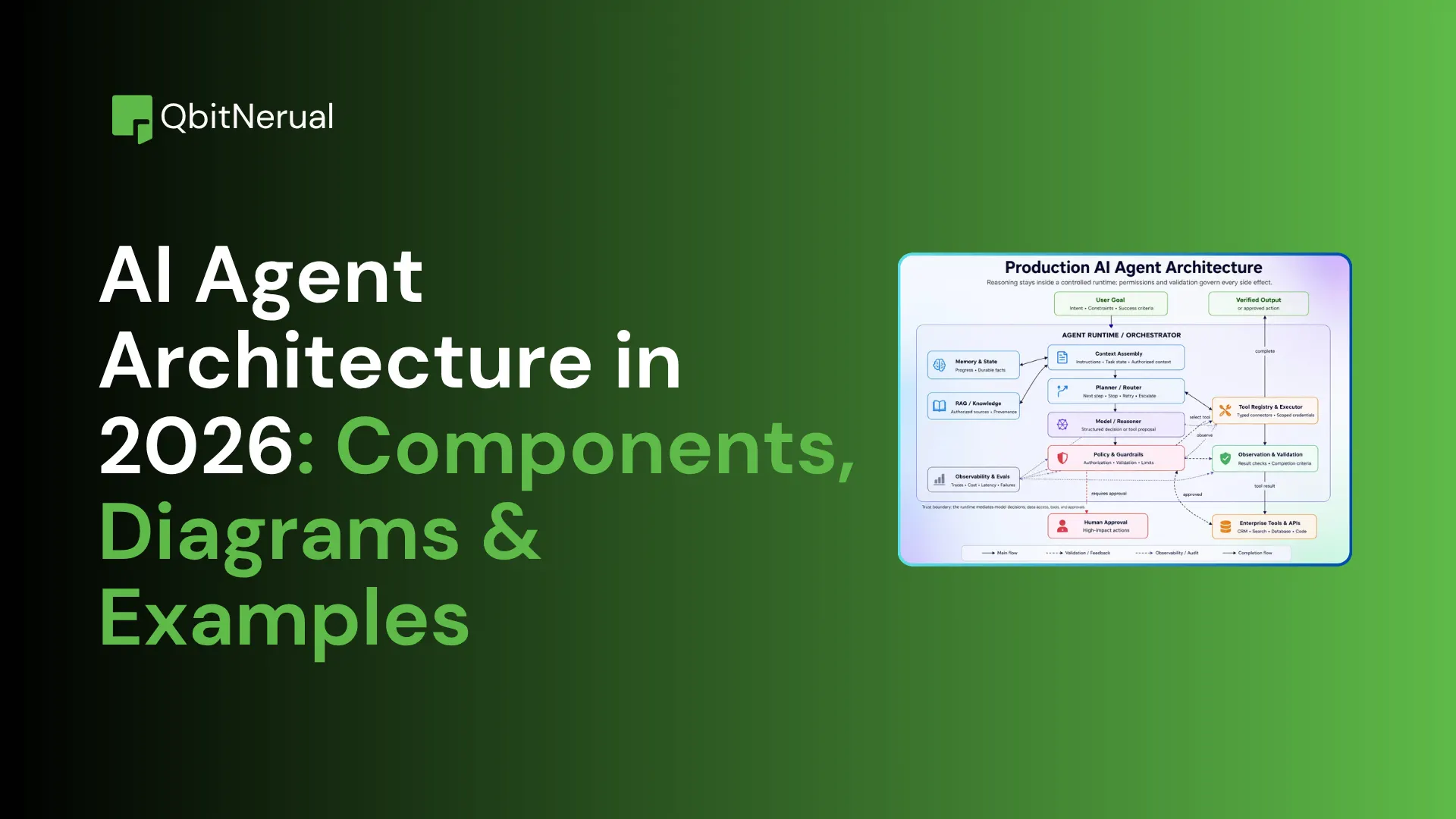
A production design separates agent capability from system control. Agents reason and act. The agent orchestration layer owns routing, state, permissions, execution policy, recovery, observability, and termination.
Orchestrator or control plane
The control plane runs the workflow graph, evaluates transition rules, creates tasks, manages queues, and coordinates deterministic and model-directed decisions. It should be able to pause, resume, cancel, and replay a run.
Agent registry and capability contracts
The registry describes every agent’s purpose, accepted input schema, output schema, tools, permissions, model, version, cost profile, health, and owner. These contracts let the runtime reject incompatible assignments before execution. Large deployments may expose a multi-agent orchestrator above several domain-specific registries.
Planner, router, and scheduler
The planner decomposes work. The router selects a capability. The scheduler controls order, concurrency, rate limits, and resource availability. Keeping these roles separate prevents one prompt from becoming an untestable control center.
Shared state and memory
Workflow state should include current tasks, evidence, decisions, side effects, and completion status. Use checkpoints and optimistic concurrency or leases to prevent conflicting updates. Long-term memory is a different concern. It should have its own retention, access, correction, and deletion policies.
Message and interoperability layer
Typed events and message buses carry tasks and results between components. The Model Context Protocol standardizes how applications connect models to tools, prompts, and resources. The Agent2Agent protocol focuses on communication and collaboration between independent agent systems. MCP does not replace orchestration, and A2A does not decide your workflow. They provide interoperable interfaces that the control plane can govern.
Tool gateway and identity
The tool layer should validate arguments, issue scoped credentials, enforce rate limits, record transaction IDs, and isolate irreversible operations. Agents should never receive broader credentials than their assigned task requires.
Policy engine and guardrails
Agentic AI orchestration still needs a deterministic policy boundary. The policy engine evaluates rules before an action runs. It can enforce risk tiers, approval requirements, content checks, location restrictions, spend limits, and stop conditions. A model can propose an action, but code should decide whether the action is allowed.
Observability and evaluation
Capture full traces, including the selected agent, model version, prompt version, tool input, tool result, state changes, latency, token usage, policy decisions, and final outcome. The AI orchestration layer should make these signals available across agents and services rather than burying them in separate logs.
Human interaction layer
People need structured ways to approve, edit, reject, correct, or take ownership of a task. LangGraph supports interrupts that save graph state and resume after external input, which makes approval a normal state transition rather than an ad hoc exception.
How is AI agent orchestration different from routing, workflows, and multi-agent systems?
The orchestration runtime governs the full lifecycle. Routing chooses where a task goes. Workflow automation executes predefined steps. A multi-agent system describes the agents that participate. These concepts overlap, but they solve different design problems.
| Concept | Primary question | Autonomy | State and control | Best fit | Example |
|---|---|---|---|---|---|
| Direct model call | What output should this input produce? | Low | Request-response only | Classification, extraction, rewriting | Extract fields from one document |
| Workflow automation | Which known step runs next? | Low | Deterministic state machine | Stable business processes | Validate, approve, and archive an invoice |
| AI orchestration | How should AI models, services, and data pipelines be coordinated? | Varies | May manage models without agent goals | Model gateways and compound AI systems | Route requests by quality, latency, or cost |
| AI agent routing | Which agent, tool, model, or workflow should handle this task? | Medium | Focused selection logic | Mixed intents and specialist catalogs | Send a refund case to a refund specialist |
| Single-agent orchestration | How should one agent’s loop, tools, approvals, and recovery be controlled? | Medium | One agent plus runtime state | Bounded tool-using tasks | Research and draft a cited memo |
| Multi-agent system | Which autonomous participants exist and how can they communicate? | High | Depends on implementation | Specialized or distributed work | Researcher, verifier, and writer agents |
| AI agent orchestration | How should the complete goal run safely from intake to verified completion? | Medium to high | Planning, state, policy, recovery, evaluation, and termination | Variable, multi-step production work | Investigate an alert and approve containment |
Which agent orchestration patterns should you use?
Choose an agentic workflow pattern based on dependency structure, uncertainty, latency, audit requirements, and failure cost. The simplest pattern that matches the real workflow is usually the most reliable.
Sequential or prompt-chaining pattern
One step feeds a typed result into the next. Use it for ordered pipelines such as extract, validate, enrich, approve, and publish. It is easy to trace and test because the route is explicit. Its weakness is rigidity, as unexpected evidence may require a branch that the original sequence did not model.
Router and handoff pattern
A router classifies the request and selects a specialist. A handoff may transfer control and conversation context to that specialist, while a manager pattern keeps control at the top and calls specialists as tools.
Use this pattern for mixed intents, language-specific handling, product boundaries, or risk-based escalation. Define a fallback when confidence is low. Do not let specialists hand off indefinitely.
Parallel fan-out and fan-in pattern
Independent workers run at the same time, then an aggregator merges their outputs. This works for multi-source research, independent code checks, scenario analysis, or ensemble evaluation. The design must specify how to handle missing results, conflicting claims, and slow workers.
Parallel execution is not safe when tasks write to the same resource without coordination. Use task ownership, version checks, and idempotency keys before enabling writes.
The orchestrator-worker pattern
A central planner creates subtasks dynamically, assigns them to workers, and synthesizes the results. Use it when the task structure is unknown until runtime, such as due diligence across an unfamiliar company or debugging an incident with several possible causes.
The planner should produce a bounded task graph. Workers should not silently create unlimited child work. Track parent-child relationships, deadlines, and a maximum number of active tasks.
Evaluator-optimizer or reflection loop
One component creates an output, and another evaluates it against a rubric, tests, or evidence requirements. The producer revises the result until it passes or reaches a budget.
Use it when quality can be checked: code tests, schema conformance, citation coverage, policy rules, or numerical verification. Avoid open-ended self-critique with no measurable pass condition.
Group-chat or debate pattern
Several agents exchange messages to explore alternatives or reach agreement. This can help with open-ended design review or hypothesis generation. It is expensive, difficult to reproduce, and vulnerable to one persuasive but incorrect participant. Add a manager, a turn limit, an evidence requirement, and a deterministic stop rule.
Hierarchical pattern
A top-level controller delegates to domain supervisors, and each supervisor coordinates local workers. Use it for large capability catalogs, separate business units, or regional policy boundaries. The hierarchy reduces routing complexity but introduces more state, latency, and ownership questions.
Event-driven or federated pattern
Agents or local orchestrators react to events while preserving domain autonomy. They communicate through typed contracts, queues, or A2A interfaces. This fits distributed enterprise systems in which each team owns its service and policy boundary. It requires strong identity, schema versioning, replay handling, and cross-domain governance.
How do you build an AI agent orchestration workflow in practice?
A useful implementation should prove the control responsibilities. The following research pipeline uses deterministic control with selected model decisions: a planner decomposes the question, two research workers run in parallel, a verifier checks evidence, a writer synthesizes the report, and a person approves publication.
This design can be implemented with an agent orchestration framework such as LangGraph or with a framework-neutral runtime.
Step 1: Define typed workflow state
State should hold operational facts and include the objective, subquestions, evidence records, validation status, retry count, cost, approval state, and final output. A production version should add state version, task ownership, timestamps, model and prompt versions, and side-effect transaction IDs.
Step 2: Define narrow agent contracts
Each role needs an input schema, an output schema, allowed tools, a completion condition, and explicit failure behavior.
- Planner input: objective and constraints. Output: bounded subquestions with dependencies.
- Researcher input: one subquestion and source policy. Output: structured evidence with URLs and excerpts.
- Verifier input: evidence set and rubric. Output: pass/fail, unsupported claims, and retry guidance.
- Writer input: verified evidence only. Output: report sections with citation mapping.
- Approver input: final report and trace summary. Output: approve, edit, or reject.
This contract-first design keeps an orchestrator agent from becoming a general assistant with unrestricted tools.
Step 3: Construct the control graph
import asyncio

async def run_workflow(state: WorkflowState) -> WorkflowState:
    state.subquestions = await planner(state.objective, max_tasks=6)

    research_jobs = [
        researcher(question=q, allowed_domains=SOURCE_ALLOWLIST)
        for q in state.subquestions
    ]
    batches = await asyncio.gather(*research_jobs, return_exceptions=True)
    state.evidence = merge_valid_evidence(batches)

    while True:
        verdict = await verifier(
            objective=state.objective,
            evidence=state.evidence,
            minimum_sources=3,
        )
        state.validation = verdict.status

        if verdict.status == "pass":
            break

        if state.retry_count >= state.max_retries:
            state.errors.append("Evidence validation failed within retry budget")
            return state

        state.retry_count += 1
        new_items = await researcher(
            question=verdict.narrowed_query,
            allowed_domains=SOURCE_ALLOWLIST,
        )
        state.evidence = merge_valid_evidence([state.evidence, new_items])

    state.final_output = await writer(
        objective=state.objective,
        verified_evidence=state.evidence,
    )

    state.approved = await request_human_approval(
        report=state.final_output,
        trace_summary=build_trace_summary(state),
    )

    if not state.approved:
        state.errors.append("Publication rejected by reviewer")
        state.final_output = None

    return state
The code keeps loops bounded and makes the approval gate explicit. A real runtime should persist state after each node so it can resume after a restart or a delayed review.
Step 4: Preserve context deliberately
Do not pass the full history to every role. Researchers need the assigned question and source rules. The verifier needs the objective, evidence, and rubric. The writer needs verified evidence, not rejected drafts. This reduces token cost and limits contamination from untrusted content.
Use immutable evidence records and versioned state updates. When two workers finish together, the reducer should merge records by evidence ID rather than overwrite the whole state object.
Step 5: Add deterministic checks
Validate outputs before the next node runs:
- Enforce JSON or typed output schemas.
- Reject sources outside the allowed policy.
- Require a minimum number of independent sources.
- Verify that every material claim maps to evidence.
- Cap subtasks, tool calls, retries, tokens, wall time, and spend.
- Block publication when validation or approval is incomplete.
This is where the runtime turns uncertain model output into a controlled application.
Step 6: Add human-in-the-loop approval
Pause before publication, payment, deletion, external communication, or any irreversible action. Persist the run and present the reviewer with the proposed action, evidence, policy result, and edit controls. The reviewer should be able to approve, modify, reject, or reassign the task.
Step 7: Trace and test every run
Log node transitions, agent selection, tool calls, model and prompt versions, latency, cost, retries, policy decisions, and approval results.
A failure walkthrough should also be part of the test suite. In this example, a researcher returns an unsupported claim. The verifier rejects it and supplies a narrower query. The runtime retries once, merges new evidence, and runs validation again. If the evidence still fails after the budget, the workflow stops. It does not send weak material to the writer.
What are the main risks and failure modes?
AI agent orchestration creates distributed-system failure modes around probabilistic components. The largest risks include stale state, conflicting actions, cascading errors, excessive permissions, duplicate side effects, runaway loops, and decisions that cannot be reconstructed.
- Context loss or state divergence: Two agents may read different state versions or overwrite each other’s updates. Use versioned records, task ownership, checkpoints, compare-and-swap updates, and provenance. Separate workflow state from long-term memory.
- Conflicting agents and duplicate work: Workers may claim the same task or take incompatible actions. Use task leases, idempotency keys, clear ownership, and aggregation rules. Writes to external systems should include a run ID and transaction ID.
- Cascading semantic errors: A weak output can become “fact” after several handoffs. Validate important intermediate results before downstream use. Preserve evidence and uncertainty. Do not let a summarizer erase warnings from a researcher or tool.
- Runaway loops and cost spikes: Set hard limits for steps, retries, tool calls, tokens, wall time, and spend. Detect repeated states and repeated tool arguments. A loop detector should stop execution even when the model keeps asking to continue.
- Prompt injection through tools or shared messages: Treat user input, web content, files, emails, and tool output as untrusted data. Keep policy in a separate channel, limit tool scope, validate proposed calls, and prevent retrieved text from changing runtime permissions.
- Excessive agency and privilege: Give every role its own identity and scoped credentials. Require approval for high-impact actions. The agentic orchestration layer should enforce these controls outside the model prompt.
- Duplicate or partial side effects: A timeout may occur after an API call succeeds but before the runtime records success. Use idempotency keys, transaction-status checks, resumable operations, and compensating actions. Do not retry a write blindly.
- Weak interoperability trust: Remote tool servers and agents can make incorrect capability claims or return malformed data. Authenticate endpoints, validate contracts, verify signatures where available, and apply local policy to every external result.
- Observability gaps: A log that says “verifier ran” is not enough. Record the input state version, output schema, evidence used, policy result, and transition reason. Redact secrets while keeping enough context for audit and replay.
Which AI agent orchestration tools and frameworks should you consider?
An AI agent orchestration platform can accelerate implementation, but no framework removes the need to design state, policies, evaluation, and failure handling. Compare AI agent orchestration tools based on how explicitly each option represents control flow, how it persists state, how it supports approval and tracing, and how well it fits your language and deployment environment.
Among current AI agent orchestration frameworks, the following are the best choices:
- LangGraph is a strong fit when the system needs explicit graph state and durable checkpoints.
- OpenAI’s SDK is useful when the application already uses OpenAI models and wants lightweight agents, handoffs, agents-as-tools, guardrails, and tracing.
- AutoGen provides a high-level API for agents and teams on top of an event-driven core.
- CrewAI combines crews with flows that manage state and execution.
- Google ADK covers agents, multi-agent workflows, evaluation, and deployment, while A2A supports communication across independently built agents.
Language model choice also affects latency, cost, privacy, and deployment.
Use these questions to compare AI agent orchestration tools and AI agent orchestration frameworks:
- Can the framework represent deterministic branches and model-directed branches in one graph?
- Can it persist and resume state without repeating side effects?
- Does it support typed inputs, outputs, and state reducers?
- Can it enforce tool permissions outside the prompt?
- Can a person inspect and modify a paused run?
- Does tracing capture transition reasons, tool data, cost, and errors?
- Can you deploy it inside your security and data boundaries?
- How difficult is it to version prompts, tools, policies, and evaluation sets together?
The table below summarizes the AI agent orchestration frameworks, including the against orchestration model, control strengths, and production caveat:
| Framework or platform | Orchestration model | Strongest fit | Control strengths | Production caveat |
|---|---|---|---|---|
| LangGraph / LangChain | Stateful graph with nodes, edges, reducers, checkpoints, and interrupts | Custom production workflows that mix code and agents | Explicit state, durable execution, human review, graph control | Requires engineering work to define schemas, policies, and deployment |
| OpenAI Agents SDK | Agents, tools, agents-as-tools, handoffs, guardrails, and tracing | OpenAI-centered Python applications | Code-driven or LLM-driven flow, built-in trace events | Teams still own persistence, access control, and business policy |
| Microsoft AutoGen | Message-driven agents and teams with high-level AgentChat plus lower-level event-driven core | Collaborative, conversational, and research workflows | Predefined team patterns and flexible event architecture | Open-ended conversations need strict stop rules and evaluation |
| CrewAI | Role-based crews plus event-driven flows | Rapid business workflow development | High-level role/task abstraction, flows, guardrails, memory, observability | Abstraction can hide state and failure details if contracts stay vague |
| Google ADK + A2A | Agent development, workflow agents, graph workflows, evaluation, and distributed interoperability | Google Cloud-aligned and cross-framework agent services | Deployment path, multi-agent support, A2A communication | Distributed trust, identity, and versioning remain application concerns |
| Semantic Kernel | Named concurrent, sequential, handoff, group-chat, and Magentic patterns | .NET and Python teams wanting explicit pattern APIs | Unified runtime and typed orchestration interfaces | Official docs mark the orchestration features experimental; verify status before adoption[9] |
| Low-code workflow platforms | Visual steps, connectors, triggers, approvals, and selected agent nodes | Integration-heavy business workflows | Fast setup and accessible governance controls | Less low-level control over state reducers, runtime internals, and custom recovery |
What are the best practices for production AI agent orchestration?
Production agentic AI orchestration should make probabilistic behavior operate inside deterministic boundaries. Keep roles narrow, contracts typed, privileges scoped, loops bounded, state versioned, failures recoverable, and consequential actions observable and reversible where possible.
- Start deterministic. Model the workflow as states, transitions, and failure paths before adding model-directed choices.
- Give every agent one responsibility. Define input, output, tools, permissions, completion, timeout, and escalation behavior.
- Separate state types. Keep workflow state, conversation history, long-term memory, and source evidence in distinct stores or schemas.
- Use structured contracts. Validate every message and tool call. Reject unknown fields and incompatible schema versions.
- Make external actions idempotent. Attach run and transaction IDs, check status before retry, and design compensating actions.
- Set hard budgets. Limit time, steps, tokens, retries, active tasks, tool calls, and spend at workflow and agent levels.
- Apply least privilege. Use per-agent identity, scoped credentials, allowlisted tools, and approval gates for irreversible actions.
- Trace decisions, not only events. Record why a route or transition occurred, what evidence supported it, and which policy allowed it.
- Test partial failure. Simulate tool outages, stale state, invalid schemas, prompt injection, conflicting outputs, delayed approval, and process restarts.
- Version the full system. Release prompts, models, tools, contracts, policies, and evaluation sets together.
Teams comparing AI agent orchestration tools should prioritize these operational controls over polished demo interfaces. A strong AI agent orchestration platform makes state, policy, and recovery visible instead of hiding them behind agent chat.
Conclusion: Treat AI agent orchestration as a control system
AI agent orchestration is valuable for coordinated specialization, shared state, tool control, recovery, and governance. While a managed AI agent orchestration platform helps operations, the ideal design uses the minimal control plane necessary to ensure reliability, observability, and safety.
Begin with the outcome by modeling states, transitions, contracts, permissions, and failures. Prioritize single agents or deterministic workflows. Only add routing, parallel execution, or adaptive planning when evaluation shows fixed controls are insufficient.
Before selecting AI agent orchestration frameworks, test a representative workflow under failure. Multi-agent orchestration introduces coordination overhead; framework choice matters, but distinct ownership of state, policy, side effects, and completion forms the true foundation for production-grade agent orchestration.
Frequently asked questions
What is AI agent orchestration?
AI agent orchestration is the runtime and control process that coordinates agents, tools, state, policies, and approvals across a goal. It determines which work runs, what context each role receives, how failures are handled, and when the system should stop. It may manage one complex agent or several specialists.
What is the purpose of an orchestrator agent?
Production agent orchestrators coordinate work that spans several steps or capabilities. They can decompose a goal, assign tasks, monitor progress, validate outputs, and aggregate results. In production, the orchestrator should not rely only on model judgment; code should enforce permissions, budgets, retries, and completion rules.
How does orchestration work in a multi-agent AI system?
The runtime creates or selects a plan, routes subtasks, distributes relevant context, executes agents sequentially or in parallel, validates results, and updates shared state. Commercial AI agent orchestration platforms package these capabilities into managed products, but teams still need clear contracts and governance.
What is the difference between AI orchestration and AI agent orchestration?
AI orchestration is a broad term for coordinating models, AI services, data, or pipelines. AI agent orchestration focuses on goal-directed agents that use tools, maintain state, and make decisions across several steps. The second therefore needs stronger controls for permissions, side effects, recovery, and termination.
What is the difference between AI agent routing and orchestration?
Routing selects the next agent, tool, model, or workflow. Orchestration manages the complete run: intake, planning, state, routing, execution, validation, retries, approvals, aggregation, logging, and completion. Routing is one function inside the larger control plane.
Do all multi-agent systems need a central orchestrator?
No. Agents can coordinate through events, peer-to-peer handoffs, shared workspaces, or federated supervisors. However, the system still needs explicit rules for identity, state ownership, conflict resolution, policy, and stopping. Using central enterprise agent orchestration platforms is one design, not a universal requirement.
What is an AI agent orchestration platform?
An AI agent orchestration platform provides runtime services for coordinating agent workflows. Typical capabilities include state management, routing, tool integration, checkpoints, tracing, evaluation, approval gates, and deployment controls. The platform should be judged by failure handling and governance, not only by how quickly it creates a demo.
Which AI agent orchestration frameworks and AI agent orchestration tools should you use?
Different AI agent orchestration frameworks fit different operating models. Choose AI agent orchestration tools based on control-flow clarity, state persistence, human review, tracing, language, deployment, data boundaries, and team skills. LangGraph fits explicit stateful graphs. OpenAI’s SDK fits OpenAI-centered Python applications. AutoGen fits message-driven teams. CrewAI fits role-based crews and flows. Semantic Kernel fits .NET/Python teams, subject to current feature status.
How do MCP and A2A fit into orchestration?
MCP standardizes connections between model applications and tools, prompts, and resources. A2A standardizes communication between independent agent systems. They solve interoperability problems. The runtime still decides who can connect, what data can move, which actions are allowed, and how the overall task progresses.
What is the role of agent orchestration patterns?
Well-designed agent orchestration patterns coordinate policies, state, and transitions across autonomous components in an agentic system. It is a conceptual layer rather than a required product. Teams can implement it through workflow code, graph runtimes, queues, policy services, and selected model decisions.