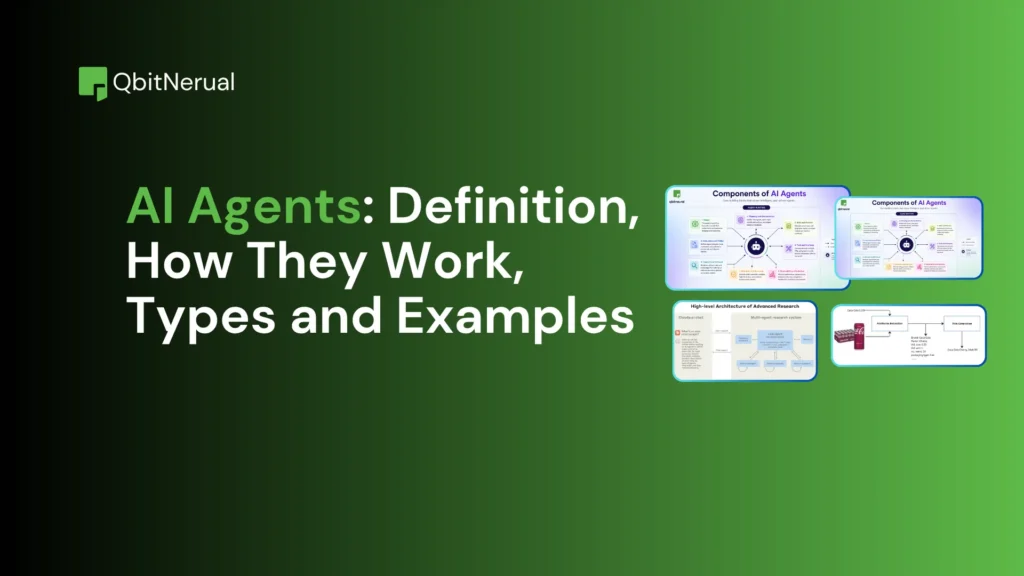
AI agents are software systems that work toward a goal by interpreting context and deciding what to do next. They use tools to take action and check whether the action worked.
People set the goals, permissions, and escalation rules. The agent chooses a path that fits within those rules. Modern AI agents use large language models (LLMs), but the concept of an intelligent agent predates generative AI.
A language model can generate an answer, and a chatbot can hold a conversation, but an AI agent works in a loop. It can gather current information, maintain task state, call an API, update a system, inspect the result, and either continue, stop, or ask a person for help. That flexibility makes agents useful for variable, multi-step work, while also making permission design, evaluation, and security essential.
This guide provides AI agents explained from first principles through implementation. It also covers the types of AI agents, architecture, use cases, AI agent evaluation, and a practical decision framework for choosing between an agent, automated processes, an assistant, or human-led work.
TL;DR
- AI agents are autonomous systems that show reasoning, plan steps, use tools, take actions, and adapt from results within defined permissions.
- An LLM powers an agent, but an LLM alone is not an agent unless a surrounding system adds goals, state, tools, an action loop, and completion rules.
- Key AI agent architecture includes a model, instructions, context or RAG, state and memory, orchestration, tools, guardrails, permissions and observability.
- Classical intelligent agents include reflex, model-based, goal-based, utility-based and learning agents; modern categories include coding, voice, computer-use, embodied and multi-agent systems.
- AI agents for business fit variable, multi-system workflows with measurable outcomes. Stable, predictable processes usually remain better candidates for deterministic automation.
- Reliable deployment starts with minimum necessary autonomy, realistic end-to-end evaluations, human approval for high-impact actions, complete logs, and a rollback path.
What is an AI agent?
An AI agent is an autonomous software system that uses an AI model to understand a goal, reason through a plan, use external tools, and take action on behalf of the users.
Unlike a model that only returns an output, an artificial intelligence agent can operate across several steps and adapt its next move within defined permissions.
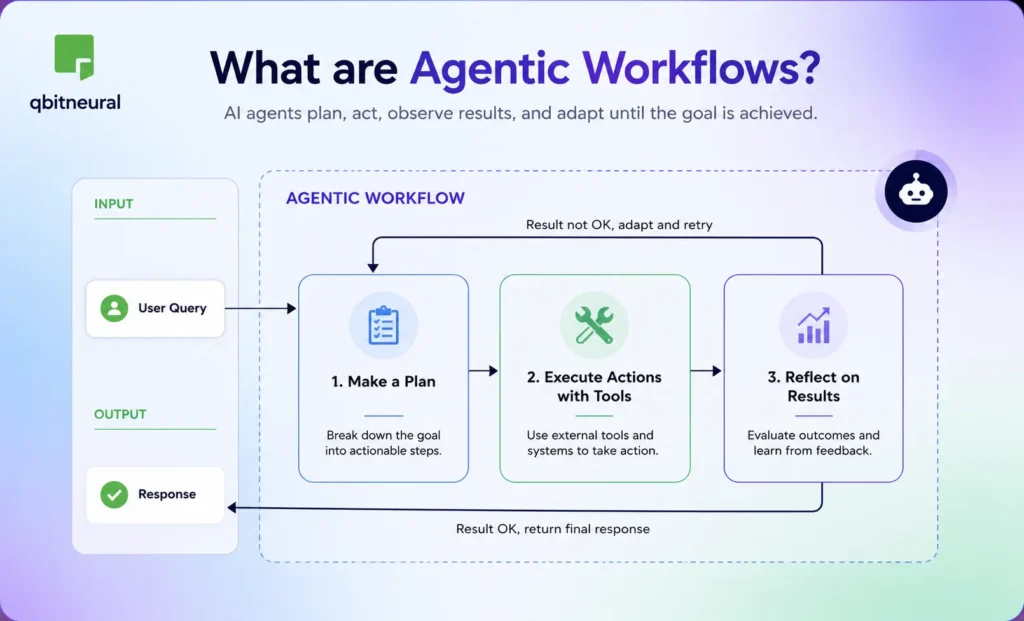
A minimum test for calling software an AI agent is whether it has all six elements below:
| Minimum criterion | What it means |
|---|---|
| Goal | A specific outcome or completion condition, not only a prompt to answer. |
| Environment or context | The information needed to understand the current situation. |
| Decision process | Logic or a model that selects the next action. |
| Action capability | Tools, APIs, software interfaces, or physical actuators. |
| Feedback and state | A way to observe results and retain progress across steps. |
| Bounded autonomy | Permission to choose among allowed actions without requesting instructions for every step. |
Autonomy for AI agents varies, as some agents only suggest actions. Others can do simple tasks but ask for approval before changing. A tightly governed production agent can handle reversible workflows on its own but still escalate issues. The key question is not if a system is fully autonomous, but how much decision and action authority it has for specific tasks.
What are the benefits of AI agents?
AI agents can reduce the coordination costs of multi-step work by gathering context, choosing tools, updating systems, and checking results within a single workflow. The highest value of AI agents comes from improving efficiency, consistency, scalability, and decision quality while keeping people involved for exceptions and approvals.
Here are some key benefits of the AI agents:
- Faster cycle time: AI agents reduce the time required to complete repetitive workflows by executing multiple actions without waiting for manual intervention.
- Important consideration: Greater speed only creates value if accuracy remains high and additional rework is not introduced.
- Greater operational coverage: AI agents can continuously monitor systems and process requests, enabling organizations to support more users and workloads without a proportional increase in headcount.
- Important consideration: Every autonomous workflow should include a clear escalation path for situations the agent cannot resolve confidently.
- Adaptive decision-making: AI agents can adjust their actions based on changing inputs, retrieved information, and business rules.
- Important consideration: Greater flexibility increases testing, governance, and validation requirements to ensure reliable decision-making.
- Consistent execution: AI agents perform approved workflows consistently, reducing variation caused by manual processes while maintaining standardized documentation and policy compliance.
- Important consideration: Because LLMs can produce non-deterministic outputs, critical actions should still be validated before execution.
- Scalable analysis: AI agents can analyze significantly larger volumes of information than human teams by combining retrieval, reasoning, and enterprise tools within a single workflow.
- Important consideration: Infrastructure, model inference, tool usage, and monitoring costs should be evaluated to ensure automation delivers measurable business value.
How do AI agents work?
AI agents work through an iterative control loop. It receives a goal, observes relevant context, forms or updates a plan, selects an allowed action, inspects the result, and continues, revises, or escalates until a completion condition is met. The loop can be tightly scripted or dynamically planned by a model.
- Define the goal and constraints: The system receives the objective, success criteria, permissions, budget, deadline, and actions that are out of scope.
- Observe the current state: The agent reads the user request, task history, system status, documents, or events that describe the environment.
- Plan the next step: A model, router, or workflow graph determines what should happen next. Complex tasks may be decomposed into smaller subtasks.
- Retrieve and contextualize: The agent fetches current data from approved documents, databases, or services instead of relying only on model memory.
- Act through a tool: The system calls an API, queries a database, executes code, edits a file, sends a message, or invokes another agent.
- Evaluate the result: The agent checks tool output, validates side effects, and compares progress with the completion criteria.
- Continue, stop, or escalate: The system proceeds when the result is valid, retries within limits, requests human approval, or stops safely when it cannot complete the task.
Research such as ReAct formalized the value of interleaving reasoning and actions, Toolformer explored model-driven API use, and Reflexion examined how language agents can use feedback across attempts. These ideas help with design patterns and avoid exposing unrestricted internal reasoning or letting a model control a production system without guardrails.
Worked example: OpenTable’s reservation-management AI agent
Restaurant reservation platform OpenTable uses Salesforce Agentforce to automate many customer-service interactions while escalating complex situations to human representatives when appropriate.
When a customer requests to modify or cancel a reservation, the AI agent follows a structured workflow instead of generating a single response.
- Receive the customer’s request.
- Authenticate the customer’s identity.
- Retrieve the reservation from the booking system.
- Check restaurant policies, reservation status, cancellation rules, and available seating.
- Determine whether the requested action complies with business policies.
- Update the reservation automatically if permitted.
- Confirm the successful change to the customer.
- Record the interaction in the CRM for future reference.
- Escalate policy exceptions, VIP reservations, payment disputes, or restaurant-specific issues to a human agent together with the reservation details, system checks, and recommended next steps.
What are the key components of AI agent architecture?
An AI agent architecture combines a model, instructions, contextual knowledge, task state, planning or orchestration, action tools, safety controls, and observability. The model supplies flexible interpretation and decision support, while the surrounding application determines what the agent can see, what it can do and how the system detects or contains failure.
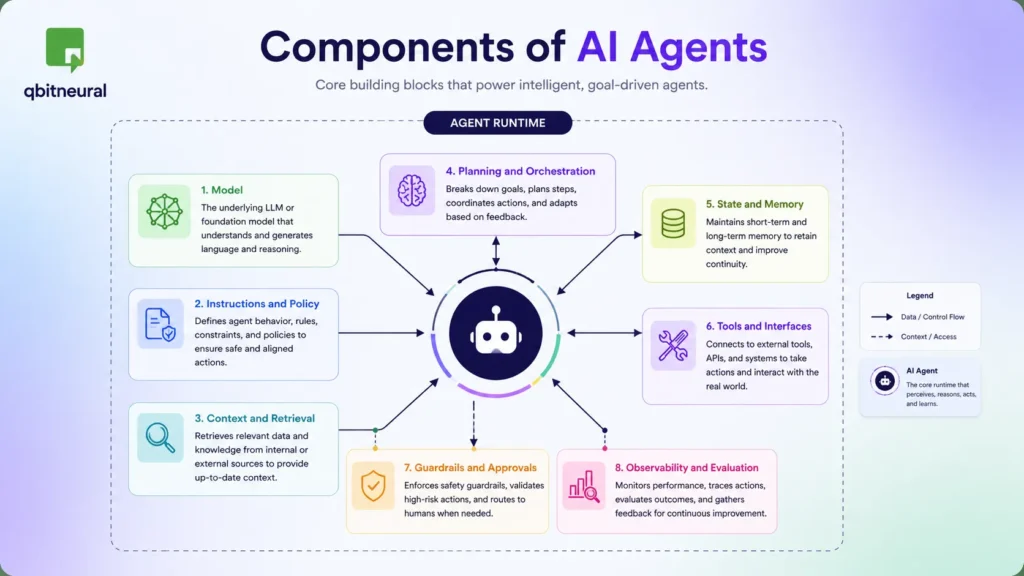
Here is the summarizing table of AI agent architecture components:
| Component | Role | Common failure | Control |
|---|---|---|---|
| Model | Interprets goals, generates structured decisions and selects among available actions. | Weak reasoning, hallucinated facts or invalid tool arguments. | Model selection, structured outputs, validators and fallback models. |
| Instructions and policy | Defines role, scope, business rules, output format and completion criteria. | Ambiguous priorities or conflicting rules. | Versioned policies, explicit hierarchy and tests for edge cases. |
| Context and retrieval | Supplies current documents, records, user state and domain knowledge through RAG or direct queries. | Stale, irrelevant, unauthorized or malicious context. | Freshness checks, permission-aware retrieval, provenance and input isolation. |
| State and memory | Tracks progress, prior actions, preferences and durable knowledge where needed. | Sensitive retention, stale memory or contamination between users. | Data minimization, scoped storage, retention limits and deletion controls. |
| Planning and orchestration | Sequences tasks, routes work, handles dependencies, retries and handoffs. | Loops, brittle plans, conflicting agents or lost state. | Workflow graphs, max steps, confidence thresholds and deterministic checkpoints. |
| Tools and interfaces | Connects the agent to APIs, databases, browsers, code execution and enterprise apps. | Wrong parameters, unsafe side effects or duplicate actions. | Typed schemas, allowlists, least privilege, idempotency and sandboxing. |
| Guardrails and approvals | Blocks disallowed actions and requires a person at defined risk points. | Over-broad autonomy or approvals that are easy to bypass. | Policy enforcement outside the model, risk tiers and signed approval records. |
| Observability and evaluation | Records traces, tool calls, outcomes, cost, latency and failure labels. | Silent failure, poor reproducibility or no basis for improvement. | Complete logs, replayable test cases, dashboards and incident review. |
The model is only one component. For many tasks, retrieval quality, tool reliability and permission design matter more. Model selection should consider reasoning quality, modality, context needs, latency, cost, deployment constraints, and the ability to produce valid structured outputs.
If you are comparing self-hosted options, use our open-source LLMs guide as a starting point and then evaluate models in the actual agent workflow.
Planning does not always need open-ended methods. A workflow graph can keep high-risk steps deterministic and help classify requests, choose routes, or fill structured parameters. In multi-agent systems, a router sends work to specialized agents and an orchestrator sequences or combines outputs.
Check our AI agent routing guide for details on routing patterns, including rule-based, semantic, classifier, LLM, and hybrid.
Model Context Protocol (MCP) can standardize how compatible AI applications discover context and invoke external tools. MCP is an integration protocol but does not replace authorization. The application still needs scoped credentials, user consent, validation, logging, and controls over which tools can be called and with what arguments.
What are the types of AI agents?
The types of AI agents can be classified in two ways. Classical AI categories describe how an agent selects actions, while modern industry categories describe the environment, interface, or workload of LLM-enabled systems.
Classical intelligent-agent types
| Type | Decision style | Strength | Limitation | Example |
|---|---|---|---|---|
| Simple reflex agent | Uses the current observation and condition-action rules; no internal model. | Fast, predictable response in a simple environment. | Cannot reason about hidden state or long-term consequences. | A thermostat or threshold alert. |
| Model-based reflex agent | Maintains an internal state that represents parts of the environment not directly visible. | Handles partial observability. | The internal model can become incomplete or stale. | A robot vacuum tracking visited areas. |
| Goal-based agent | Compares possible actions with a desired future state. | Can plan toward a defined outcome. | May treat all successful paths as equally good. | A route planner seeking a destination. |
| Utility-based agent | Scores outcomes to balance competing objectives or uncertainty. | Makes trade-offs among cost, speed, quality or risk. | Utility design can encode poor incentives. | A scheduler optimizing time and service level. |
| Learning agent | Improves its policy, model or decisions from data and feedback. | Adapts when conditions change. | Can learn from biased or unsafe feedback. | A fraud system updated from reviewed cases. |
These categories come from the study of intelligent agents. Modern LLM agents are often goal-based or utility-aware, maintain a model of task state, and may improve from feedback. The classical taxonomy remains useful because it forces teams to ask what information the system uses, what objective it optimizes, and whether it learns after deployment.
Modern AI-agent categories
| Modern category | Defining feature | Best fit |
|---|---|---|
| Workflow agent | Completes a bounded business process through a mostly explicit graph. | Predictable enterprise operations. |
| LLM tool-using agent | Uses a language model to select and call APIs or functions. | Variable knowledge and action tasks. |
| Coding agent | Reads repositories, edits code, runs tests and prepares changes. | Software maintenance and engineering. |
| Computer-use agent | Interacts with graphical interfaces through a browser or virtual desktop. | Legacy apps without reliable APIs. |
| Voice agent | Combines speech recognition, dialogue, tools and speech output. | Phone support, booking and field assistance. |
| Embodied or robotic agent | Perceives and acts through sensors and physical actuators. | Navigation, manipulation and industrial systems. |
| Multi-agent system | Coordinates specialized agents that delegate, review or combine work. | Tasks requiring distinct skills or parallelism. |
Categories can overlap; for example, a coding agent can be goal-based, use tools, learn from test feedback, and serve as an expert within a group of agents. More agents do not automatically produce a better system.
Using many agents can introduce routing errors, miscommunication, duplicated efforts, higher latency, and a larger attack surface. It’s best to use multiple agents only when specialization, independent review, or parallel execution provides measurable value.
Personal and local agents are another deployment pattern. They run close to a user’s files and applications, which can give better control but also create more permissions to manage.
Our NanoClaw vs OpenClaw comparison shows how agent designs can differ in isolation, memory, tool access, and operating model.
What is the difference between AI agents and agentic AI?
An AI agent is an individual software entity that works towards specific goals, while agentic AI includes one or more agents, which can plan, use tools, and act with some autonomy. Agentic AI also includes orchestration, governance, shared state, and multi-agent workflows beyond one agent.
Here is the difference table:
| Dimension | AI agent | Agentic AI |
|---|---|---|
| Unit | One software agent or role. | A broader application, architecture or operating pattern. |
| Example | A research agent that gathers and summarizes sources. | A research workflow coordinating search, analysis, fact-checking and report-writing agents. |
| Primary design question | What can this agent observe, decide, and do? | How do agents, workflows, controls and people coordinate? |
| Evaluation scope | Task success, tool reliability, and safe behavior of one agent. | End-to-end outcome, handoffs, routing, shared state, cost and governance. |
How do AI agents differ from LLMs, chatbots, assistants and automation?
The key difference is system behavior. An LLM generates model outputs, while a chatbot manages a conversation. An AI assistant helps a user complete tasks, deterministic automation follows predefined rules, and an AI agent can choose and execute multiple actions toward a delegated goal.
Here is the table summarizing the difference:
| System | Primary purpose | Planning | Tool use | Best fit | Main risk |
|---|---|---|---|---|---|
| LLM | Generate or transform information from a prompt. | No inherent goal loop. | Not inherently. | Reasoning, extraction and drafting. | Unsupported or incorrect output. |
| Chatbot | Manage a conversation and respond to messages. | Usually reactive. | Optional and often limited. | Support, guidance and Q&A. | Confident but unhelpful conversation. |
| AI assistant | Help a person complete work. | Usually user-led; may suggest steps. | Can use approved tools. | Copilot-style work and user-approved actions. | Overreliance or unclear responsibility. |
| Deterministic automation / RPA | Execute a known process from a rule, event or schedule. | Predefined path and branches. | Preconfigured integrations. | Stable, high-volume workflows. | Brittleness when conditions change. |
| AI agent | Completes a bounded outcome from a goal, event or schedule. | Selects or revises steps within controls. | Core capability. | Variable, multi-step, cross-system tasks. | Wrong or unauthorized action. |
AI agent vs LLM is a model-versus-system distinction. A language model understands language, can come up with a plan, or select a tool, but it doesn’t have ongoing memory, permissions, or a built-in environment to perform tasks. The application around the model creates the agent.
AI agent vs chatbot is an action-loop distinction. A chatbot provides an interactive action loop (responding to messages). But an AI agent can work toward a goal beyond replying with the next message.
AI agent vs assistant is mainly about delegation. An assistant normally keeps control with the user, whereas intelligent agents can operate toward a goal even between user interactions.
AI agents for automation make sense when inputs and paths vary. Traditional automation works better when rules are stable, outcomes are predictable, and every possible step can be planned out. Often, the best systems combine both: deterministic code enforces reliability while an agent handles language, classification, planning, or special cases.
What can AI agents do?
AI agents are useful when a workflow requires several context-dependent steps, access to multiple systems, and an outcome that can be checked. Common AI agent use cases include customer operations, software engineering, research, IT, security, sales, finance, procurement, and physical systems. The best AI agents for business are designed around a measurable workflow with clear success metrics.
Some top applications of AI agents include:
- Customer service: Customer service AI agents investigate customer issues, retrieve account and order information, apply business policies, update enterprise systems, and escalate complex cases to human representatives when required.
- Software engineering: AI agents help developers plan implementation tasks, generate or modify code, execute automated tests, analyze failures, prepare pull requests, and summarize code reviews.
- Research and knowledge work: Research AI agents plan searches, gather information from multiple sources, compare evidence, summarize findings, and generate cited reports.
- IT operations and cybersecurity: AI agents monitor infrastructure, investigate alerts, collect diagnostic information, execute approved remediation actions, and escalate incidents that require human intervention.
- Sales and finance: Sales AI agents qualify leads, reconcile financial records, prepare proposals, review contracts, and coordinate approval workflows across multiple business systems.
- Procurement and supply chain: AI agents compare suppliers, monitor inventory levels, evaluate purchasing options, recommend vendors, and coordinate procurement workflows.
- Robotics and embodied AI: Embodied AI agents combine perception, planning, and physical control to complete real-world tasks using robots, autonomous vehicles, or industrial equipment.
How do you build an AI agent?
You can build an AI agent by defining an outcome, selecting a model, supplying context, exposing necessary tools, designing the control loop, adding state where it improves the task, enforcing safety boundaries, and testing complete workflows before deployment. Effective AI agent development starts with the least autonomy needed to solve the task.
- Define the outcome and boundaries: State the objective, completion criteria, allowed actions, prohibited actions, risk owner, and escalation path. Replace vague goals such as “handle support” with measurable work such as “resolve eligible address-change requests and escalate identity mismatches.”
- Choose the model for the workload: Evaluate reasoning, structured output, tool calling, modalities, latency, cost, context length, privacy, and deployment constraints. A stronger model may reduce retries, but system design can matter more than benchmark rank.
- Design context and retrieval: List the sources required for each decision. Use permission-aware access, freshness metadata, and source provenance. Keep untrusted content separate from system policy so retrieved text cannot silently become an instruction.
- Add tools with strict interfaces: Expose only the capabilities needed for the task. Define typed inputs and outputs, validate arguments, use least-privilege credentials, and make side-effecting operations idempotent where possible.
- Choose an orchestration pattern: Use a fixed workflow for predictable sequences, a router for specialist selection, a planner-executor for variable tasks, a state graph for explicit transitions, or a multi-agent design only when specialization adds value.
- Add state and memory deliberately: Store current task state, prior actions, and durable knowledge separately. Define who can access the memory, how long it is retained, how it is corrected, and how a user can request deletion.
- Enforce controls outside the model: Add approval gates, allowlists, sandboxing, rate limits, step budgets, spend limits, timeouts, retries, policy checks, and rollback. Do not depend on a prompt as the only security boundary.
- Evaluate realistic end-to-end tasks: Test normal, ambiguous, edge and adversarial cases. Measure the final outcome, tool behavior, recovery, cost, and escalation – not only whether one response appears reasonable.
- Deploy gradually and monitor: Begin in offline evaluation or recommendation mode, move to shadow mode, then permit low-risk reversible actions. Monitor traces, failure clusters, policy violations, and changes in data or user behavior.
How should AI agents be evaluated?
AI agents should be evaluated on complete workflow outcomes. A good AI agent evaluation measures task success, factual grounding, tool reliability, latency, cost, recovery behavior, escalation quality, safety, and auditability across realistic business scenarios.
Although public benchmarks help compare foundation models, production-ready AI agent systems should always be tested using task-specific, end-to-end workflows that reflect real operating conditions.
Build the evaluation dataset using real-world AI agent workflows instead of idealized examples. Include routine requests alongside missing information, conflicting data, unavailable AI agent tools, policy exceptions, adversarial prompts, and requests that should be refused or escalated to a human.
Evaluation thresholds should reflect business impact. For example, a research AI agent may tolerate a temporary search failure, whereas enterprise AI agents handling financial transactions should require much stricter authorization, verification, and side-effect controls.
Before deploying intelligent agents, perform offline evaluations to validate accuracy and safety, use shadow mode to compare against current workflow, run controlled pilots with low-risk users, and monitor post-deployment. Track failures by category, as improvements in AI agent performance may hide unsafe actions, excessive tool calls, retries, costly loops, or poor handoffs.
Some key metrics to evaluate AI agents are:
- Task success: Measure whether the AI agent completed the workflow according to predefined success criteria using scenario-based pass, partial, and fail evaluations.
- Tool reliability: Verify that the AI agents selected the correct tools, supplied valid arguments, executed actions successfully, and avoided duplicate or unintended operations.
- Factual grounding: Confirm that responses are supported by current, authorized sources and that generated outputs remain consistent with retrieved evidence.
- Latency and cost: Evaluate whether the AI agent completes workflows within acceptable response times and budget constraints while minimizing retries and unnecessary tool use.
- Recovery and resilience: Test how effectively the AI agent handles unavailable tools, stale information, ambiguous instructions, and unexpected failures without abandoning the workflow.
- Escalation quality: Assess whether the AI agent transfers complex or high-risk cases to humans at the appropriate time while providing sufficient context for a smooth handoff.
- Safety and policy compliance: Ensure the AI agent remains within its assigned permissions, adheres to organizational policies, and rejects requests that violate security or compliance requirements.
- Auditability: Verify that every decision, tool call, prompt version, and workflow step is fully traceable so reviewers can reconstruct and audit the agent’s behavior when necessary.
What are the risks and limitations of AI agents?
AI-agent risk comes from giving probabilistic models the ability to affect external systems. Incorrect reasoning can become an incorrect action, while access to tools creates exposure to prompt injection, excessive permissions, runaway loops, privacy leakage, and unclear accountability. So, security depends on application controls as much as model behavior.
Risks and limitations of AI agents include:
- Incorrect or fabricated actions: Intelligent agents may select a plausible but incorrect action or rely on fabricated information, making validation and human approval essential for high-impact decisions.
- Prompt injection and agent hijacking: Malicious instructions hidden in emails, documents, or web pages can manipulate an agent unless tool access and context are carefully restricted.
- Excessive permissions: AI agents with unnecessary access to enterprise systems increase the risk of unauthorized data exposure or unintended changes, making least-privilege access essential.
- Runaway loops and rising costs: Poorly designed workflows can repeatedly retry tasks, invoke tools, or hand off work between agents, increasing latency and infrastructure costs.
- Privacy and memory leakage: Sensitive information can persist in memory or be retrieved outside its intended context if retention and access policies are not properly enforced.
- Non-deterministic behavior: The same request can produce different execution paths or outcomes, requiring testing, logging, and safeguards for business-critical workflows.
- Accountability and compliance: Organizations must define clear ownership, maintain audit logs, and document approvals so automated decisions remain traceable and compliant.
- Multi-agent coordination failures: Multiple AI agents can duplicate work, exchange incomplete context, or make conflicting decisions without robust orchestration and shared state management.
When should you use an AI agent?
Use an AI agent when the goal is clear, but the path varies, the workflow spans multiple steps or systems, errors are recoverable, and success can be verified. Prefer deterministic automation when the rules and sequence are stable, an assistant when a person should remain in control, and a human-led process when stakes or ambiguity exceed safe automation.
| Choose | Good fit | Boundary |
|---|---|---|
| AI agent | Variable inputs, multiple tools, context-dependent decisions, measurable outcome and bounded permissions. | Do not use when actions are irreversible and ground truth is unavailable. |
| Deterministic workflow | Stable rules, known sequence, strict repeatability and well-defined exceptions. | Do not add a model where explicit code already solves the problem reliably. |
| AI assistant | A person should review information, choose the next step or approve most actions. | Avoid pretending a user-led copilot is autonomous. |
| Human-led process | High stakes, novel judgment, ethical accountability, negotiation or unclear objectives. | Use AI only for bounded support such as retrieval, drafting or checking. |
What are examples of AI agents?
Real-world examples of AI agents include production systems that research complex questions, correct financial data, organize product catalogs, retrieve workplace knowledge, query business databases, handle customer calls, and coordinate enterprise workflows.
These AI agent examples go beyond generating text, as each system interprets a goal, retrieves context, invokes tools or specialized subagents, evaluates intermediate results, and either completes the task or routes uncertain cases for human review.
Delivery Hero’s product knowledge agents
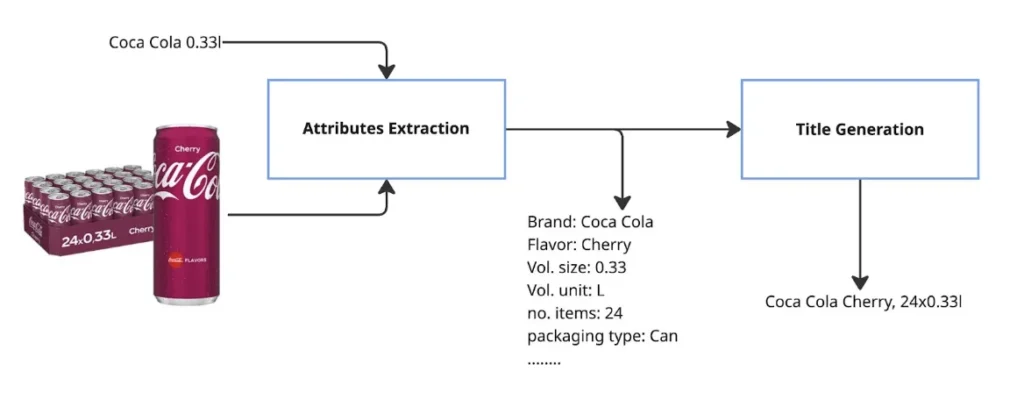
Delivery Hero uses two specialized AI agents to structure product-catalog data.
An Attribute Extraction agent analyzes vendor titles and images to identify 22 predefined attributes, while a Title Generation agent converts those attributes into standardized product names.
The implementation introduces a confidence-scoring layer that transforms model logits into probability estimates. It automatically flags low-confidence outputs for human review, establishing a controlled workflow that includes multimodal extraction, generation, validation, and escalation.
Anthropic’s multi-agent research system
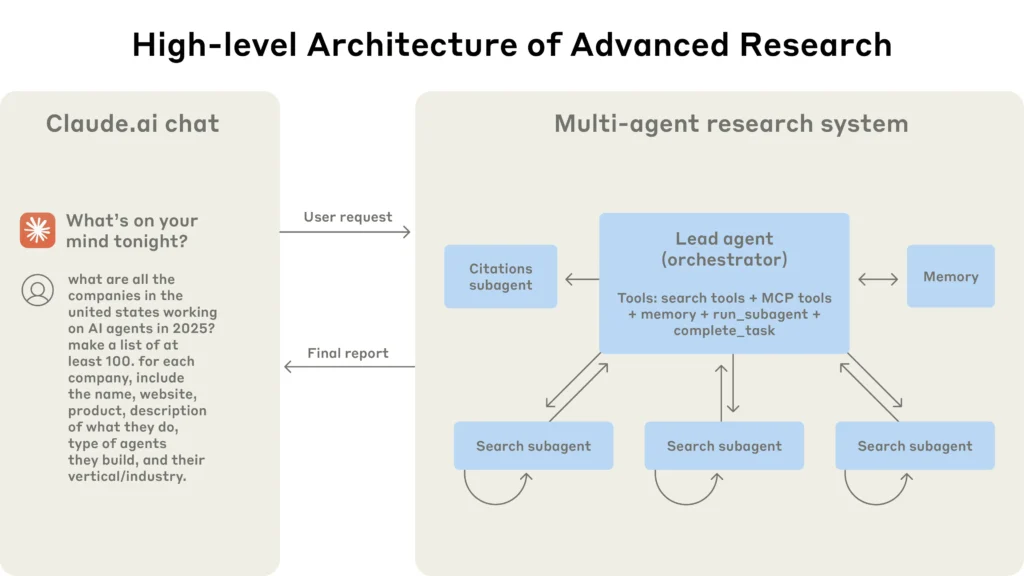
Anthropic’s Research feature uses an orchestrator-worker multi-agent system in which a lead agent decomposes a complex research request, launches parallel subagents, and assigns them different search directions.
Each worker iteratively uses web search tools, filters relevant evidence, and returns findings to the lead agent, which synthesizes the final cited response.
Anthropic evaluates the workflow using an LLM judge that scores factual accuracy, citation accuracy, completeness, source quality, and tool-use efficiency, with human review retained for edge cases.
Dropbox Dash knowledge agent
Dropbox Dash demonstrates how enterprise AI agent systems can turn a natural-language request into a multi-step knowledge-retrieval workflow.
When an employee asks for documents related to “tomorrow’s all-hands,” the agent resolves the relative date, identifies matching calendar events, searches connected workplace sources, and retrieves associated files.
It then validates the execution path and returns the relevant material, demonstrating how planning and tool orchestration enhance an AI agent’s capabilities beyond those of a conventional semantic search interface.
Salesforce Horizon text-to-SQL agent
Salesforce’s internal Horizon Agent converts employees’ natural-language questions into governed analytical queries rather than merely producing plausible answers from model memory.
The enterprise AI agent retrieves relevant business context and dataset metadata, enriches the user’s request, generates and executes appropriate SQL, and returns the result with an explanation and supporting context.
Its conversational state also allows employees to refine follow-up questions without rebuilding the analytical query from the beginning.
Intercom Fin Voice customer-service agent
Intercom’s Fin Voice is a production customer-service AI agent that integrates automatic speech recognition, language models, retrieval-augmented generation, text-to-speech, and telephony into one real-time support workflow.
During a call, the system transcribes the customer’s speech, retrieves relevant support knowledge, generates and vocalizes an answer, preserves conversational context, and transfers the case to a human representative when necessary. Its architecture must simultaneously manage latency, voice quality, retrieval accuracy, and escalation timing.
Conclusion
AI agents are goal-directed systems that observe context, plan, use tools, evaluate results, and continue or escalate within bounded authority. They fit variable, multi-step workflows where outcomes can be checked; they are unnecessary when deterministic automation already provides a reliable path. Start with one measurable and reversible workflow, define completion criteria and permissions, test realistic failures and require approval at high-risk steps. Increase autonomy only after evaluation data shows that the agent can complete the work reliably, safely and at an acceptable cost.
Frequently asked questions about AI agents
What are AI agents?
AI agents are software systems that pursue goals through a loop of observation, decision, action and feedback. They can use models, memory and external tools to complete multi-step work within permissions set by people. This plural definition is useful when discussing a category of systems rather than one AI agent.
What is an AI agent?
An AI agent is a goal-directed software system that interprets context, chooses a next action, uses an approved tool or interface, and checks the result. A one-shot model response is not enough; an agent maintains task progress and can continue, stop, or escalate according to completion rules.
What is an artificial intelligence agent?
An artificial intelligence agent is a program that perceives an environment and selects actions toward an objective. Modern agents often use an LLM for language and reasoning, but the system also needs state, tools, permissions, and an execution loop. The full phrase is equivalent to the shorter term AI agent.
How do AI agents work?
AI agents work by receiving a goal, observing current context, planning a step, retrieving relevant information, calling a tool, validating the result, and repeating until the task is complete or requires escalation. Production agents usually combine model-based decisions with deterministic controls, budgets, and approval gates.
What are the types of AI agents?
The main classical types of AI agents are simple reflex, model-based, goal-based, utility-based, and learning agents. Modern practical categories include workflow, tool-using LLM, coding, computer-use, voice, embodied, and multi-agent systems. These categories overlap, so one agent can belong to several types.
What does agent in artificial intelligence mean?
An agent in artificial intelligence is an entity that observes its environment and takes actions to achieve a goal. Intelligent agents differ in how much state, planning, utility optimization, and learning they use. LLM-based agents are a modern implementation of this older AI concept rather than a completely new category.
What does “AI agents explained” mean for beginners?
AI agents explained simply are systems that can do more than answer: they can decide what step comes next, use tools, see what happened, and continue toward an outcome. The safest mental model is a bounded digital operator with a goal, a limited workspace, and clear rules for when to stop or ask for help.
How are AI agents for business used?
AI agents for business coordinate multi-step work across systems such as CRM, ERP, ticketing, knowledge and analytics platforms. Good use cases include case resolution, code maintenance, research, reconciliation and alert triage. Business value should be measured through cycle time, success rate, exceptions, risk and total operating cost.
How are AI agents for automation different from RPA?
AI agents for automation can adapt when inputs, language, or paths vary, while RPA and deterministic workflows follow predefined rules. Use an agent for bounded decisions and exceptions; use traditional automation for stable, repeatable steps. Many production systems combine an agentic decision layer with deterministic execution and approval controls.
What does AI agent development involve?
AI agent development involves defining a measurable outcome, choosing a model, designing retrieval and state, exposing tightly scoped tools, selecting an orchestration pattern, adding permissions and guardrails, building end-to-end evals and monitoring production traces. The difficult work is usually integration, control, and evaluation rather than the initial prompt.
How to make AI agents?
To build AI agents, start with a single bounded workflow and define explicit success and stop conditions. Add only the context and tools the task requires, validate every side effect, enforce least privilege, test normal and adversarial scenarios, and deploy first in recommendation or shadow mode before allowing independent actions.
Are intelligent agents the same as AI agents?
Intelligent agents are the broader academic term for systems that perceive and act toward goals. AI agents is the common modern term, often referring to LLM-enabled software that plans and uses tools. Classical agents do not require an LLM; reflex controllers, utility-based planners, and learning systems can also be intelligent agents.
Is ChatGPT an AI agent?
ChatGPT can function as a chatbot or as an agentic system, depending on the mode and tools used. As of July 2026, OpenAI describes ChatGPT Work and workspace agents as agents that can complete longer tasks across apps and files. Ordinary conversational use remains more reactive and does not make every chat an autonomous agent.[14]
Do AI agents need large language models?
No. Classical AI agents can use rules, planning, search, control systems, or reinforcement learning without an LLM. Many modern agents use large language models because they handle unstructured language, flexible planning and tool selection, but the surrounding architecture still provides state, permissions, execution and verification.
What is a multi-agent system?
A multi-agent system contains several agents that coordinate, delegate, compete, or review work in a shared environment. Specialization and parallelism can help with complex tasks, but the design adds routing, communication, consistency, security, and cost problems. Use multiple agents only when they outperform a simpler single-agent workflow.
What is the difference between AI agents and agentic AI?
An AI agent is one goal-directed software entity. Agentic AI is the broader system pattern that may include multiple agents, orchestration, tools, shared state, governance and human approval. Industry usage is inconsistent, so architecture and authority should be described explicitly instead of relying on the label.
How autonomous are AI agents?
AI-agent autonomy ranges from recommendations to gated actions and broader delegated execution. The appropriate level depends on impact, reversibility, evidence quality, permissions, and the available fallback. A reliable design starts with minimum necessary autonomy and expands only after evaluations show safe and consistent performance.
Can AI agents make mistakes?
Yes. AI agents can misinterpret a goal, use stale context, choose the wrong tool, submit invalid parameters, enter loops or follow malicious instructions embedded in external data. Controls include least privilege, validation, approvals, budgets, logging, adversarial testing, rollback, and clear ownership for incidents.
How do AI agents use MCP?
Compatible AI agents can use the Model Context Protocol to discover contextual resources and tools exposed by MCP servers through a standardized interface. MCP simplifies integration, but the host application must still enforce authentication, authorization, user consent, tool scope, argument validation, logging, and protection against untrusted content.[8]
Reference Links
- Stuart Russell and Peter Norvig – Artificial Intelligence: A Modern Approach, 4th edition
- Yao et al. – ReAct: Synergizing Reasoning and Acting in Language Models
- Schick et al. – Toolformer: Language Models Can Teach Themselves to Use Tools
- Shinn et al. – Reflexion: Language Agents with Verbal Reinforcement Learning
- Model Context Protocol – Specification, version 2025-11-25
- NIST – AI Risk Management Framework and Generative AI Profile
- NIST – Strengthening AI Agent Hijacking Evaluations
- Liu et al. – AgentBench: Evaluating LLMs as Agents
- Debenedetti et al. – AgentDojo: Evaluating Prompt Injection Attacks and Defenses for LLM Agents
- OpenAI – ChatGPT Work and workspace agents (July 2026)