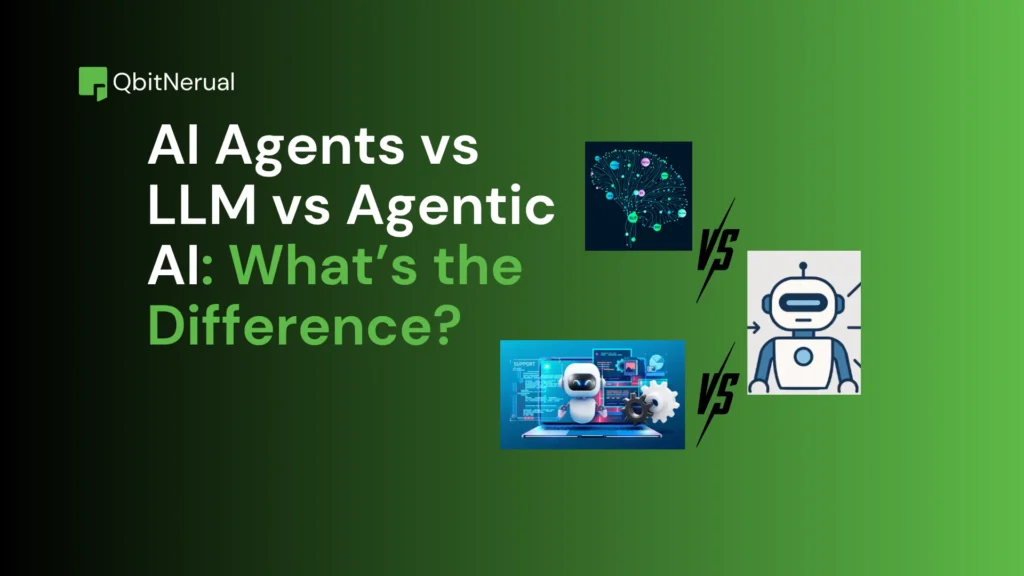
An LLM (Large Language Model) is a model that generates or transforms information. An AI agent is a software system that uses a language model, tools, state, and a control loop to pursue a goal. Agentic AI is the design approach in which one or more agents plan and act with bounded autonomy.
Choosing the correct architectural layer is crucial, as engineering teams misjudge the AI agent vs LLM difference. A direct model call may be enough for data extraction or text summarization, while a variable workflow demands tools, persistent task state, validation, and action.
Implementing an overly complex layer adds latency, cost, and failure modes, and underbuilding leaves people manually orchestrating the processes the system was meant to automate.
Similarly, the agentic AI vs LLM comparison is architectural. A model produces an output from the context it is provided. On the other hand, an agentic application manages an operational path. It decides what information to retrieve, which actions to take, how to evaluate results, and when to finalize the task or escalate to a human operator.
This guide will compare AI agents vs LLMs and agentic AI vs LLM layers, explain the missing middle in grounded LLM workflows, and provide a framework for choosing the right design for your requirements.
TL;DR
Don’t have a few minutes? Here’s the quick version:
- An LLM predicts and generates content from a supplied context window. It does not inherently have a goal, persistent state, or permission to affect external systems.
- An AI agent is a goal-directed application that combines a model with tool use, memory and state, instructions, an execution loop, and completion or escalation rules.
- Agentic AI describes a broader architecture or operating pattern for adaptive, goal-directed action. A single agent can be agentic; a multi-agent system is optional.
- Use a direct model call for bounded generation. Add retrieval-augmented generation (RAG) or deterministic workflow logic when the data changes but the path is known. Use an agent when the path itself must adapt.
- Choose the least autonomous design that can reliably complete the task. Add authority only when dynamic decisions and action create measurable value.
What are LLMs, AI agents, and agentic AI?
These terms overlap in practice, so let’s define them first before comparing them.
What is an LLM?
An LLM is a deep learning model trained on large datasets to process and generate language and other content. Most modern LLMs use transformer architectures and predict the most likely next tokens from the prompt, instructions, conversation, and other information within the context window.
It can summarize documents, extract fields, classify requests, draft code, translate text, and produce structured outputs. The model itself does not inherently own a business goal, retain durable task progress, possess credentials, call enterprise systems, or verify that an external action succeeded.
LLMs are used as a foundation model for many downstream applications. Applications can add retrieval, conversation history, tools, and storage around the model, but those capabilities belong to the application architecture rather than the base model.
What is an AI agent?
An AI agent is software that pursues a defined outcome by observing context, selecting a next step, using approved capabilities, and checking the result. Modern agents often use an LLM, but the concept predates LLMs; rule-based, search, robotic, and reinforcement-learning agents can also operate without language models.
A practical AI agent architecture includes a model, instructions, task context, memory and state, a planner or control loop, tools, permissions, guardrails, and observability.
An agent shows goal-directed behavior, where it can plan, revise after receiving tool output, and stop when a goal is met. For example, a paper ReAct formalized an iterative pattern that interleaves model decisions with actions and observations from an environment.
What is agentic AI?
Agentic AI is a system-level design pattern in which AI components pursue outcomes through reasoning and planning, task decomposition, tools, state, and iterative control. An agentic system contains one capable agent, several specialized agents, deterministic workflow steps, software services, and human approval points.
AI agent vs LLM: What is the key difference?
The key difference in AI agent vs LLM is that an LLM returns a model output, while an AI agent uses model outputs inside a system that can choose tools, preserve task state, take actions, inspect results, and continue until it reaches a stopping condition or escalation point.
Here is the key difference table comparing agent vs LLM:
| Dimension | LLM | AI agent |
|---|---|---|
| Nature | A trained model invoked by an application | An application or runtime that may use one or more models |
| Trigger | Prompt or API request | Goal, event, schedule, message, or upstream workflow |
| Control flow | Usually one request and response | Iterative loop or explicit state graph |
| Tools | Not inherently available | Selects from approved tools and interfaces |
| State | Uses supplied input and context window | Maintains task progress, prior actions, and external state |
| Planning | Can propose a plan | Can execute and revise a plan within controls |
| Output | Generated content or structured data | Verified result, system change, handoff, or escalation |
| Recovery | Application must retry or repair | Can inspect failures and choose an allowed recovery path |
| Oversight | Content review | Permissions, checkpoints, action validation, and audit logs |
| Cost and latency | Usually one or a few model calls | Multiple calls, tool executions, storage, and tracing |
| Primary risk | Plausible but incorrect output | A wrong decision becoming an external action |
Agentic AI vs LLM: How do they differ?
In agentic AI vs LLM, an LLM generates or transforms information, while agentic AI uses models, tools, state, orchestration, and feedback to pursue outcomes across multiple steps.
Here is the key difference table comparing LLM vs agentic AI:
| Comparison | LLM | Agentic AI |
|---|---|---|
| Primary purpose | Generate, analyze, classify, or transform content | Pursue an operational outcome |
| Execution pattern | Prompt → response | Observe → decide → act → verify → continue or escalate |
| State | Model input for the current call | Task, user, system, and workflow state across calls |
| Integration | Invoked by an application | Coordinates models, APIs, data, workflows, and people |
| Risk type | Content error | Content error plus action, permission, and coordination risk |
| Governance | Input/output controls | Least privilege, approvals, tracing, rollback, and escalation |
AI agent vs agentic AI: Are they the same?
AI agents and agentic AI are related but not identical. An AI agent is usually one goal-based software entity or role. Agentic AI is an architecture that includes orchestration, shared state, governance, and sometimes multiple agents working together.
A single well-designed agent can exhibit agentic behavior. Multiple agents are useful only when specialization, parallel work, independent review, or separate permission boundaries improve the outcome. Otherwise, extra agents add routing errors, handoff failures, duplicated work, cost, and debugging complexity. Our AI agent routing guide explains when routing and orchestration are justified.
Here is the key difference table comparing AI agent vs agentic AI:
| Dimension | AI agent | Agentic AI |
|---|---|---|
| Unit | One agent, role, or runtime | An end-to-end architecture or operating pattern |
| Scope | A bounded goal and tool set | A broader business or technical outcome |
| Example | An agent that verifies refund eligibility | A refund operation coordinating policy, fraud, billing, CRM, messaging, and escalation |
| Evaluation level | Task success, tool reliability, safe behavior | End-to-end outcome, handoffs, shared state, cost, and governance |
| Governance level | Permissions and controls for one agent | System-wide identity, routing, approvals, logging, and recovery |
| Multiple agents required? | No | No; a multi-agent system is one optional design |
How do LLMs, AI agents, and agentic AI fit together?
The LLM supplies language understanding and model outputs. A grounded application adds private or current data, rules, and interfaces. An agent adds goal-directed control, tools, state, and an execution loop. Agentic AI governs overall outcomes, the boundaries of autonomy, and system coordination.
Simplistic AI agents vs LLM comparisons often overlook the second layer. Retrieval-augmented generation (RAG) merges a parametric model with retrieved non-parametric memory to supply external evidence for knowledge-intensive tasks. A RAG assistant answers from enterprise documents without deciding subsequent business actions.
Deterministic LLM workflows use tool use and API integration to classify requests, retrieve records, and generate responses through a predictable path. This design excels when the workflow is stable and exceptions are well-defined.
Agents are required when paths cannot be hard-coded. They handle task decomposition, choose information sources, and adapt to tool failures. Similarly, agentic RAG lets the system autonomously decide what to search and when to iterate, meaning not every RAG pipeline is an agent.
The broader agentic system adds workflow orchestration, identity, permissions, budgets, and governance, blending deterministic and model-directed steps. Use the lowest architectural layer that meets your requirements for outcome and reliability.
When should you use an LLM, an AI agent, or agentic AI?
Use an LLM for a bounded generation or analysis step. Add RAG or deterministic workflow logic when the task needs current or private data but the path is known. Use an AI agent when the system must choose and execute several context-dependent actions. Use broader agentic architecture only when adaptive coordination creates enough value to justify added cost, latency, and risk.
Here is the table that helps you decide when to use an LLM, an AI agent, or agentic AI and why:
| Task | Recommended architecture | Why |
|---|---|---|
| Summarize a report | Direct LLM call | One bounded transformation; no external action |
| Answer employee policy questions | RAG assistant | Needs approved, current documents; path remains simple |
| Extract invoice fields and validate totals | Deterministic LLM workflow | Model handles unstructured input; code enforces calculations and schema |
| Repair a software bug | AI agent | Requires repository inspection, edits, tests, and iteration from failures |
| Resolve a routine support case | AI agent with approval thresholds | Needs account data, policy checks, system updates, and measurable completion |
| Conduct multi-source research | Agent or orchestrator-worker workflow | Search direction and evidence requirements change during the task |
| Approve a high-value payment | Human-led decision with AI support | Impact is high; AI can retrieve and analyze but should not own final authority |
| Coordinate procurement across systems | Governed agentic architecture | Requires shared state, approvals, supplier data, ERP actions, and exception handling |
Do not use an agent when:
- A deterministic rule or standard automation can complete the task reliably.
- The work is a one-step transformation such as rewriting, translation, extraction, or classification.
- The system cannot verify the result’s correctness before a high-impact action.
- The required latency budget cannot tolerate several model and tool calls.
- The available credentials are broader than the task requires, or the action cannot be reversed.
- The objective is ambiguous, and no one can define success, constraints, or escalation rules.
What are the trade-offs and risks of LLMs and agentic systems?
More autonomy increases capability but also expands the failure surface. A model can produce an incorrect answer, an agent can convert that answer into a sequence of tool calls or system changes. Production design must scale permissions, evaluation, observability, and human review with the impact of the action.
- Hallucination or weak reasoning: Unsupported facts, invalid assumptions, or flawed plans require grounding, structured outputs, validators, task-specific evaluations, and safe fallbacks.
- Compounding errors: One incorrect step can affect every later decision, so agent workflows need step limits, checkpoints, independent validation, and explicit stop conditions.
- Prompt injection: Untrusted content may try to override instructions or redirect tools, making input sanitization, instruction-data separation, constrained tools, and external policy enforcement essential.
- Tool misuse: An agent may select the wrong function, submit invalid arguments, repeat an operation, or trigger an unsafe side effect, so tools need typed schemas, allowlists, validation, idempotency, and simulation.
- Excessive permissions: Broad access increases the damage an agent can cause, which makes least-privilege credentials, scoped identities, per-tool authorization, and short-lived tokens necessary.
- Data exposure: Sensitive information may be retrieved, logged, or shared with an unauthorized component unless the system uses permission-aware retrieval, data minimization, isolation, redaction, and retention controls.
- Latency and cost: Long reasoning loops, repeated retrieval, and unnecessary model calls can increase response time and infrastructure cost, requiring budgets, caching, model routing, timeouts, and maximum step counts.
- Poor debuggability: A final answer may hide where the execution path failed, so production systems need complete traces, versioned prompts and tools, replay capabilities, and labeled failure analysis.
- Irreversible actions: Errors involving payments, legal decisions, safety, or customer accounts require approval gates, transaction limits, rollback mechanisms, dual control, and human escalation.
What are the most common misconceptions?
The most common mistake is treating an LLM, an AI agent, and agentic AI as a linear maturity ladder. They describe different layers or design properties. A larger or more autonomous system is not automatically more accurate, efficient, or appropriate for the task.
Myth 1: Every AI agent is an LLM.
Classical agents, rules engines, planners, reinforcement-learning systems, and robots can operate without language models. Modern LLM agents are one implementation category. The LLM handles language and flexible decisions, the agent architecture supplies goals, state, tools, and environment interaction.
Myth 2: LLMs have no memory.
A base model does not retain persistent task or user memory between independent calls. An application can supply conversation history, retrieved records, cached summaries, or durable storage. The important distinction is model context versus application-managed memory and state.
Myth 3: Agentic AI always means multiple agents.
A single agent can plan, use tools, evaluate results, and adapt within constraints. A multi-agent system is an architectural option for specialization or parallelism, not the definition of agency. Use it only when it improves measurable outcomes.
Myth 4: Agents learn automatically after deployment.
A runtime feedback loop can change the next action during a task, but durable learning requires an explicit process. That may include curated memory, reviewed policy updates, fine-tuning, reinforcement learning, or software changes. Unreviewed self-modification is not a default feature of production agents.
Myth 5: More autonomy is always better.
Autonomy is useful when it removes costly coordination from variable work. It is harmful when the workflow is deterministic, success cannot be verified, permissions are excessive, or errors are irreversible. The objective is not maximum autonomy; it is reliable completion with the minimum authority required.
Conclusion: Choose the layer, then bound the autonomy
LLMs, AI agents, and agentic AI are complementary layers. The AI agent vs LLM question separates a model output from a goal-directed system, while agentic AI vs LLM separates a model from an end-to-end operating pattern. Start with the outcome, choose the simplest architecture that can achieve it, and add retrieval, tools, memory and state, and autonomy only when the workflow requires them. The stronger the system’s ability to act, the stronger its permissions, evaluation, monitoring, rollback, and human escalation must be.
Frequently asked questions
What is the difference between an AI agent and an LLM?
An LLM is a model that produces text, code, classifications, or structured outputs from supplied context. An AI agent is a software system that uses a model or other decision logic within a loop that can maintain task state, select tools, take actions, inspect results, and stop or escalate. This is the core difference between an LLM and AI agent.
What is the difference between agentic AI and an LLM?
An LLM is one model component. Agentic AI is a broader architecture for pursuing an outcome through models, tools, state, planning, action, and feedback. In LLM vs agentic AI, the comparison is therefore model versus system: the model generates a decision or response, while the system manages what happens before and after it.
Are AI agents and agentic AI the same?
They overlap, but the terms are not always identical. An AI agent usually refers to one goal-directed software entity or role. Agentic AI is a degree of agency, which can include one agent, deterministic workflows, several agents, shared state, governance, and human approval. Industry usage varies, so document capabilities rather than relying only on labels.
Can an AI agent work without an LLM?
Yes. Intelligent agents existed before modern LLMs and can use rules, search, planning algorithms, reinforcement learning, control systems, or other models. LLMs are useful when the agent must interpret natural language, reason over unstructured information, or select tools flexibly, but they are not a universal requirement.
Is ChatGPT an LLM or an AI agent?
ChatGPT is an application powered by language models, not a single LLM. Its behavior depends on the feature and configuration. A basic chat interaction resembles an LLM application, while tool-enabled features can search, run code, use connected data, or take actions.
Is RAG an AI agent?
Retrieval-augmented generation (RAG) is not automatically an AI agent. A standard RAG pipeline follows a known path: retrieve relevant passages, place them in context, and generate an answer. It becomes more agent-like when the system dynamically decides what to retrieve, uses several sources, evaluates evidence sufficiency, repeats searches, or chooses downstream actions.
What is an LLM agent?
An LLM agent is an AI agent that uses a large language model as its main interpretation, planning, or decision component. The surrounding system adds instructions, tools, task state, permissions, execution logic, and validation. The LLM supplies flexible language and reasoning capabilities; the agent runtime controls what the model can access and do.
Do AI agents have memory?
AI agents can have short-term task state, conversation history, retrieved context, or durable memory, but these are application features rather than inherent properties of the LLM. Good designs separate temporary task state from long-term storage, restrict access by user and purpose, define retention limits, and provide correction or deletion mechanisms.
Does agentic AI require multiple agents?
No. A single agent can exhibit goal-directed behavior, use tools, adapt from observations, and operate with bounded authority. Multiple agents are useful when the task benefits from specialization, parallel execution, independent review, or separate permission domains. They should not be added merely to make an architecture appear more advanced.
When is a direct LLM call better than an AI agent?
A direct LLM call is better when the task is bounded, one-step, and does not require dynamic external action. Examples include summarization, rewriting, extraction, classification, and drafting. It is usually faster, cheaper, easier to test, and easier to secure. Add an agent only when variable multi-step decisions create enough value to justify the extra complexity.
What is an AI agent vs LLM?
What is an AI agent vs LLM asks whether the solution is a model or a system. An LLM generates an output from context. An AI agent uses a model, tools, state, and a control loop to pursue a goal and verify progress. The two are complementary: an LLM often powers the agent, while the agent supplies operational capability.
Which is better: agent vs LLM?
Neither is universally better. In agent vs LLM, choose the LLM for bounded generation or analysis and choose an agent for variable, multi-step work that needs tools, state, and verifiable actions. The best architecture is the simplest one that can reliably meet the task’s outcome, latency, cost, safety, and governance requirements.
Sources and further reading
- IBM — What Are Large Language Models?
- Google Cloud — What Are AI Agents?
- Google Cloud — Core Concepts of AI Agents
- Google Cloud — What Is Agentic AI?
- OpenAI — A Practical Guide to Building AI Agents
- Anthropic — Building Effective Agents
- Lewis et al. — Retrieval-Augmented Generation for Knowledge-Intensive NLP Tasks
- Yao et al. — ReAct: Synergizing Reasoning and Acting in Language Models
- Anthropic — Demystifying Evals for AI Agents
- NIST — AI Risk Management Framework: Generative AI Profile
- OWASP — LLM01: Prompt Injection
- OWASP — Agentic AI Threats and Mitigations
- OpenAI — ChatGPT Work