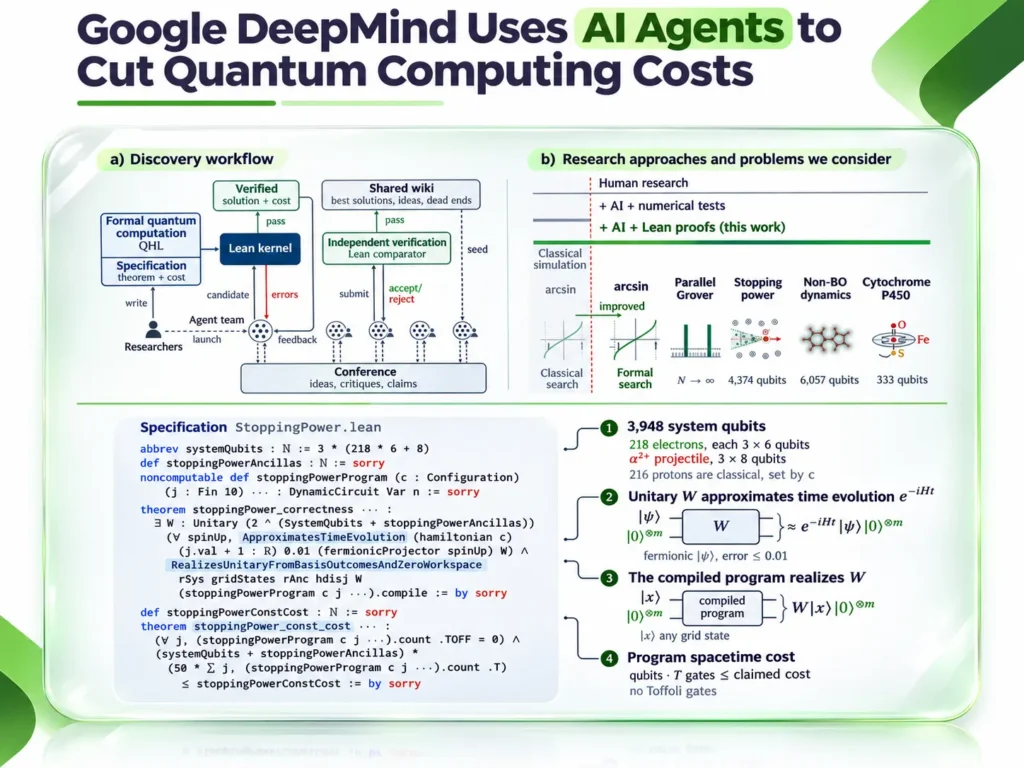
Google DeepMind and Google Quantum AI researchers have announced a new method that uses AI agents and formal verification to reduce the resource needs of quantum algorithms.
Google DeepMind team reports machine-checked programs with up to 290× lower qubit gate cost for one benchmark and roughly 11×, 8×, and 2.5× reductions for three scientific simulations. Their method uses a large language model search with the Lean 4 theorem prover to jointly synthesize and verify quantum circuits.
These savings are estimates, not results from running the algorithms on quantum computers. Still, they show how formal proofs could help improve algorithms in ways that classical computer simulations cannot.
What Did Google’s Team Demonstrate?
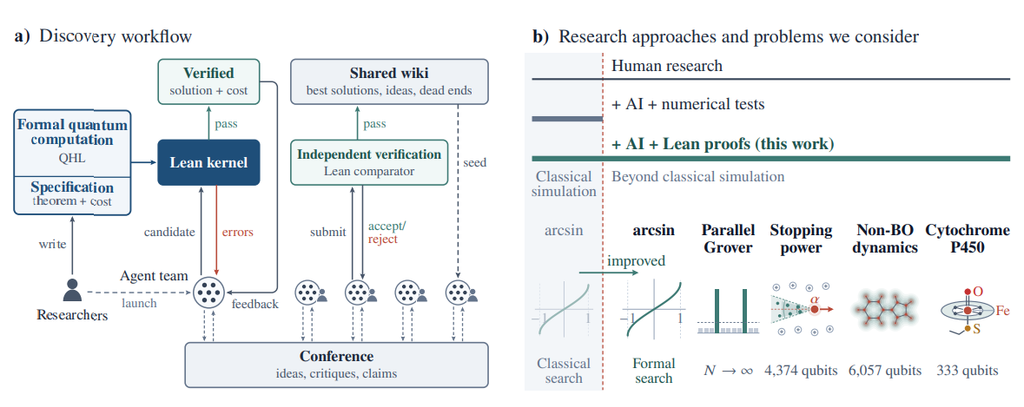
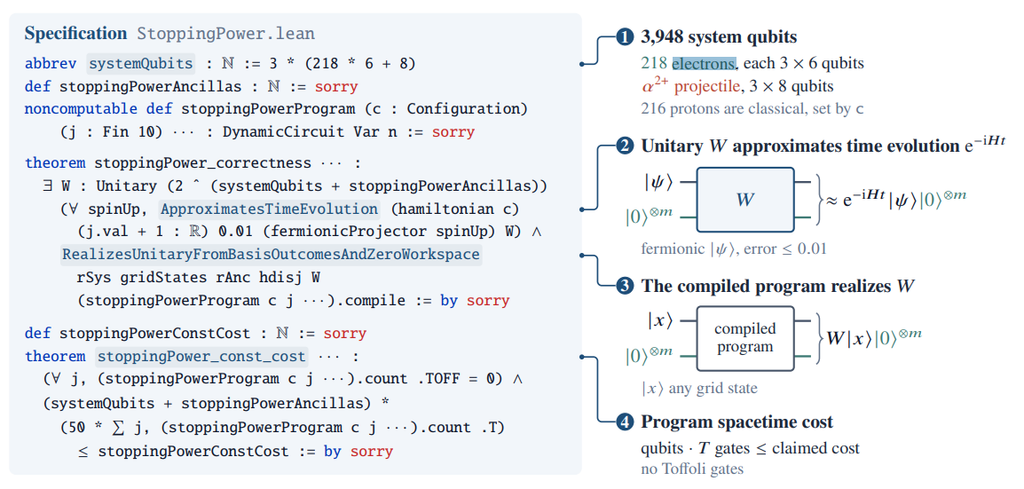
The researchers built a formal quantum programming framework in the Lean 4 theorem prover, encoding problems as “Hoare logic” specifications of correctness and resource cost. They launched autonomous AI agents (based on Google’s Gemini 4) to propose new quantum circuits that meet these specs. Each candidate solution came with a machine-checked proof of both correctness and its resource use (measured by logical qubits × T gates).
Failed proofs generate error feedback, allowing agents to refine their programs iteratively. This workflow enabled discovery of new algorithms that are mathematically verified against the problem description, even for problem sizes too large to simulate classically. An independent verifier double-checks every proof to ensure agents didn’t “cheat” by weakening the task or assumptions. Agent teams share ideas via a common wiki and regular virtual conferences, combining concepts and code across subteams.
How Much Did AI Reduce Resource Costs?
The study reports verified resource reductions in five problems (see table below). Resource cost is measured by Q·T, the product of logical qubits Q and non-Clifford T gates T (a standard metric for fault-tolerant quantum computing).
| Application | Verified Resource Improvement |
| Arcsine (quantum arithmetic) | 290× (Q·T reduced from 1.08×10^8 to 3.70×10^5) |
| Fusion simulation (stopping power) | 10.9× |
| Molecular photochemistry (C₂₃H₂₀N₃O) | 8.08× |
| Drug-metabolism (Cytochrome P450) | 2.49× |
| Unstructured Grover search (parallel) | up to 2.55× (expected oracle rounds) |
For example, the AI-generated program for a 25-bit fixed-point arcsine state preparation used 100 logical qubits and 3,698 T gates, yielding a >290× lower Q·T cost than the previous best-known construction.
In fusion physics (one alpha particle + 218 electrons), the improved circuit used 4,374 qubits (vs. 5,650 baseline) and cut Q·T by 10.9×. In the photochemistry task (187 electrons, 47 nuclei), resources fell by ~8.08×.
For the Cytochrome P450 enzyme model, costs were 2.49× lower. (Parallel Grover search saw only modest gains, up to 1.4× fewer oracle rounds.)
Each reduction is measured against a result from the literature baseline. In all cases, the agents started with the best published algorithm and found a version that was proven to use fewer resources under the stated cost model. But these improvements apply to specific problems and use formal cost metrics. For instance, the 290× improvement applies only to the arcsine routine
Why Does Formal Verification Matter?
Testing quantum programs by simulation is limited to very small circuits. The Lean-based approach gets around this by using mathematical proofs instead. Agents search through many possible circuits. For each one, they use Lean to prove that it works correctly and stays within the allowed cost. This makes it possible to explore ideas that are too large to test with ordinary simulation.
The cost measure Q×T estimates the extra resources needed to correct errors in a fault-tolerant quantum computer. It combines the number of logical qubits with the number of costly T gates. By proving reductions in this measure, the team’s work identifies algorithmic shortcuts that could lower the future hardware requirements for chemistry, fusion, and other applications.
The important point is that every program the system finds comes with a Lean proof showing that it works as intended and meets the stated cost limit. If the proof fails, it reveals a problem and helps the AI try another approach.
This is important as quantum problems grow larger: without a proof, an AI could produce a shorter circuit that gives the wrong answer. Combining search with proof lets the AI suggest and check ideas that would be difficult for people to verify by hand.
Remaining Challenges
Even with these major improvements, practical quantum advantage is still a long way off. Each of the four scientific tests needs far more qubits and operations than the first fault-tolerant quantum computers, expected within the next decade, are likely to have.
The paper says the verified programs need several million times more operations than the roughly one million operations expected from early error-corrected machines. In other words, the algorithms now look much more efficient on paper, but current and near-term hardware cannot run them yet.
Also, proving that a program uses a certain amount of computing power does not show how well it will work in practice. The Lean proofs assume perfect quantum gates. They do not account for errors, the extra work needed to connect qubits, or limits on how qubits can be connected in real machines. A real quantum speedup will still require larger, more reliable processors and the extra resources needed for error correction.
Meanwhile, this work is best seen as an important step in building the tools and methods for quantum computing. It shows that AI and mathematical proof tools can help design quantum algorithms in ways people have not yet achieved on their own. Whether these AI-designed circuits lead to a real quantum advantage will depend on better hardware and further advances in algorithms.