
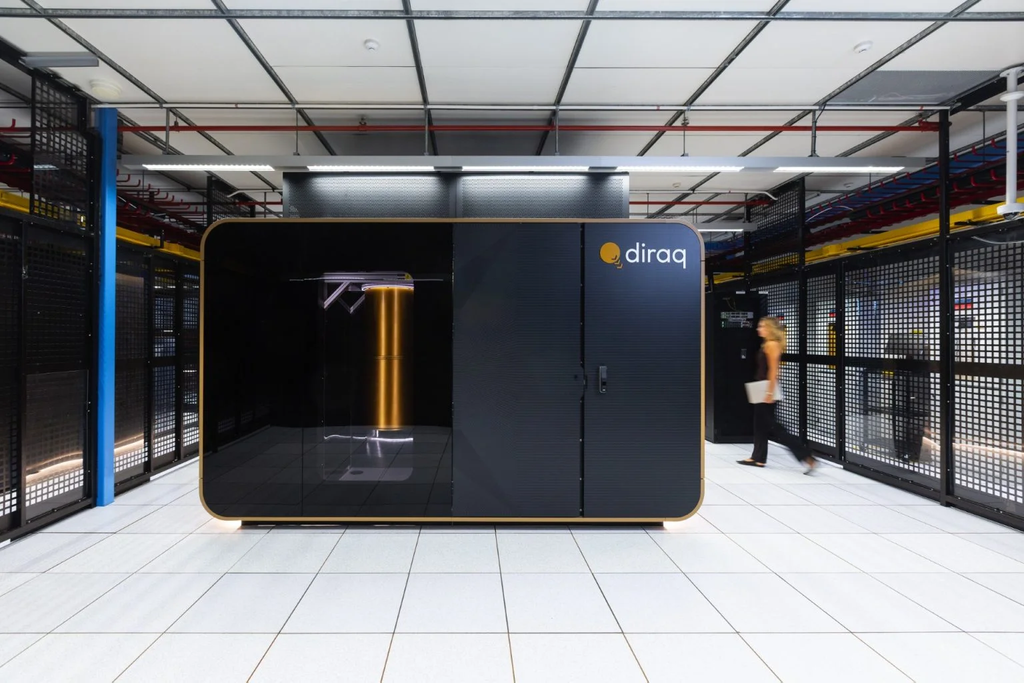
Quantum computing startup Diraq has installed an eight-qubit silicon spin quantum computer inside Equinix’s SY3 commercial data center in Sydney. The machine draws less than 20 kilowatts of power and occupies about 172 square feet. It is the first silicon spin quantum computer to run in a shared commercial data center.
The deployment matters because quantum hardware usually depends on highly controlled research environments. Diraq now wants to show that silicon spin systems can operate alongside conventional computing infrastructure without forcing data centers to undergo major redesigns.
What Did Diraq Deploy at Equinix’s Sydney Data Center?
The Diraq Equinix quantum computer currently runs an eight-qubit silicon spin processor. The system includes its own cryogenic cooling and control electronics. This allows the full machine to operate inside the Equinix facility alongside standard servers.
The current installation uses about 172 square feet of floor space. Diraq plans to increase the system to as many as 256 qubits within the next year while keeping the same surrounding infrastructure.
Capital Brief reports that Diraq will first use the system for internal validation and performance testing to confirm that its quantum chip performs in the data center as reliably as it does in the company’s UNSW laboratory.
Why Silicon Spin Qubits Could Make Quantum Computing More Scalable
Silicon spin qubits store quantum information in the spin state of electrons confined inside semiconductor structures. Like other solid-state quantum systems, they require cryogenic temperatures, but their main attraction is manufacturing. Diraq builds its qubits using silicon CMOS-compatible processes similar to those used in conventional semiconductor fabrication.
That approach could give silicon spin systems a practical scaling advantage if manufacturers can produce large, reliable qubit arrays with established semiconductor tools. Diraq has already demonstrated coherent operation of an eight-qubit array fabricated using a 300 mm CMOS-compatible process.
The infrastructure requirements also differ across quantum architectures. Superconducting processors rely on cryogenic electronic circuits, while trapped-ion systems hold charged atoms inside vacuum chambers and control them with electromagnetic fields and lasers. Silicon spin systems remain cryogenic, but Diraq’s strategy is to concentrate more of the scaling challenge on the chip rather than expanding the surrounding facility.
How Does Diraq’s Quantum Computer Fit Inside a Commercial Data Center?
The Sydney system shows Diraq’s vision of quantum processors to sit beside CPUs, GPUs, cloud systems, and high-performance computing infrastructure.
Equinix and Diraq originally designed the deployment to test open network connectivity, remote monitoring, secure integration, and links between the quantum system and classical processors. Those capabilities will become important if future quantum machines operate as accelerators.
Diraq projects a future utility-scale system could use about 300 kW. It says stable power and footprint as qubit counts grow could ease scaling, though these figures remain projections,
What’s Next for Diraq’s Quantum Computing Roadmap?
Diraq is targeting up to 256 qubits in the deployed Sydney system within the next year. Its longer roadmap calls for 150,000 qubits by 2029 and more than two million physical qubits on a single chip by 2031. Those targets have not yet been demonstrated.
The company also reached Stage C of DARPA’s Quantum Benchmarking Initiative in October 2026. DARPA describes Stage C as a verification and validation phase in which government teams examine whether proposed utility-scale quantum systems can actually be constructed and operated as designed. Diraq is one of six companies currently listed in Stage C.
Separately, the U.S. Department of Commerce announced planned CHIPS incentives of up to $38 million for Diraq to develop and scale silicon spin quantum logic units and manufacturing capabilities.
Diraq also released its Quantum at Work report alongside the deployment. Its modeling suggests that improving drug-development success rates by 10 percentage points could reduce the cost of developing a medicine by more than $600 million.
Does This Deployment Mean Commercial Quantum Computing Is Here?
Not yet. Diraq can operate a silicon spin quantum computer inside a commercial data center. It does not show that an eight-qubit machine can outperform classical computers on commercially useful problems.
The next tests will involve reliability, gate fidelity, error rates, control systems, scalability, and eventually fault-tolerant operation. DARPA’s Stage C process is specifically designed to test whether roadmaps toward utility-scale quantum computing hold up under independent technical scrutiny.
For now, the Equinix deployment is best viewed as an infrastructure milestone. Diraq has moved silicon spin quantum hardware out of the lab and into the type of environment where future quantum systems may eventually need to operate. Whether that architecture can scale from eight qubits to commercially useful machines remains the much larger question.