Enterprises are increasing the use of AI agents, averaging 12 per organization, with most or all teams and business functions integrating them according to Salesforce’s 2026 Connectivity Report. The number of deployed agents is projected to increase by 67% by 2027, highlighting the need for businesses to identify governable agentic AI use cases rather than deploying agents without clear objectives.
Agentic AI use cases are business workflows in which AI agents pursue a goal, plan multiple steps, use enterprise tools and data, take actions, check results, and adapt with limited human input. Common agentic AI use cases include customer service resolution, sales follow-up, financial operations, cybersecurity response, software development, procurement, supply-chain planning, and autonomous shopping.
This guide explains more than 100 agentic AI use cases and real-world examples across industries and business functions. Each section includes practical applications, enterprise case studies, implementation considerations, and measurable outcomes.
TL;DR
- Agentic AI refers to autonomous AI systems that can plan, make decisions, use tools, and complete multi-step tasks with limited human input.
- The most valuable agentic AI use cases automate complex workflows across customer service, sales, marketing, finance, healthcare, cybersecurity, IT operations, and supply chains.
- In the agentic AI vs. generative AI comparison, generative AI primarily creates content, while agentic AI turns insights into actions and executes workflows toward defined goals.
- Real-world agentic AI examples include resolving customer support requests, qualifying sales leads, detecting security threats, processing insurance claims, and optimizing procurement decisions.
- Leading agentic AI applications help enterprises reduce repetitive work, accelerate decision-making, operate continuously, and improve employee and customer experiences.
- In marketing, AI agent use cases include audience research, campaign planning, content personalization, lead nurturing, performance monitoring, and autonomous budget optimization.
- Agentic commerce and autonomous shopping AI enable digital agents to research products, compare options, personalize recommendations, manage purchases, and support post-purchase activities.
- Businesses should begin with controlled, high-value agentic AI use cases, apply human oversight and scoped permissions, and expand autonomy only after performance and safety are validated.
- The long-term value of AI agentic systems lies in combining reasoning, workflow orchestration, enterprise data, APIs, memory, and governance to complete meaningful work at scale.
What is agentic AI?
Agentic AI is a class of AI systems that uses a large language model (LLM) as its reasoning engine to understand a goal, break it down into actionable steps, and execute those tasks with some autonomy by planning and using tools. It retains relevant state or memory, evaluates results, and adapts its next actions. People set the objective, policies, permissions, and escalation rules. The agent decides how to proceed within those boundaries.
Here are some benefits that agentic AI offers:
- Faster cycle times: AI Agents can coordinate tasks that otherwise wait in queues or move through several teams.
- More capacity without proportional headcount: Routine multi-step work can be handled continuously, allowing specialists to focus on exceptions and judgment-heavy cases.
- 24/7 operation: Customer, employee, IT, and commerce agents can respond outside business hours while preserving escalation rules.
- Shorter decision loops: AI Agents can retrieve current context, act, and verify the result in one workflow instead of producing a report that someone must translate into action.
- Connected systems: Tool-enabled agents can bridge CRM, ERP, ticketing, knowledge, analytics, and collaboration platforms.
- Consistent execution: Policies, checklists, and approved knowledge can be applied at each step, with logs that support review.
- Personalization at scale: AI Agents can tailor guidance, offers, or support using consented customer and employee context.
What are the top agentic AI use cases for business?
The top agentic AI use cases for business are workflows in which an AI agent can coordinate information, decisions, and actions across multiple systems. High-value examples include autonomously resolving customer requests, qualifying and routing sales leads, reconciling financial transactions, investigating security alerts, updating software pull requests, processing contracts, optimizing procurement decisions, and responding to supply-chain disruptions.
Businesses should prioritize workflows that are frequent, measurable, bounded, and reversible. Processes involving unrestricted financial authority, sensitive personal data, legal decisions, or irreversible actions require stricter permissions and human approval.
Agentic AI applications and use cases by industry and business function
Before going into the details of individual agentic AI use cases and examples, here is a summary table at a glance if you are short on time:
| # | Industry | Use case | Example |
|---|---|---|---|
| 1 | Customer service | Autonomous case resolution and customer request fulfillment. | OpenTable reported 70% of diner and restaurant inquiries resolved autonomously. |
| 2 | Sales | Research accounts, qualify leads, draft outreach, update CRM, and schedule follow-ups. | CentralSquare is using Agentforce to answer, qualify, triage, and route leads. |
| 3 | Marketing | Audience research, campaign creation, personalization, and performance optimization. | Incrementa reported a 40% increase in campaign reach. |
| 4 | Retail and e-commerce | Autonomous product discovery, comparison, cart creation, and checkout. | Liverpool projected a 10x ROI for its AI shopping assistant. |
| 5 | Finance and accounting | Transaction reconciliation, financial close, forecasting, and control monitoring. | Finnit reported a 90% reduction in accounting-procedure time. |
| 6 | Healthcare | Patient scheduling, access coordination, documentation, and administrative workflow automation. | IntentAI powers more than 200,000 healthcare appointments annually. |
| 7 | Insurance | Claims intake, underwriting support, policy servicing, and advisor assistance. | SIGNAL IDUNA cut escalations for complex inquiries from 27% to 3%. |
| 8 | Document processing | Document extraction, classification, validation, comparison, and routing. | Unifi built a multi-stage contract system at roughly 1/30 the cost of alternatives. |
| 9 | Human resources | Employee self-service, onboarding coordination, and HR transaction completion. | LC Waikiki reported up to 60% faster HR self-service execution. |
| 10 | Procurement | Supplier discovery, purchase-order management, approval routing, and exception handling. | LC Waikiki reported 50% fewer manual errors in procurement. |
| 11 | IT operations | Incident triage, root-cause diagnosis, service fulfillment, and automated remediation. | mobilezone cut IT resolution time by 50%. |
| 12 | Cybersecurity | Security alert investigation, evidence enrichment, threat containment, and response orchestration. | Google reports 50% faster MTTR in organizations adopting its agentic SecOps capabilities. |
| 13 | Software development | Issue-to-code execution, testing, code review, and pull-request creation. | GitHub found a 7-point improvement in coding-agent pull-request merge rates with memory. |
| 14 | Data analytics | Natural-language analysis, governed data retrieval, insight generation, and recommended actions. | EBANX built Sirius for real-time payment analysis. |
| 15 | Research | Autonomous search planning, source synthesis, evidence comparison, and report drafting. | Huge reduced new-business intake research from days to minutes. |
| 16 | Supply chain and logistics | Demand sensing, inventory optimization, shipment routing, and exception management. | Moglix reported a 4x improvement in sourcing-team efficiency. |
| 17 | Manufacturing | Predictive maintenance, quality monitoring, production optimization, and work-instruction support. | Enpal reduced quote-generation time from 120 to 15 minutes. |
| 18 | Education | Student support, admissions guidance, learning assistance, and administrative automation. | Wiley reported more than 40% higher case resolution during peak student inquiries. |
Agentic AI in customer service
Agentic AI in customer service does more than answer FAQs. AI customer service agents authenticate the customer, retrieve account context, apply policy, perform an approved action, verify the outcome, and hand off with a complete summary when human judgment is needed.
Furthermore, AI agents in customer service can work across CRM systems, knowledge bases, order management tools, billing systems, booking applications, and communication channels to deliver faster support.
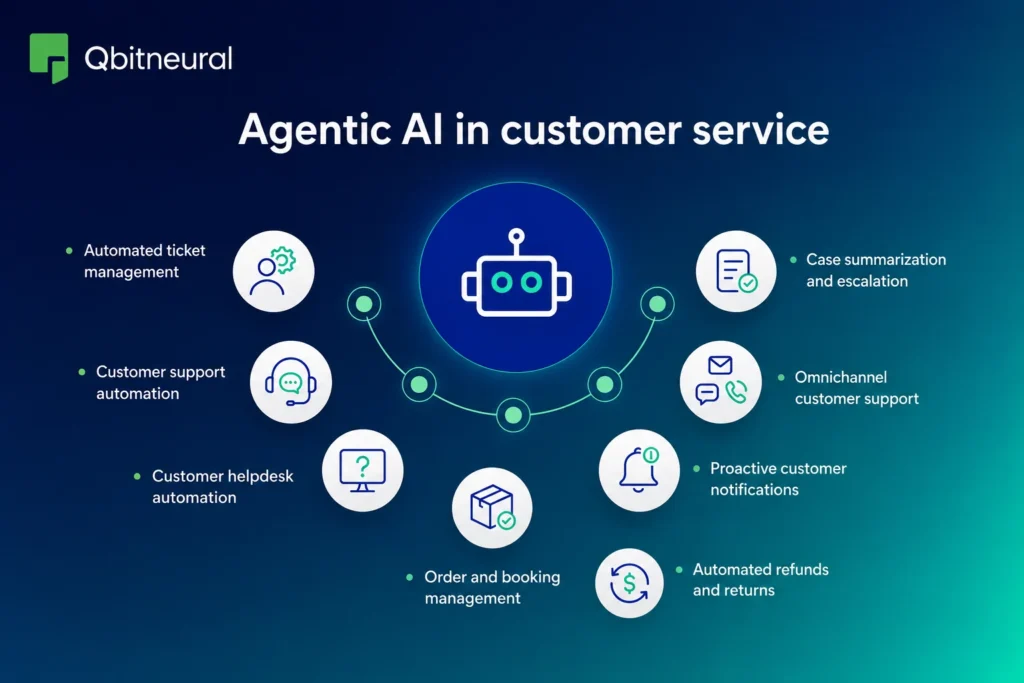
The best use cases of agentic AI in customer service include:
- Automated ticket management: Customer service AI agents classify requests, assess urgency, detect duplicate tickets, assign priorities, and route cases to the appropriate workflow or representative.
- Customer support automation: AI agents independently resolve routine inquiries by searching approved knowledge, reviewing account information, applying company policies, and completing permitted actions. In fact, a report by Gartner states that by 2029, AI will resolve 80% of common customer service issues with zero human help.
- Customer helpdesk automation: AI customer service agents guide users through account access, product setup, subscription questions, troubleshooting, and other common support issues.
- Order and booking management: Customer service AI agents can check order status, update delivery details, modify reservations, cancel eligible services, and communicate changes to customers.
- Automated refunds and returns: An agent reviews purchase history, return windows, warranty conditions, and refund thresholds before approving a bound refund, return, or replacement.
- Proactive customer notifications: AI agents monitor orders, appointments, outages, and delivery events and notify customers of delays or required actions before a ticket is submitted.
- Omnichannel customer support: Agents maintain context across email, chat, messaging, web, and voice channels so customers do not need to repeat information.
- Case summarization and escalation: When human judgment is needed, the customer service AI agents summarize the issue, the supporting data, the policies reviewed, and the actions already attempted.
Real-world agentic AI case study. OpenTable reported that Agentforce autonomously resolved 70% of diner and restaurant inquiries. During tax week, 1-800Accountant reported a 90% case-deflection rate, showing how AI customer service agents can absorb seasonal demand while humans handle complex cases.
Agentic AI use cases in sales
Agentic AI in sales helps organizations maintain momentum across lengthy and data-intensive buying journeys. It ensures that relevant information is collected, decisions are recorded, and appropriate next steps occur without relying on representatives to coordinate every administrative action manually.
Sales agents are best deployed within clearly defined commercial boundaries. Pricing exceptions, contractual commitments, negotiations, and relationship-sensitive decisions should remain under human control, while the AI agent supports speed, consistency, and CRM discipline throughout the sales process.
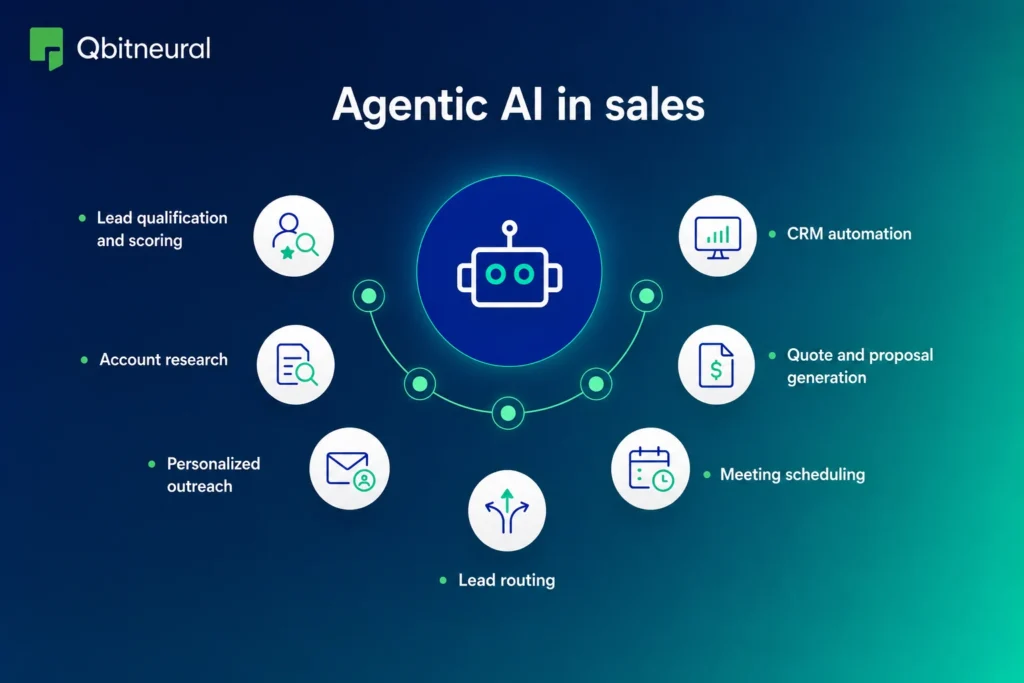
Agentic AI use cases in sales include:
- Lead qualification and scoring: AI agents evaluate company size, industry, intent, territory, engagement, and fit before assigning a lead score.
- Account research: Sales AI agents gather relevant company news, business priorities, existing relationships, and likely pain points from approved sources.
- Personalized outreach: Agents prepare account-specific emails, call briefs, and follow-up messages using approved messaging and customer proof points.
- Lead routing: Sales AI agents assign opportunities to the correct representative based on territory, product line, account ownership, and qualification rules.
- Meeting scheduling: Agents coordinate calendars, propose suitable times, send invitations, and prepare representatives with relevant account context.
- Quote and proposal generation: Sales agents retrieve product configurations, pricing rules, and approved terms to prepare quotes or commercial proposals.
- CRM automation: Agents log calls, update opportunity stages, add notes, create follow-up tasks, and identify incomplete records.
Agentic AI example in practice. CentralSquare is using Agentforce to autonomously answer inquiries, qualify and triage leads, and schedule follow-ups. At T-Mobile, an AI-driven agent embedded in the PromoGenius app helps retail representatives find technical information. The app reached 83,000 unique users and roughly 500,000 launches per month.
Agentic AI in marketing
Agentic AI in marketing introduces a closed feedback loop between customer insight, campaign execution, and performance measurement. Marketing AI agents can monitor changing results, use approved data to assess what is happening, and recommend the next action aligned with a defined campaign objective.
Successful AI agents in marketing depend on reliable customer data and explicit governance. Every AI marketing agent should operate within documented rules for brand voice, privacy, audience eligibility, budget limits, and publishing authority so that faster execution does not create compliance or reputational risk.
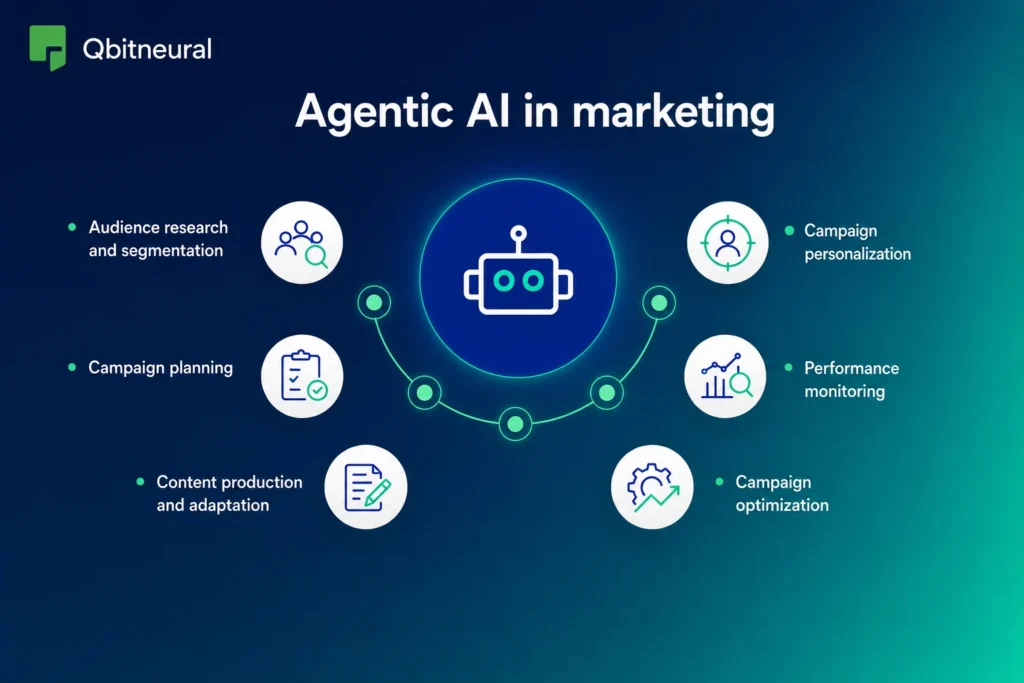
Use cases of AI agents in marketing include:
- Audience research and segmentation: AI agents analyze CRM, behavioral, and market data to identify relevant customer segments.
- Campaign planning: AI marketing agents develop campaign briefs, channel recommendations, messaging priorities, and audience strategies.
- Content production and adaptation: Agents create approved content variants for different audiences, channels, formats, and stages of the customer journey.
- Campaign personalization: AI agents tailor messages, offers, recommendations, and journeys based on customer context and behavior.
- Performance monitoring: Agents track reach, engagement, conversions, costs, and anomalies across connected marketing platforms.
- Campaign optimization: Marketing AI agents recommend or apply bounded changes to audiences, bids, budgets, creative, and timing.
Real-world agentic AI case study. Incrementa uses Gemini Enterprise to automate client reporting and data analysis, helping the marketing company scale personalized service and increase campaign reach by 40%.
Agentic AI use cases in retail and E-commerce
Agentic AI in retail is changing how customers and digital systems interact with product catalogs. As conversational interfaces and autonomous shopping tools drive discovery, retailers must ensure pricing, availability, attributes, delivery, and return policies are accurate and machine-readable.
AI agents in retail and ecommerce can minimize purchase friction, but trust remains essential. Merchants must implement clear consent, payment controls, identity verification, transparent recommendations, and spending or suitability safeguards.
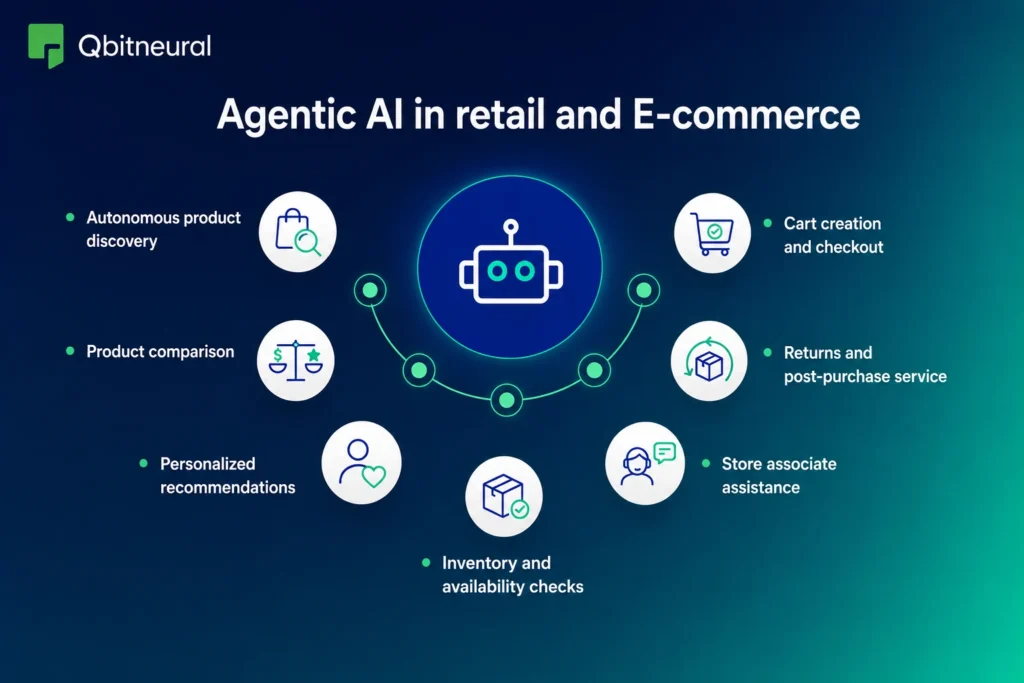
AI agent use cases in retail and ecommerce include:
- Autonomous product discovery: Shopping agents search merchant catalogs based on a customer’s intent, budget, preferences, and constraints.
- Product comparison: Agents compare prices, specifications, ratings, delivery options, warranties, and compatibility requirements.
- Personalized recommendations: Retail AI agents recommend products based on customer context, purchase history, and stated needs.
- Inventory and availability checks: Agents verify real-time stock levels, store availability, delivery dates, and substitution options.
- Cart creation and checkout: Autonomous shopping AI agents assemble carts, apply eligible promotions, and complete authorized transactions.
- Returns and post-purchase service: Agents initiate returns, track refunds, arrange replacements, and provide order updates.
- Store associate assistance: AI agents in ecommerce can help employees answer product, policy, inventory, and technical questions.
Real-world agentic AI examples. Visa agentic commerce can browse, compare, apply preferences, and pay within rules the user sets. Stripe’s Agentic Commerce Suite supports product discovery, checkout, and scoped payment tokens. Google Cloud reports that Mexican retailer Liverpool projected a 10x ROI for its AI shopping assistant.
Agentic AI in finance
Agentic AI in finance is suited to work that is repetitive. Financial processes involve incomplete documentation, policy interpretation, reconciliation across several systems, and exceptions that require evidence before an action proceeds.
Because finance agents may interact with sensitive records and material transactions, autonomy should be introduced gradually. AI agents in finance need scoped access, segregation of duties, approval thresholds, complete audit trails, and clear accountability for any recommendation or action that affects reporting, payments, or regulatory compliance.
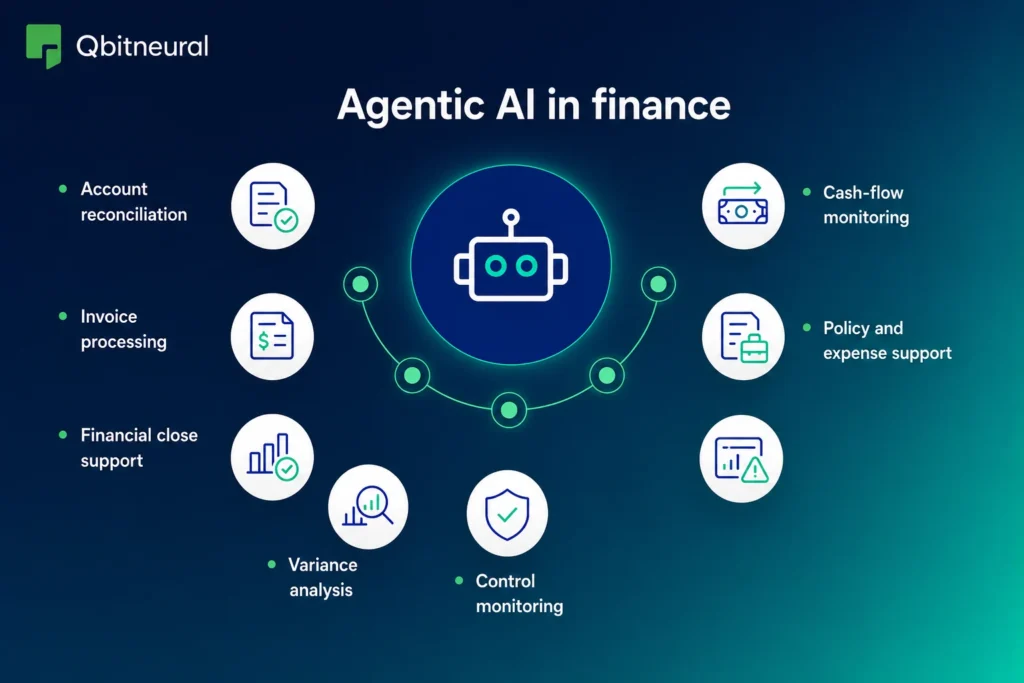
Agentic AI applications in finance include:
- Account reconciliation: Agents compare ledger entries, bank records, invoices, and supporting evidence to identify discrepancies.
- Invoice processing: AI agents extract invoice data, validate suppliers and purchase orders, identify exceptions, and route approvals.
- Financial close support: Agents collect evidence, track incomplete tasks, prepare journal-entry recommendations, and monitor close progress.
- Variance analysis: Finance agents explain differences between actuals, budgets, forecasts, and previous reporting periods.
- Cash-flow monitoring: Agents track balances, receivables, payables, and expected transactions to support cash forecasting.
- Policy and expense support: AI agents answer travel, expense, reimbursement, and accounting-policy questions using approved documents.
- Control monitoring: Agents identify policy breaches, duplicate payments, missing approvals, and unusual financial activity.
Agentic AI example in practice. Finnit reports that its AI automation for corporate finance teams reduces the time spent on accounting procedures by 90%. The Public Service Commission of Canada built a travel-policy agent that reduced travel-mailbox emails by 90%, shortened some complex queries from five days to 10–30 seconds, and reports about CAD 120,000 in annual salary-cost avoidance.
Agentic AI in healthcare
Agentic AI in healthcare can reduce administrative friction that prevents patients and staff from moving efficiently through the healthcare system. The early deployments can focus on access and coordination, where delays, fragmented information, and repetitive communication create high operational costs.
Agentic AI use cases in healthcare include:
- Appointment scheduling: Healthcare AI agents schedule, reschedule, confirm, and cancel appointments based on provider availability.
- Patient access support: Agents answer routine questions about services, locations, preparation requirements, and next steps.
- Eligibility and benefits verification: AI agents in healthcare retrieve permitted insurance information and identify missing eligibility data.
- Referral coordination: AI agents collect referral documents, confirm requirements, route requests, and communicate status.
- Documentation support: Agents prepare summaries, organize forms, and retrieve relevant records for administrative review.
- Follow-up automation: Healthcare AI agents send reminders, collect routine updates, and coordinate next appointments.
- Voice-based patient service: AI voice agents in healthcare handle routine scheduling and administrative calls while escalating sensitive cases.
Agentic AI example in practice. IntentAI uses Google Cloud to power more than 200,000 healthcare appointments annually. Its AI agent handles 77% of customer chats and the company reports a 2x increase in call-center agent productivity.
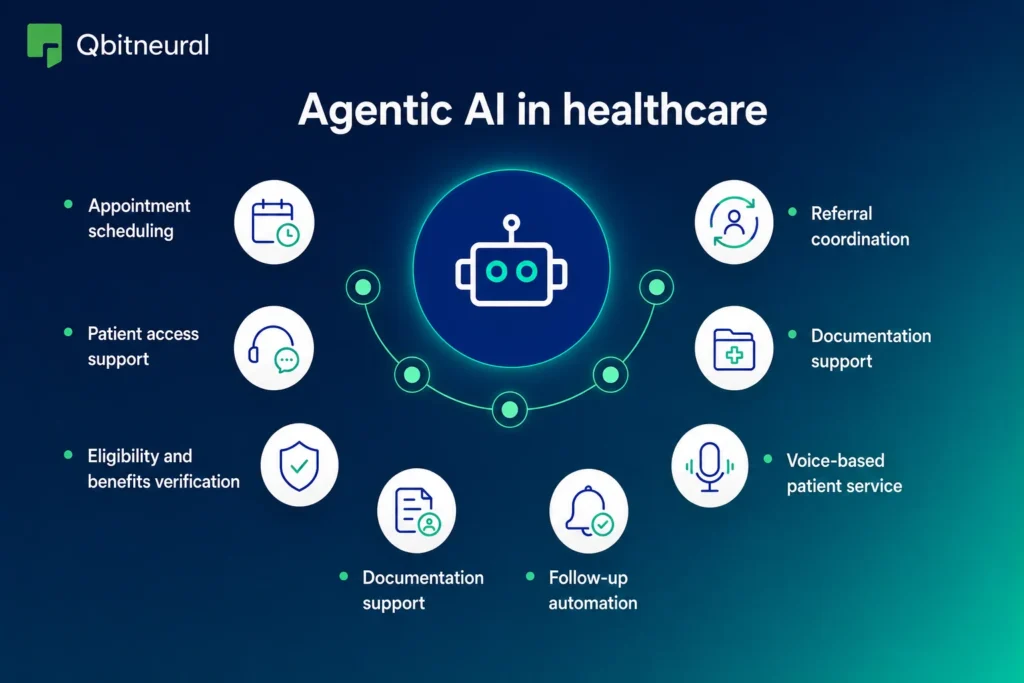
AI agents use cases in insurance
Agentic AI in insurance can help reduce the time between receiving a request and presenting a complete, reviewable recommendation to an authorized employee. But AI agents in insurance must remain explainable and auditable because their outputs may affect coverage, pricing, claims, or customer rights.
Agentic AI applications in insurance include:
- Claims intake automation: Agents collect first-notice-of-loss information, documents, images, and incident details.
- Claims document validation: AI agents identify missing evidence, compare information, and request additional documentation.
- Policy servicing: Agents answer coverage questions, update permitted information, and route policy changes.
- Underwriting research: Insurance agents retrieve risk data, summarize evidence, and support initial risk assessment.
- Quote preparation: AI agents collect required information and prepare recommendations for complex or specialist risks.
- Fraud investigation support: AI agents for insurance analyze claims, identity, transaction, and behavioral signals for suspicious patterns.
- Advisor assistance: Insurance AI agents retrieve product, policy, and customer information for brokers and service representatives.
Real-world agentic AI case study. SIGNAL IDUNA’s Co SI knowledge solution made searches 30% faster for less-experienced health-insurance service agents and reduced inquiries requiring further escalation from 27% to 3%.
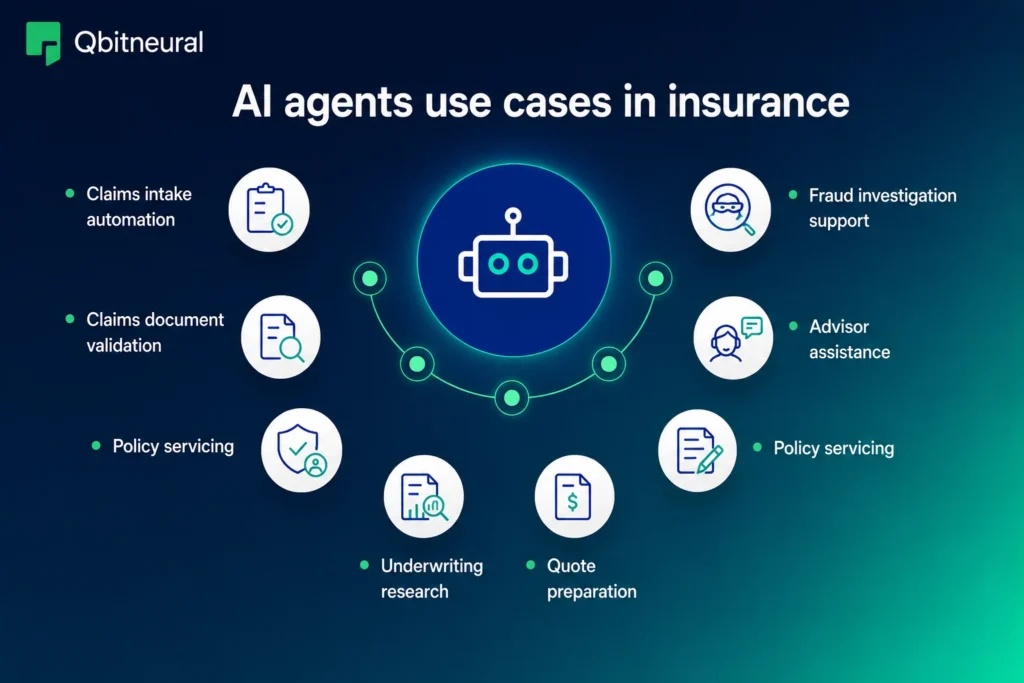
Agentic AI applications in document processing
Agentic AI applications in document processing address a limitation of conventional extraction tools: obtaining information from a file does not complete the business process that the document initiated. An agentic system can retain context as a document moves through validation, enrichment, review, and approval stages.
The most reliable implementations use confidence thresholds and evidence traceability. Low-confidence information, conflicting clauses, missing evidence, and material exceptions should trigger additional verification or human review before the workflow continues.
AI agents use cases for document processing include:
- Document classification: Agents identify contracts, invoices, claims, forms, policies, and other document types.
- Data extraction: AI agents convert unstructured document content into validated structured fields.
- Document comparison: Agents compare versions, clauses, terms, values, and supporting evidence.
- Contract review: Document agents identify missing clauses, obligations, dates, risks, and approval requirements.
- Evidence validation: Agents check whether signatures, attachments, certificates, and required fields are present.
- External system verification: AI agents query CRM, ERP, policy, legal, or supplier systems to validate extracted data.
Real-world agentic AI case study. Unifi implemented a multi-stage AI contract management solution using Microsoft Copilot Studio and Power Platform to automate the processing of complex legal agreements. The solution reduced contract review from days to minutes, enabled accurate natural-language search across contracts up to 200 pages long, and eliminated the need for legal software costing 30 times more, allowing legal teams to spend significantly more time on strategic work instead of manual document review.
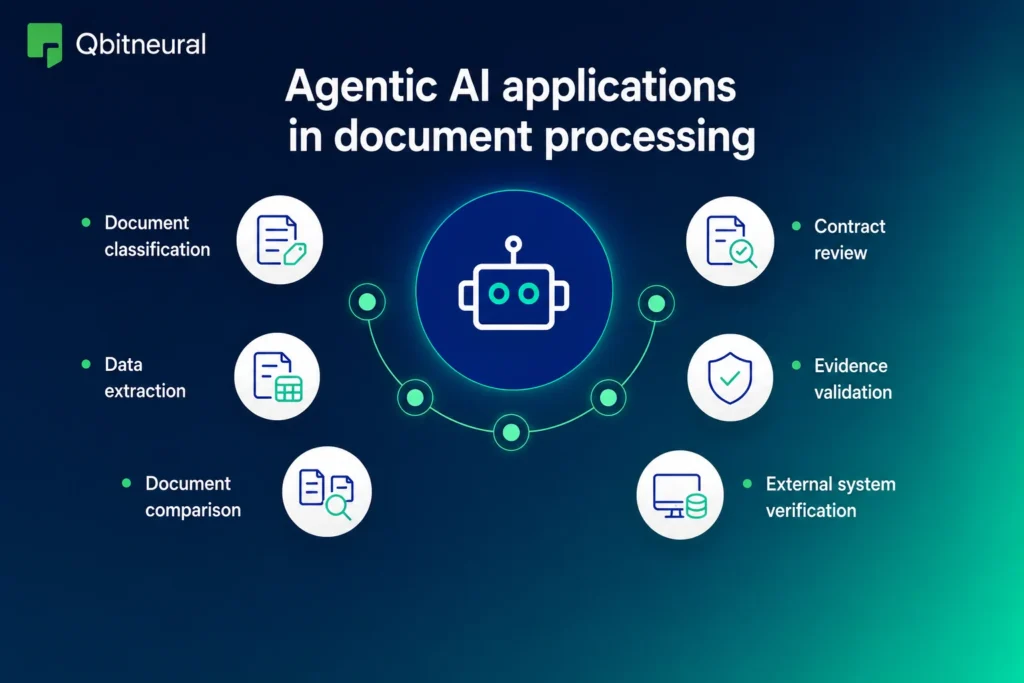
Agentic AI in HR (human resources)
Agentic AI in HR can improve the employee experience by making approved information and routine services easier to access. Its value is greatest when employees currently depend on fragmented portals, policy documents, email inboxes, and manual follow-ups to complete straightforward administrative processes.
Agentic AI use cases in HR include:
- Employee policy support: Agents answer questions about leave, benefits, travel, attendance, and workplace policies.
- Leave and payroll assistance: HR agents process permitted leave requests and answer routine payroll questions.
- Onboarding automation: Agents coordinate documents, system access, training, introductions, and task reminders.
- Employee record updates: AI agents update approved profile, contact, benefits, or administrative information.
- Learning recommendations: Agents identify approved courses and development resources based on role and needs.
- Task and document tracking: HR agents monitor missing forms, acknowledgments, training, and onboarding activities.
- Sensitive-case escalation: Agents recognize high-risk employee concerns and route them to qualified HR staff.
Real-world agentic AI case study. LC Waikiki integrated SAP Joule agents into HR workflows and reports up to a 60% increase in HR self-service execution speed. The agent supports tasks such as leave requests and payroll questions through natural-language interactions in Microsoft Teams.
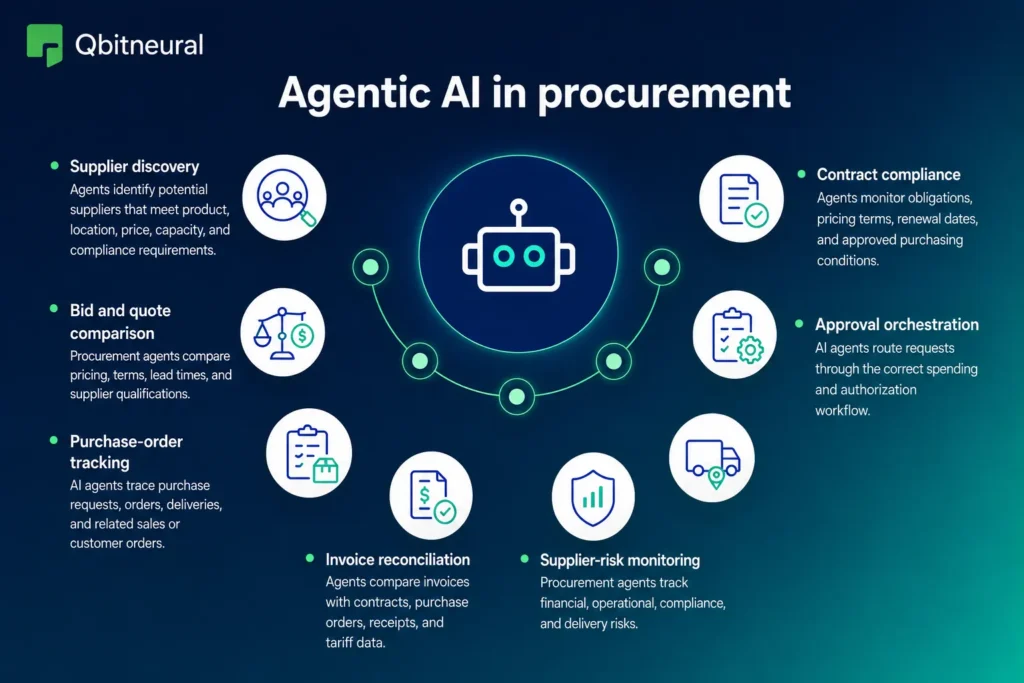
Agentic AI use cases in procurement
Agentic AI in procurement improves coordination across fragmented sourcing, supplier, contract, ERP, compliance, and logistics information. It is useful when procurement teams spend substantial time gathering evidence and tracking dependencies before a purchasing decision can move forward.
AI agents in procurement should not bypass established financial controls. Effective implementations preserve approved supplier lists, spending limits, competitive-bidding requirements, and segregation of duties. They also enforce final authorization rules while enabling the agent to accelerate research, preparation, and workflow coordination.
AI agent use cases in procurement include:
- Supplier discovery: Agents identify potential suppliers that meet product, location, price, capacity, and compliance requirements.
- Bid and quote comparison: Procurement agents compare pricing, terms, lead times, and supplier qualifications.
- Purchase-order tracking: AI agents trace purchase requests, orders, deliveries, and related sales or customer orders.
- Invoice reconciliation: Agents compare invoices with contracts, purchase orders, receipts, and tariff data.
- Supplier-risk monitoring: Procurement agents track financial, operational, compliance, and delivery risks.
- Contract compliance: Agents monitor obligations, pricing terms, renewal dates, and approved purchasing conditions.
- Approval orchestration: AI agents route requests through the correct spending and authorization workflow.
Agentic AI in IT
Agentic AI in IT operations is valuable because technology incidents rarely remain inside one application. Diagnosing and resolving an issue may require information from observability platforms, service-management records, identity tools, cloud infrastructure, endpoints, deployment history, and internal knowledge.
Agentic AI in IT should be introduced according to the potential impact of each action. Read-only investigation and low-risk service fulfillment can support greater autonomy, while privileged access changes, production modifications, data deletion, and irreversible remediation should require explicit approval and reliable rollback procedures.
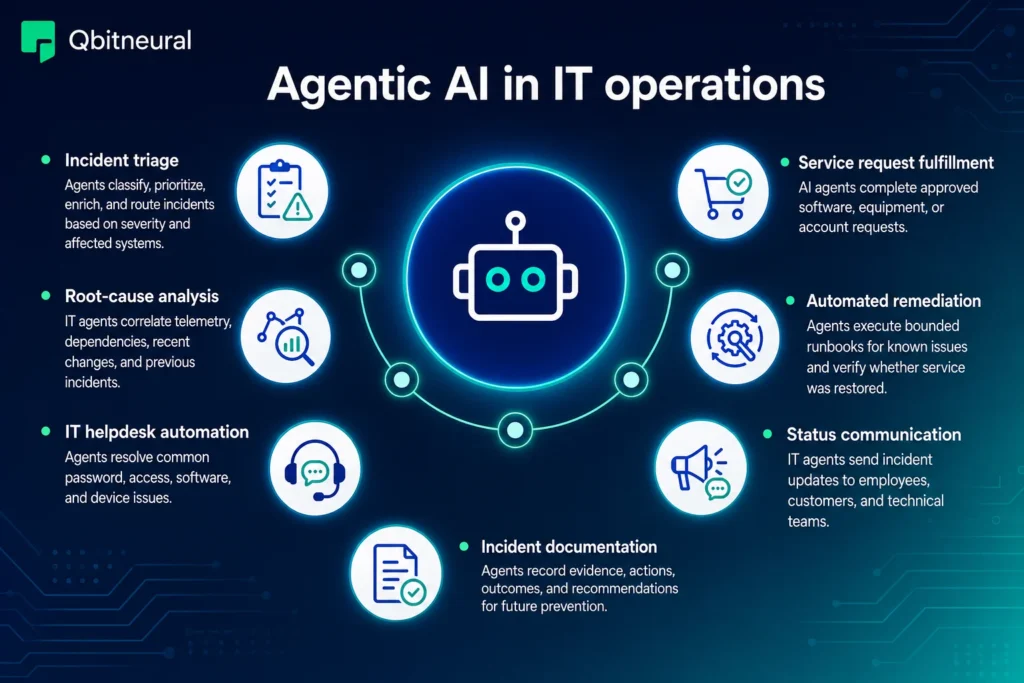
Agentic AI use cases in IT operations include:
- Incident triage: Agents classify, prioritize, enrich, and route incidents based on severity and affected systems.
- Root-cause analysis: IT agents correlate telemetry, dependencies, recent changes, and previous incidents.
- IT helpdesk automation: Agents resolve common password, access, software, and device issues.
- Service request fulfillment: AI agents complete approved software, equipment, or account requests.
- Automated remediation: Agents execute bounded runbooks for known issues and verify whether service was restored.
- Status communication: IT agents send incident updates to employees, customers, and technical teams.
- Incident documentation: Agents record evidence, actions, outcomes, and recommendations for future prevention.
Real-world agentic AI examples: mobilezone built customer and IT agents with Copilot Studio; Microsoft reports the deployment handles more than 1,600 chats per month and cut IT resolution time by 50%. ServiceNow’s own AI-enabled self-service program reports that 89% of customer self-service requests are supported by AI while maintaining 9.0 CSAT, and that its 2025 efforts saved employees more than 2.3 million hours.
Agentic AI in cybersecurity
Agentic AI in cybersecurity addresses a persistent imbalance between the volume of security signals and the number of analysts available to investigate them. It helps security teams reach defensible conclusions faster without forcing analysts to manually reconstruct the same evidence across tools and investigation steps by maintaining context.
AI agents in cybersecurity require stricter controls than many lower-risk enterprise agents because a mistaken response can interrupt legitimate operations or expose sensitive systems. Agentic AI in cybersecurity fraud detection and threat response should therefore use least-privilege permissions, evidence-backed recommendations, approval gates, comprehensive logging, and tested rollback mechanisms.
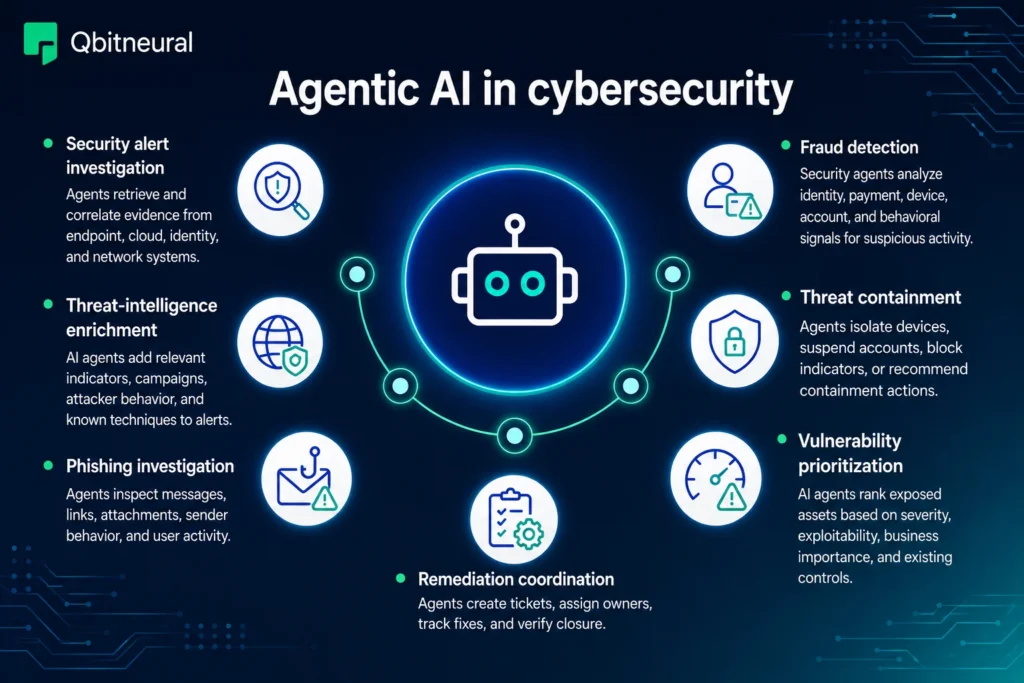
Agentic AI applications in cybersecurity include:
- Security alert investigation: Agents retrieve and correlate evidence from endpoint, cloud, identity, and network systems.
- Threat-intelligence enrichment: AI agents add relevant indicators, campaigns, attacker behavior, and known techniques to alerts.
- Phishing investigation: Agents inspect messages, links, attachments, sender behavior, and user activity.
- Fraud detection: Security agents analyze identity, payment, device, account, and behavioral signals for suspicious activity.
- Threat containment: Agents isolate devices, suspend accounts, block indicators, or recommend containment actions.
- Vulnerability prioritization: AI agents rank exposed assets based on severity, exploitability, business importance, and existing controls.
- Remediation coordination: Agents create tickets, assign owners, track fixes, and verify closure.
Real-world agentic AI case study: St. Luke’s University Health Network implemented Microsoft Security Copilot agents to automate security-alert triage. Its Security Alert Triage Agent autonomously investigates and closes thousands of false-positive alerts, saving the security team nearly 200 hours per month. St. Luke’s also reported that work that previously required hours of reviewing alerts across multiple portals can now be completed in minutes, allowing analysts to focus on genuine threats and higher-value security investigations.
Agentic AI use cases in software development
Agentic AI in software development shifts AI’s role from an on-demand coding assistant to a system capable of taking responsibility for a bounded engineering task. Software agents can maintain task context, inspect tool outputs, and continue working until they reach a defined completion condition or require human input.
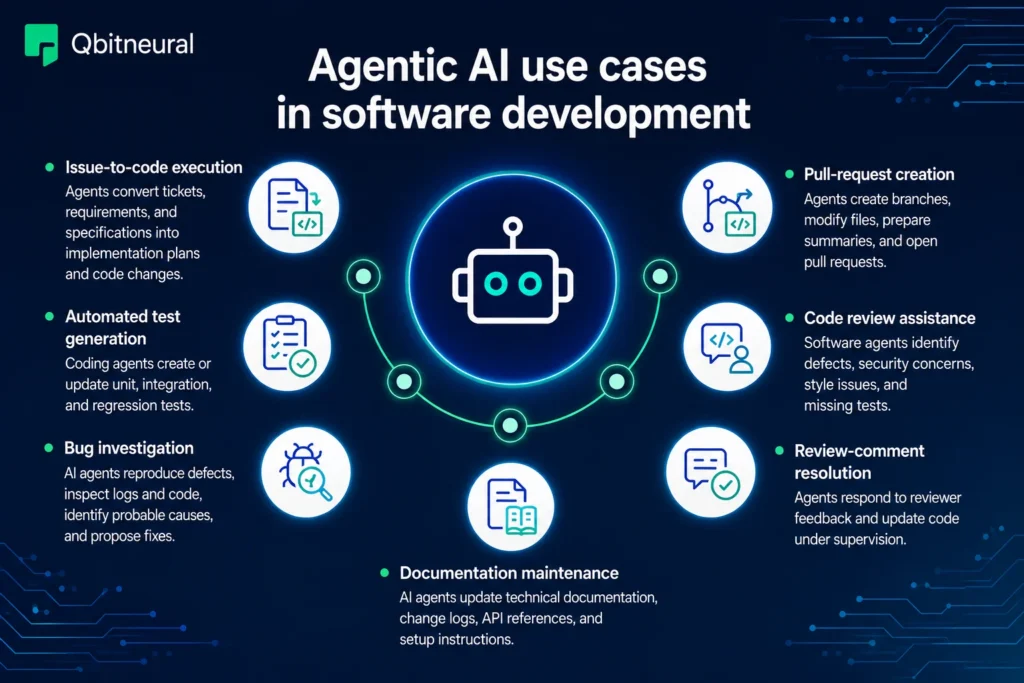
AI agent use cases in software development include:
- Issue-to-code execution: Agents convert tickets, requirements, and specifications into implementation plans and code changes.
- Automated test generation: Coding agents create or update unit, integration, and regression tests.
- Bug investigation: AI agents reproduce defects, inspect logs and code, identify probable causes, and propose fixes.
- Pull-request creation: Agents create branches, modify files, prepare summaries, and open pull requests.
- Code review assistance: Software agents identify defects, security concerns, style issues, and missing tests.
- Review-comment resolution: Agents respond to reviewer feedback and update code under supervision.
- Documentation maintenance: AI agents update technical documentation, change logs, API references, and setup instructions.
Real-world agentic AI case study. GitHub reports that adding cross-agent memory increased its coding-agent pull-request merge rate from 83% to 90%. General Motors says Copilot Coding Agent helps developers avoid repetitive work, while Copilot Code Review handles pull-request reviews and summaries so teams can focus on complex tasks.
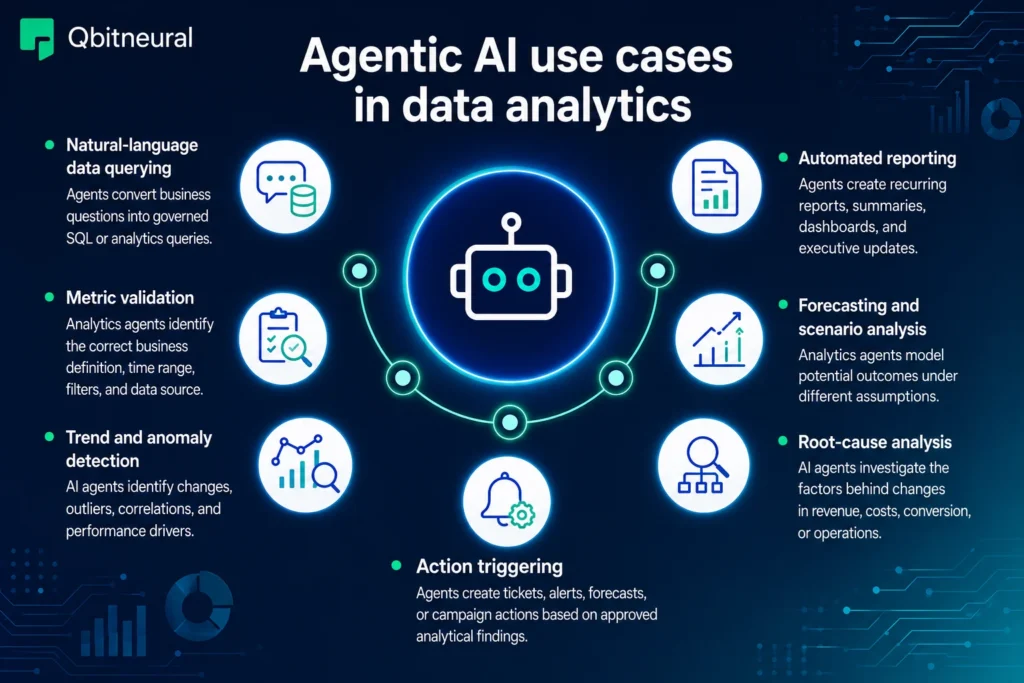
Agentic AI use cases in data analytics
Agentic AI in data analytics brings asking a business question and acting on the resulting insight close. Traditional analytics tools require users to locate the correct dashboard, understand data structures, select appropriate filters, and manually coordinate whatever action follows the analysis.
AI agents in data analytics can simplify this process, but they depend on trusted semantic definitions, governed datasets, and transparent lineage. Without those foundations, an agent can produce a persuasive explanation based on the wrong metric, incomplete data, or an unauthorized source, making validation as important as speed.
Agentic AI use cases in data analytics include:
- Natural-language data querying: Agents convert business questions into governed SQL or analytics queries.
- Metric validation: Analytics agents identify the correct business definition, time range, filters, and data source.
- Trend and anomaly detection: AI agents identify changes, outliers, correlations, and performance drivers.
- Automated reporting: Agents create recurring reports, summaries, dashboards, and executive updates.
- Forecasting and scenario analysis: Analytics agents model potential outcomes under different assumptions.
- Root-cause analysis: AI agents investigate the factors behind changes in revenue, costs, conversion, or operations.
- Action triggering: Agents create tickets, alerts, forecasts, or campaign actions based on approved analytical findings.
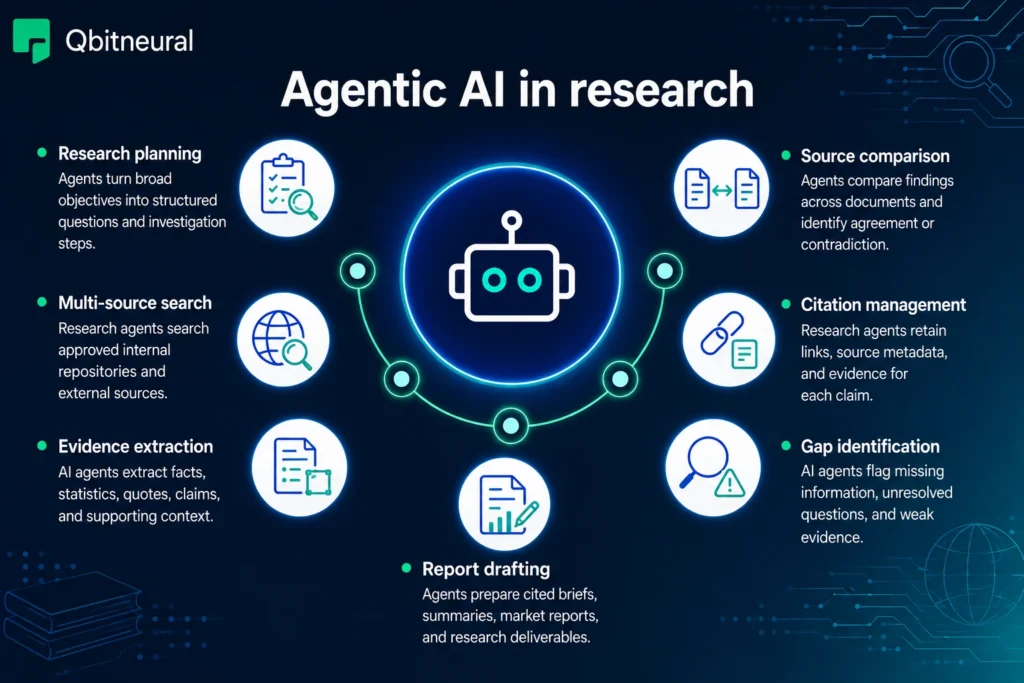
Agentic AI in research
Agentic AI in research is valuable when an investigation requires repeated searching, evidence comparison, source tracking, and refinement. Research agents can maintain a structured plan across a long task, investigate several sub-questions, and preserve the relationship between claims and supporting sources.
Agentic AI applications in research include:
- Research planning: Agents turn broad objectives into structured questions and investigation steps.
- Multi-source search: Research agents search approved internal repositories and external sources.
- Evidence extraction: AI agents extract facts, statistics, quotes, claims, and supporting context.
- Source comparison: Agents compare findings across documents and identify agreement or contradiction.
- Citation management: Research agents retain links, source metadata, and evidence for each claim.
- Gap identification: AI agents flag missing information, unresolved questions, and weak evidence.
- Report drafting: Agents prepare cited briefs, summaries, market reports, and research deliverables.
AI agents in supply chain
Agentic AI in supply chain management helps organizations respond to conditions that change faster, like demand shifts, supplier delays, inventory shortages, transportation disruptions, and capacity constraints.
AI agents in supply chain management can preserve context across these dependencies and compare possible responses before recommending an action. However, they should respect procurement policies, service commitments, safety-stock rules, production constraints, and human approval requirements for material operational changes.
AI agent use cases in supply chain management include:
- Demand sensing: Agents monitor sales, market, operational, and external signals to update forecasts.
- Inventory optimization: Supply-chain agents recommend replenishment, reallocation, or safety-stock changes.
- Supplier discovery: AI agents identify alternative suppliers based on cost, capacity, location, and risk.
- Production planning: Agents compare demand, capacity, materials, labor, and equipment constraints.
- Shipment tracking: AI agents monitor logistics events and predict delays or missed delivery commitments.
- Disruption management: Agents evaluate alternative suppliers, routes, schedules, and inventory sources.
- Exception coordination: Supply-chain agents route recommendations and approvals across procurement, logistics, and operations.
Real-world agentic AI examples. Moglix used generative AI to discover maintenance, repair, and operations suppliers and reported a 4x improvement in sourcing team efficiency. Recurso Confiable reports tracking 7x more shipments, processing 3 million+ shipments per year, and providing updates in under 2 seconds.
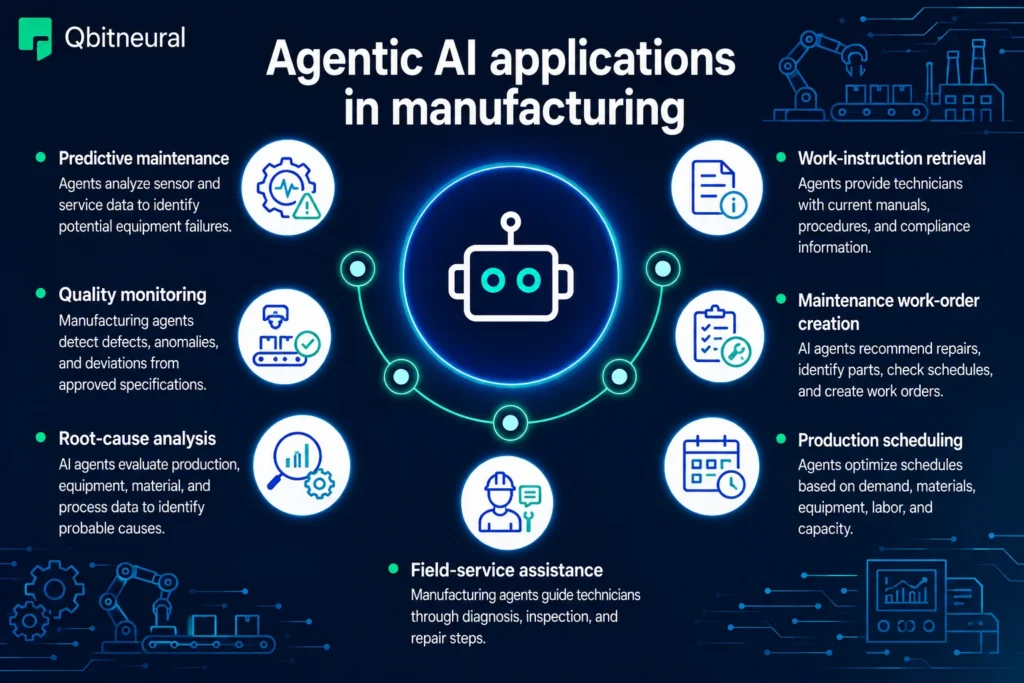
Agentic AI applications in manufacturing
Agentic AI in manufacturing brings value to decisions that depend on a combination of operational data, technical knowledge, and real-time conditions. Its use cases should begin with decision support and bounded workflow coordination before expanding toward autonomous actions that could affect equipment, production output, regulatory compliance, or worker safety.
Agentic AI use cases in manufacturing include:
- Predictive maintenance: Agents analyze sensor and service data to identify potential equipment failures.
- Quality monitoring: Manufacturing agents detect defects, anomalies, and deviations from approved specifications.
- Root-cause analysis: AI agents evaluate production, equipment, material, and process data to identify probable causes.
- Work-instruction retrieval: Agents provide technicians with current manuals, procedures, and compliance information.
- Maintenance work-order creation: AI agents recommend repairs, identify parts, check schedules, and create work orders.
- Production scheduling: Agents optimize schedules based on demand, materials, equipment, labor, and capacity.
- Field-service assistance: Manufacturing agents guide technicians through diagnosis, inspection, and repair steps.
Real-world agentic AI case study. Enpal automated parts of its solar-panel sales and quoting process, reducing quote generation time by 87.5%, from 120 minutes to 15 minutes.
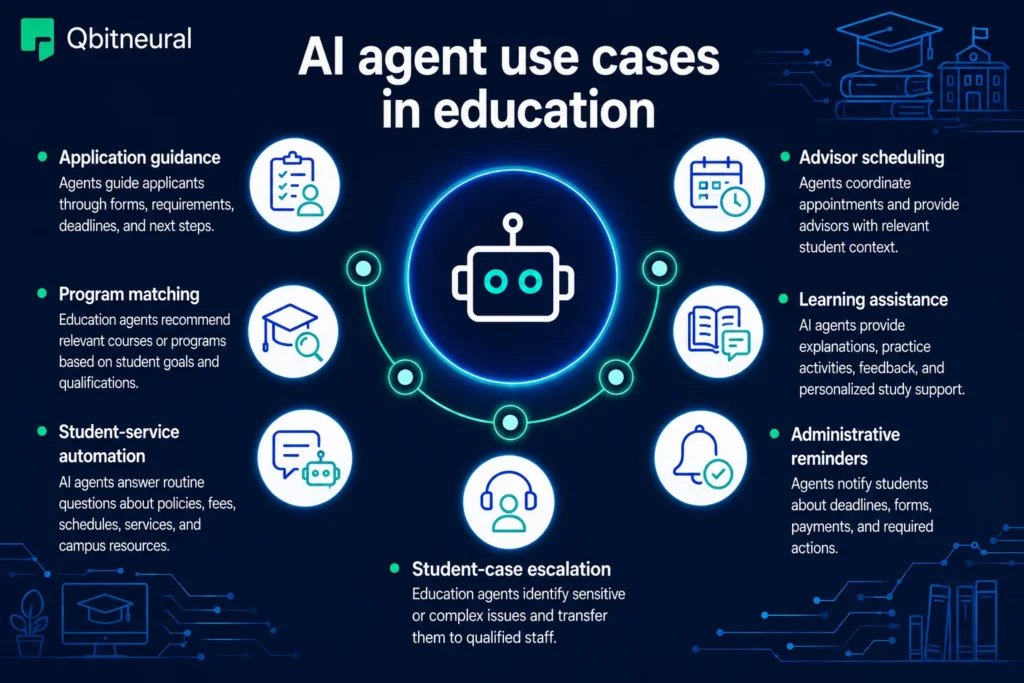
AI agents use cases in education
Agentic AI in education can make student services and learning resources more accessible by providing context-aware support outside normal office hours. It is particularly relevant when students must navigate fragmented information across learning platforms, admissions systems, policy documents, schedules, and administrative portals.
Agentic AI applications in education include:
- Application guidance: Agents guide applicants through forms, requirements, deadlines, and next steps.
- Program matching: Education agents recommend relevant courses or programs based on student goals and qualifications.
- Student-service automation: AI agents answer routine questions about policies, fees, schedules, services, and campus resources.
- Advisor scheduling: Agents coordinate appointments and provide advisors with relevant student context.
- Learning assistance: AI agents provide explanations, practice activities, feedback, and personalized study support.
- Administrative reminders: Agents notify students about deadlines, forms, payments, and required actions.
- Student-case escalation: Education agents identify sensitive or complex issues and transfer them to qualified staff.
Real-world Agentic AI examples. Una, an Agentforce-powered agent that guides students through the application process and matches them with programs. Wiley, which serves learners and educators, reported more than a 40% increase in case resolution with Agentforce compared with its previous chatbot during peak inquiry periods.
Emerging Use Case: Agentic Commerce and Autonomous Shopping Agents
Agentic commerce applies agentic AI to the full shopping journey, enabling autonomous shopping AI agents to interpret a buyer’s intent, browse merchant catalogs, compare prices and product specifications, check real-time availability, apply preferences or spending limits, and initiate a purchase with the user’s permission.
These AI agents can also coordinate multiple steps across search, merchant, payment, delivery, and post-purchase systems, turning a request such as “find the best laptop under $1,500 and deliver it by Friday” into an executable workflow. Google introduced the Universal Commerce Protocol for agent-led shopping, while OpenAI’s Agentic Commerce Protocol supports structured product discovery and increasingly connected shopping experiences in ChatGPT.
How do you identify the right AI agent use cases for your team?
The right use case is the workflow where autonomy creates measurable value without introducing unmanageable risk. Here is a seven-question screening checklist that helps identify the right AI agent use cases.
- Is the workflow multi-step, variable, and repetitive enough that fixed automation alone struggles?
- Does it require information or actions across multiple tools, teams, or data sources?
- Is the business outcome measurable, for example, time saved, cases resolved, revenue recovered, defects prevented, or cycle time reduced?
- Can the agent operate inside a bounded scope with specific tools, spending limits, data access, and completion criteria?
- Are most mistakes reversible, detectable, or safe to route to human review?
- Do you have reliable source data, a process owner, and examples of both successful and failed cases?
- Can the organization monitor actions, investigate errors, and continuously improve prompts, tools, policies, and evaluations?
How to build an AI agent for enterprise use cases?
Building an enterprise agent is a product, process, data, security, and change-management effort. Guidance for building AI agents for enterprise from NIST and Google emphasizes identity, scoped access, governance, observability, and iterative architectural choices for agents that can act on real systems.
- Define the outcome and success metric. Write the job in operational terms: “resolve eligible password-reset requests” is better than “help with IT.” Capture the baseline, target, quality threshold, and owner.
- Map the workflow and exceptions. Document current steps, data sources, handoffs, policy decisions, frequent failure modes, and where human judgment is legally or operationally required.
- Choose the autonomy level. Start with recommendation-only or action-with-approval. Expand to autonomous action only for bounded, reversible tasks after evidence shows the agent is reliable.
- Select the architecture. Use a single AI agent architecture for a narrow workflow. Introduce specialized or multi-agent orchestration only when roles, context boundaries, or tools are genuinely different; extra agents add coordination and testing complexity.
- Ground the agent in trusted data. Connect approved knowledge, records, and semantic definitions. Define freshness, access rules, citation expectations, and what the agent should do when sources disagree.
- Give tools scoped permissions. Create a distinct agent identity where possible. Use least privilege, short-lived credentials, transaction limits, allowlists, environment separation, and deterministic checks around sensitive writes.
- Add guardrails and escalation. Specify forbidden actions, approval thresholds, confidence and risk rules, privacy controls, safe completion behavior, and a human handoff that includes full context.
- Evaluate real tasks and adversarial cases. Test normal, edge, and failure scenarios: prompt injection, misleading documents, tool errors, duplicate actions, stale data, privilege escalation, memory poisoning, and unsafe instructions.
- Pilot, observe, and expand gradually. Instrument every step. Review task success, business value, user feedback, cost, latency, tool failures, and security events. Increase scope only when the evidence supports it.
Conclusion
The most valuable agentic AI use cases are high-frequency workflows where an AI agent can coordinate context and tools, complete several steps, and produce a measurable outcome with appropriate human control. Begin with one workflow, one owner, one baseline, and one clear boundary of autonomy. Prove task success and economic value, then expand the agent’s tools, scope, or collaboration with other agents.
Frequently asked questions
What is agentic AI?
Agentic AI is AI that can work toward a goal, choose steps, use approved tools, check results, and adapt without a person prompting every action. People still define the objective, permissions, policies, and situations that require approval.
What are agentic AI use cases?
Agentic AI use cases are repeatable workflows where an AI agent can coordinate information and actions across several steps. Strong examples include resolving a support case, qualifying a lead, reconciling an invoice, investigating a security alert, updating a software pull request, or assembling a shopping cart under a buyer’s rules.
What are examples of agentic AI in real life?
Real examples include OpenTable resolving customer inquiries autonomously, LC Waikiki using agents for procurement and HR self-service, GitHub’s coding agent completing software tasks, finance agents reconciling transactions, security agents investigating alerts, and shopping agents comparing products and completing authorized purchases.
How is agentic AI different from generative AI or traditional automation?
Generative AI mainly creates content or answers a prompt. Traditional automation follows fixed rules. Agentic AI can combine generated reasoning with tools, memory, decision policies, and feedback so it can choose and execute the next step instead of waiting for a new prompt.
How is agentic AI different from a chatbot?
A basic chatbot answers messages. An agent can maintain task state, plan a sequence, use tools such as CRM or ERP APIs, perform actions, verify outcomes, and escalate. Some chat interfaces are front ends for agents, so the difference is capability rather than appearance.
What is agentic AI in marketing?
Agentic AI in marketing coordinates research, audience analysis, brief creation, content workflows, campaign monitoring, reporting, and optimization. A marketing agent can use CRM and analytics data, trigger approved actions, and learn from campaign outcomes rather than only generate copy.
How do I know if my team is ready for agentic AI?
Your team is ready for a pilot when it has a high-volume multi-step workflow, reliable data, safe tool access, a measurable baseline, an accountable owner, representative test cases, and a human escalation path. If the task is irreversible, poorly documented, or impossible to monitor, start with decision support or simpler automation.
Is agentic AI safe for enterprise use?
Agentic AI can be used safely when autonomy is bounded and controls are designed into the system. Enterprises should use agent identities, least-privilege permissions, approval thresholds, trusted data, continuous evaluations, action logs, monitoring, incident response, and protections against prompt injection, tool misuse, identity abuse, and memory poisoning.
How does agentic AI work in practice?
The agent receives a goal or trigger, gathers context, plans tasks, uses approved tools, checks what happened, and either completes, retries, re-plans, or escalates. The workflow repeats until the completion criteria are met or a policy requires human review.
What industries benefit most from agentic AI?
The clearest production value is appearing in customer service, sales, marketing, finance, IT operations, cybersecurity, software development, procurement, supply chains, and document-heavy work. Healthcare, insurance, education, and autonomous shopping are also advancing, but high-impact decisions usually need tighter human review and stronger controls.
What’s the fastest way to identify a good agentic AI use case for my team?
Start with a high-volume, multi-step workflow that crosses systems, has a measurable outcome, and can tolerate bounded automation. Favor reversible actions, reliable data, clear ownership, and an obvious escalation path; avoid beginning with irreversible decisions or unrestricted access to sensitive systems.